Safe Water, Responsible Use and Reuse of Every Drop
EXPLORE SDG 6
Water at SRM University-AP
SDG 5 calls for an end to discrimination and violence against women and girls, recognition of unpaid care work, full participation of women in leadership, and equal access to resources and opportunity. At SRM University-AP the goal is pursued through the people who make up the community, the facilities that help them study and work, and the programmes that build awareness and confidence.
SRM University-AP treats water as one connected system: it measures every kilolitre it takes in, serves free purified drinking water, saves water through efficient fixtures and planting, treats its own sewage and reuses the treated water. In 2025 the campus used 431,579 kilolitres (KL) of water and reused 143,535 KL of treated wastewater, about a third of what it consumed.
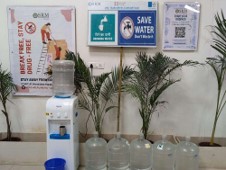
Image 1: Free drinking water point with “Save Water” signage
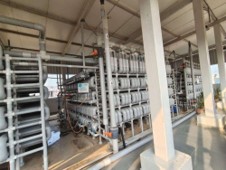
Image 2: Bio pipe sewage treatment plant, where used water is treated for reuse
DRINKING WATER
Provision of Safe and Clean Drinking Water
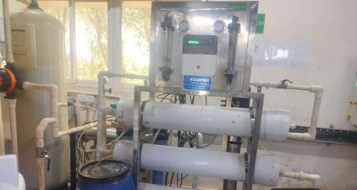
Free, purified drinking water is available to every student, staff member and visitor at 190 dispenser points across hostels, academic blocks and common areas. Water is purified by multi-stage reverse osmosis with UV and chlorine dosing, stored in stainless steel tanks and audited daily.
Image 3: RO plant that supplies the campus drinking water
WATER TESTING
Water Testing
Treated water is sampled daily at the softener outlet and sent every month to NABL-certified laboratories. Independent laboratory reports for treated sewage water test suspended solids, oxygen demand, nitrogen, oil and grease and coliform bacteria, and are available as supporting documents.
FRAMEWORK
Framework and Guidelines
Water use is governed by two approved university policies, the Policy on Water Reuse, Conservation and Sustainable Water Management (effective 10 June 2024) and the Water Pollution Prevention Policy (effective 5 May 2024), supported by written procedures for chemical storage and spill response.
TREATMENT
In House Waste Water Treatment
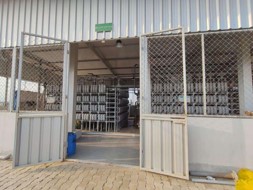
Four sewage treatment plants, two conventional and two chemical-free Bio pipe plants, treat the campus sewage. The treated water goes to toilet flushing, cooling and gardening, and seven water treatment plants supply treated water to the buildings.
SOURCES
Sustainable Water Extraction and Rain Water Harvesting
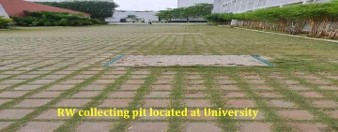
Every source of water is metered and recorded: the campus received 517,311 KL in 2025 from the CRDA supply, the Kondavity Vagu, river pumps and tankers. Eleven rainwater harvesting systems return roof and run-off water to the ground and raise the groundwater level.
Image 5: Rainwater collecting pit in the grass-paved area
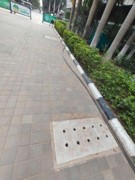
Image 6: Walkway with a rainwater pit cover
WATER-WISE CAMPUS
Water Conscious Planting and Building Standards
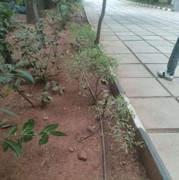
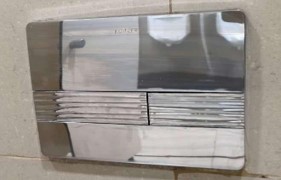
Nearly 68% of the 34,577 plants on campus are drought tolerant or moderately so and are watered by drip irrigation. Every tap is low-flow, 94% of washrooms have dual-flush toilets, and there are no overhead tanks.
Image 7: Drip irrigation along a shrub bed
Image 8: Dual-flush plate
POLLUTION PREVENTION
Preventing Water System Pollution
Written procedures for chemical storage and for spill prevention and response keep polluted water out of drains and water bodies, including after accidents, backed by spill kits in each laboratory and an external environmental audit.
BEYOND THE CAMPUS
Off Campus Water Conservation
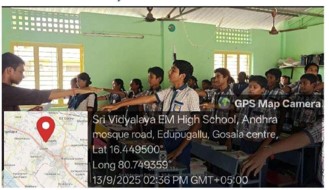
Students and faculty sampled water in four villages, held focus group discussions on rooftop rainwater harvesting in Ainavolu village, and ran a water and sanitation awareness project at Sri Vidyalaya EM High School.
Image 9: Students taking a water pledge at Sri Vidyalaya EM High School
COMMUNITY
Water in Community
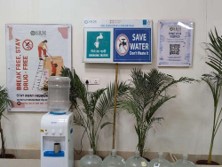
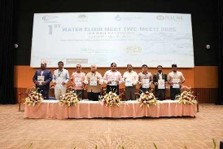
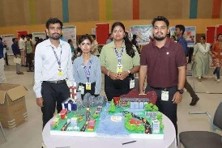
Conscious water use is promoted on the campus and beyond it. “Save Water” boards and “Free Drinking Water” posters sit at every drinking water point, the 1st Water Elixir Meet (27 February – 1 March 2025) brought 277 participants and speakers from five countries together on water security, and the Environmental Sustainability Exhibition (19 September 2025) drew 242 attendees, 71 of them from outside the university.
Image 10: Water-saving signage above a dispenser
Image 11: Water Elixir Meet 2025
Image 12: Student model at ESE-3.0
CONCLUSION
Conclusion
By recording every source, serving free purified drinking water, fitting efficient fixtures, planting for drought, treating sewage in-house and reusing about a third of the water it consumes, SRM University-AP reduces its draw on rivers and tankers and shares its learning with schools, villages and researchers.