School of Engineering and Science(SEAS)
SEAS Electronics and Communication Engineering B.Tech. in Semiconductor Engineering

B.Tech. Semiconductor Engineering

The rapid growth of the global semiconductor industry and India’s strategic focus on becoming a semiconductor manufacturing and design hub have created an unprecedented demand for skilled semiconductor engineers. National initiatives such as the India Semiconductor Mission, Semicon India Programme, Make in India, and Digital India are driving significant investments in semiconductor fabrication, chip design, packaging, and testing. The proposed B.Tech. in Semiconductor Engineering aims to bridge the gap between conventional electronics education and the specialized skills required by the semiconductor ecosystem. By providing a curriculum focused on semiconductor materials, device fabrication, CMOS technology, VLSI, compound semiconductors, MEMS, photonics, and advanced manufacturing, the program will develop industry-ready graduates capable of contributing to research, innovation, and the growth of India’s semiconductor sector.

About the Program

The B.Tech. in Semiconductor Engineering is a multidisciplinary undergraduate program designed to develop skilled professionals for the rapidly evolving semiconductor industry. The program provides a strong foundation in semiconductor materials, device physics, integrated circuit technologies, fabrication processes, CMOS technology, compound semiconductors, MEMS, photonics, packaging, testing, and reliability. Through a balanced curriculum integrating theory, laboratory practice, simulation, industry internships, and research-oriented projects, students acquire the knowledge and practical skills required to address challenges across the semiconductor value chain. Aligned with national initiatives such as the India Semiconductor Mission and the vision of Atmanirbhar Bharat, the program prepares graduates for careers in semiconductor manufacturing, chip design, process engineering, research and development, and technology innovation, while fostering entrepreneurship, ethical practice, and lifelong learning.

Unique Selling Points

Industry-Aligned Curriculum

A contemporary curriculum designed in consultation with industry and research experts, covering the complete semiconductor value chain.

Comprehensive Semiconductor Education

Specialized courses spanning semiconductor physics, CMOS technology, device fabrication, VLSI, compound semiconductors, MEMS, photonics, packaging, testing, and reliability.

Strong Hands-on Learning

Extensive laboratory training using industry-standard EDA tools, characterization equipment, fabrication process simulations, and project-based learning.

Focus on Advanced Semiconductor Technologies

Exposure to emerging technologies such as GaN and SiC power devices, silicon photonics, heterogeneous integration, Lab-on-Chip systems, MEMS, and AI-assisted chip design.

Semiconductor Manufacturing Orientation

Emphasis on wafer fabrication, cleanroom practices, lithography, thin-film deposition, etching, doping, process integration, packaging, and quality assurance.

Industry Internship and Experiential Learning

Structured internships, industrial training, and collaborative projects with semiconductor industries, R&D laboratories, and fabrication facilities.

Research and Innovation Ecosystem

Opportunities to participate in faculty-led research, publish technical papers, develop prototypes, and pursue interdisciplinary innovation.

Alignment with National Semiconductor Initiatives

Designed to support the objectives of the India Semiconductor Mission, Semicon India Programme, and the vision of Atmanirbhar Bharat by developing a future-ready semiconductor workforce.

Career Readiness Across the Semiconductor Value Chain

Graduates are prepared for careers in chip design, process engineering, fabrication, packaging, testing, reliability engineering, product development, and semiconductor research.

Entrepreneurship and Startup Support

Encourages innovation and technology commercialization through incubation support, design challenges, hackathons, and startup mentoring in semiconductor and deep-tech domains.

Interdisciplinary Learning Environment

Integrates concepts from electronics, materials science, physics, nanotechnology, photonics, computer engineering, and manufacturing to provide holistic engineering education.

Future-Focused Skill Development

Develops competencies in problem-solving, design thinking, simulation, automation, sustainability, ethics, communication, teamwork, and lifelong learning to meet the evolving needs of the global
Brochure

Research Focus in Semiconductor Engineering

Career/ Higher Studies / Entrepreneurship Opportunities

What are the career opportunities and higher education prospects after completing the B.Tech. Semiconductor Engineering program?
The program is expected to create job opportunities in the following sectors

Why Join Us?

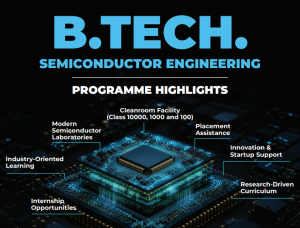
Cleanroom Facility (Class 10,000, 1000 and 100)

Modern Semiconductor Laboratories

Industry-Oriented Learning

Internship Opportunities

Placement Assistance

Innovation & Startup Support

Research-Driven Curriculum

Key Learning Areas

Key Laboratories

Semiconductor Device Simulation & Fabrication Laboratory (Tools like Silvaco TCAD suit, Synopsys Sentaurus TCAD, COMSOL Multiphysics, Coventor SEMulator3D etc.)

Brochure

Programme Educational Objectives (PEO)
Enable the undergraduate students to learn the fundamentals of Electronics and Communication Engineering deeply and lay a strong foundation for their professional careers or higher studies.
Impart the skills to design and develop solutions for complex electronics engineering problems in a multi-disciplinary environment.
Work in guided multi-disciplinary electronics and communication-related field research groups using technical know-how, common tools and environments to achieve project objectives.
Facilitate the development of effective communication skills, lifelong learning, leadership qualities and ethical professional conduct across their higher education and career paths.

Architect modern communication systems to meet stated requirements.

Design, build and test electronic systems for given specifications.
Analyse, plan and apply the acquired knowledge in basic sciences, mathematics and Electronics and Communication Engineering to solve complex problems with technical, economic, environmental, and social contexts.

Programme Outcomes (PO)

Engineering Knowledge
Apply the knowledge of mathematics, science, engineering fundamentals, and engineering. specialisation in the solution of complex engineering problems.
Identify, formulate, research literature, and analyse engineering problems to arrive at substantiated conclusions using the first principles of mathematics, natural, and engineering sciences.
Design solutions for complex engineering problems and design system components, and processes to meet the specifications with consideration for public health and safety, and cultural, societal, and environmental considerations.
Use research-based knowledge, including design of experiments, analysis and interpretation of data, and synthesis of the information to provide valid conclusions.
Create, select, and apply appropriate techniques, resources, and modern engineering and IT tools, including prediction and modelling, to complex engineering activities with an understanding of the limitations.
Apply reasoning informed by contextual knowledge to assess societal, health, safety, legal, and cultural issues and the consequent responsibilities relevant to the professional engineering practice.
Understand the impact of professional engineering solutions in societal and environmental contexts, and demonstrate the knowledge of and need for sustainable development.
Apply ethical principles and commit to professional ethics and responsibilities and norms of engineering practice.
Function effectively as an individual and as a member or leader in teams and in multidisciplinary settings.
Communicate effectively with the engineering community and with society at large. Be able to comprehend and write effective reports and documentation. Make effective presentations and give and receive clear instructions.
Demonstrate knowledge and understanding of engineering and management principles and apply these to one’s work as a member and leader in a team. Manage projects in multidisciplinary environments.
Recognise the need for and have the preparation and ability to engage in independent and life-long learning in the broadest context of technological change.