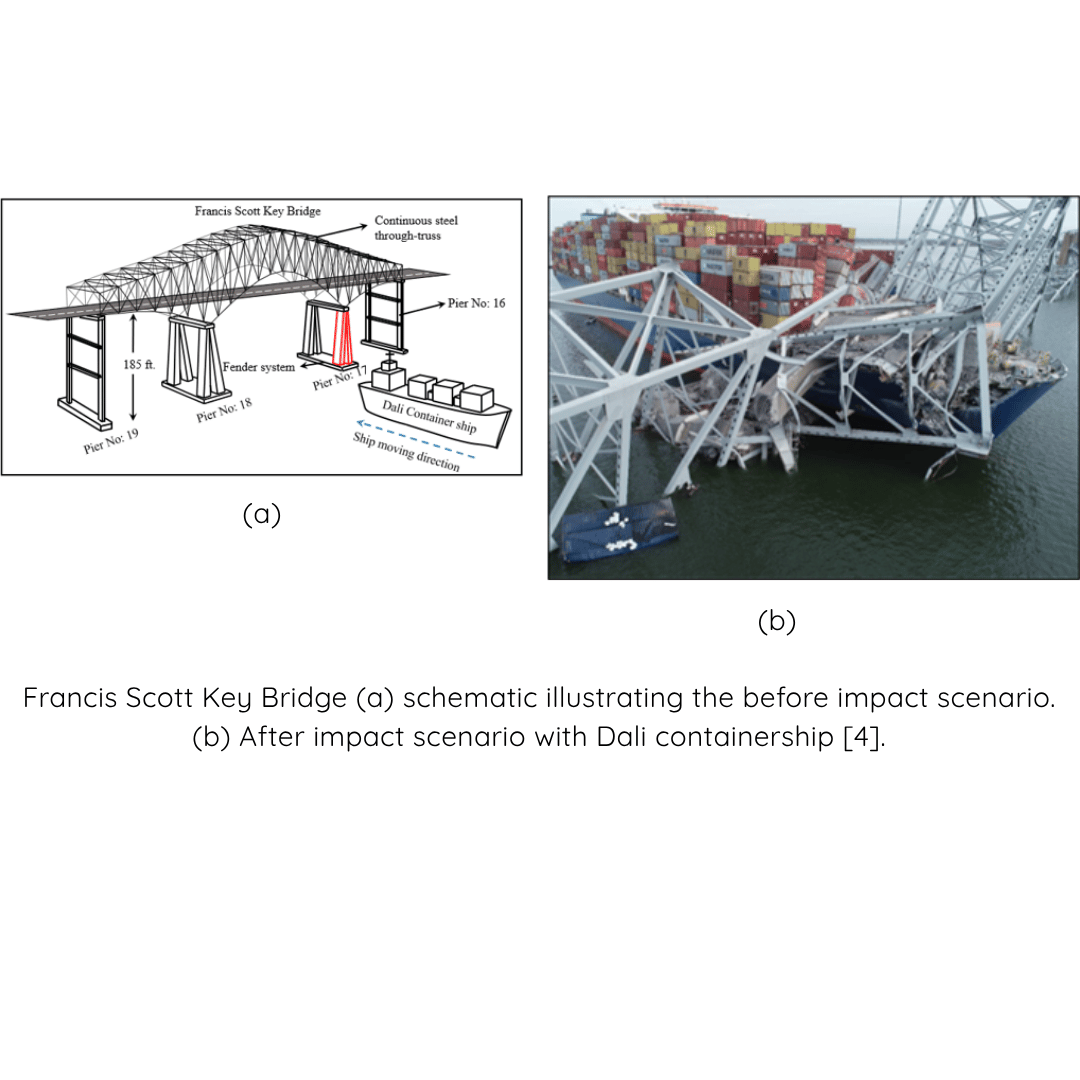
 When a container ship struck the Francis Scott Key Bridge in 2024, the collapse showed how vulnerable major structures can be to sudden lateral impact. Columns in bridges and high-rise buildings rarely carry load neatly through their centre, and accidental collisions rarely arrive at a convenient moment. Researchers at SRM University-AP have examined how a modern structural material responds when both forces act together. In research published in Structures (Elsevier), a Q1 journal with an impact factor of 4.9, Mr Tangudupalli Mahesh Kumar, PhD Scholar, Department of Civil Engineering, studied the behaviour of Ultra-High-Performance Concrete-Filled Steel Tube (UHPCFST) columns under lateral impact while carrying an eccentric axial load. The paper is titled “Dimensional analysis–based prediction of lateral impact response of UHPCFST columns under eccentric axial loading“.
Concrete-filled steel tube columns are widely used because they combine the strength of steel with the durability of concrete. Using advanced computer simulations, the study examined how geometry, material properties and loading conditions shape a column’s resistance to impact. The results identify the factors that most affect strength and safety, and give engineers a clearer basis for designing structures that can withstand extreme events such as vehicle crashes and ship strikes.
Abstract
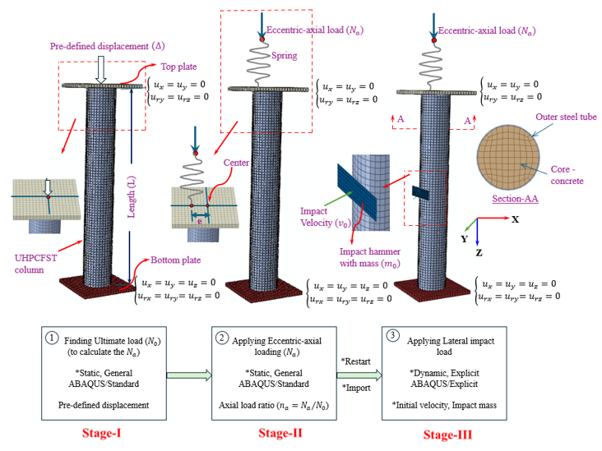
This study investigates the dynamic lateral impact response of Ultra-High-Performance Concrete-Filled Steel Tube (UHPCFST) columns subjected to eccentric axial loading. Using finite element models in ABAQUS, the research explores the influence of geometry, material properties and loading conditions on impact resistance. Non-dimensional functional relationships were developed using Buckingham’s π theorem and were validated to have strong predictive capability.
Practical Implementation/Social Implications of the Research
The findings support the design of safer bridge piers and high-rise building columns that must withstand accidental impacts. They also contribute towards improved design guidelines for eccentric loading conditions, which are common in practice and less well covered than centrally loaded cases. Better understanding of how such columns fail can help prevent catastrophic collapses of the kind seen with the Francis Scott Key Bridge in 2024. The use of ultra-high-performance concrete also supports sustainable infrastructure, since its strength allows material usage to be reduced.
Future Plans
The next stage of the research will extend the study to CFST columns under fire and elevated temperature conditions. The team also plans to study the structural behaviour of CFST columns subjected to wind load.
Read the full article here