
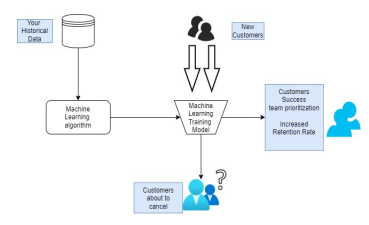

 Banks, mobile network operators, and subscription businesses lose revenue when customers close accounts or switch to rival providers. Spotting early warning signs allows companies to resolve service issues and retain customers before they leave. At SRM AP, researchers have patented a two-stage prediction method called the Random Leaf Model to help organisations identify those patterns more reliably. Instead of treating all customers as one large group, the system first groups people with similar behaviour using an ensemble of decision trees. It then evaluates each group on its own to calculate the probability that a customer will leave.
The invention, titled “System and Method for Predicting Customer Churn Using Random Leaf Model”, was granted Indian Patent No. 607647 under Application No. 202441036236 on October 28, 2026 in the Patent Office Journal. Developed entirely within SRM University-AP, the patent is credited to Dr Sumalatha Saleti, Associate Professor in the Department of Computer Science and Engineering, alongside B.Tech graduates Mr Yaswanth Chowdary Thotakura, Mr Dinesh Manikanta Yarramsetty, Mr Kalyan Kumar Doppalapudi, and Mr Shasank Alaparthi. The patented methodology also builds on their peer-reviewed study presented at the 2024 International Conference on Intelligent Computing and Emerging Communication Technologies (ICEC).
Customer churn, the decision of a customer to stop using a product or service, is a significant challenge for businesses, particularly in highly competitive and data-driven markets. This research presents the Random Leaf Model (RLM), a hybrid machine-learning methodology designed to improve customer churn prediction. The model combines the segmentation capability of Random Forest with the probabilistic classification capability of Logistic Regression. In the first stage, Random Forest identifies relatively homogeneous customer segments by capturing patterns through an ensemble of decision trees. In the second stage, Logistic Regression is applied to the identified segments to estimate the likelihood of churn. The research also considers resampling techniques to address class imbalance, a common issue in churn datasets where customers who leave may be fewer than those who remain. The approach was evaluated using multiple churn datasets and compared with other models. The reported results indicate that the Random Leaf Model can improve the identification of relevant customer groups, including the model’s ability to identify non-churn cases, while maintaining competitive overall accuracy. A prototype web framework was also implemented using Flask to demonstrate churn prediction on banking, credit-card, and telecommunications datasets.
To test practical usability, the team built a Flask-based web prototype that analyses new customer records across banking, credit-card, and telecommunications datasets. In commercial settings, banks and telecom operators can apply these predictions to review service bottlenecks, refine customer support, and allocate retention resources efficiently, provided models are validated against local company data with strict customer privacy safeguards. Next, the researchers plan to test advanced machine-learning and deep-learning architectures to improve generalisation across varied business settings. They also aim to develop real-time prediction pipelines for live customer data and add explainable AI features so teams can see which factors trigger each churn alert.
Read the associated research paper here