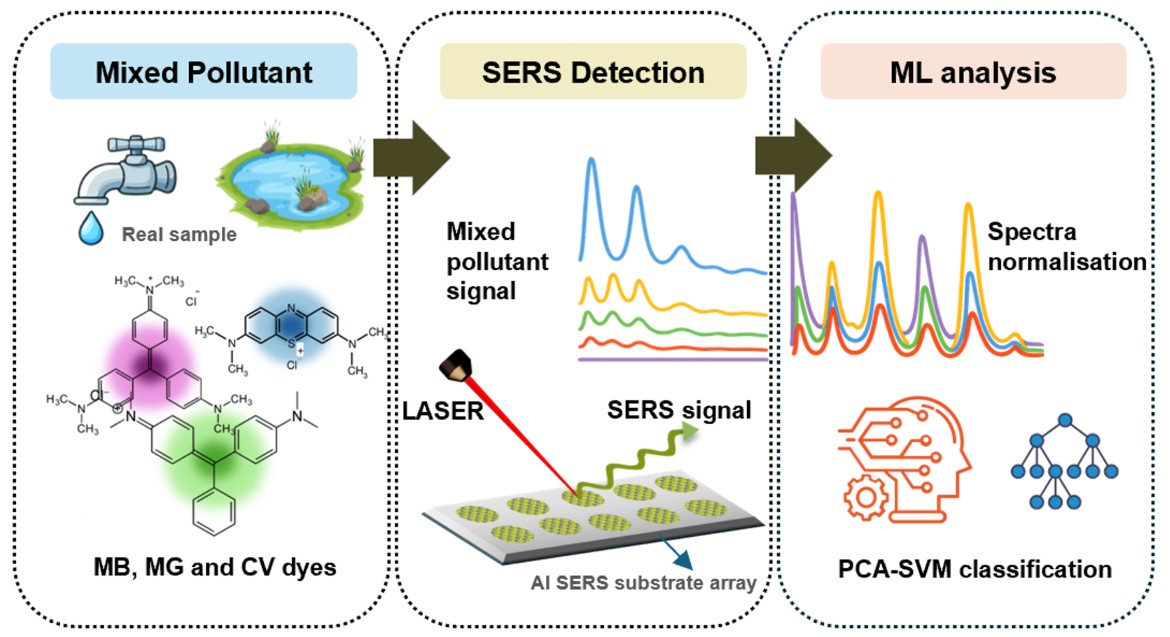
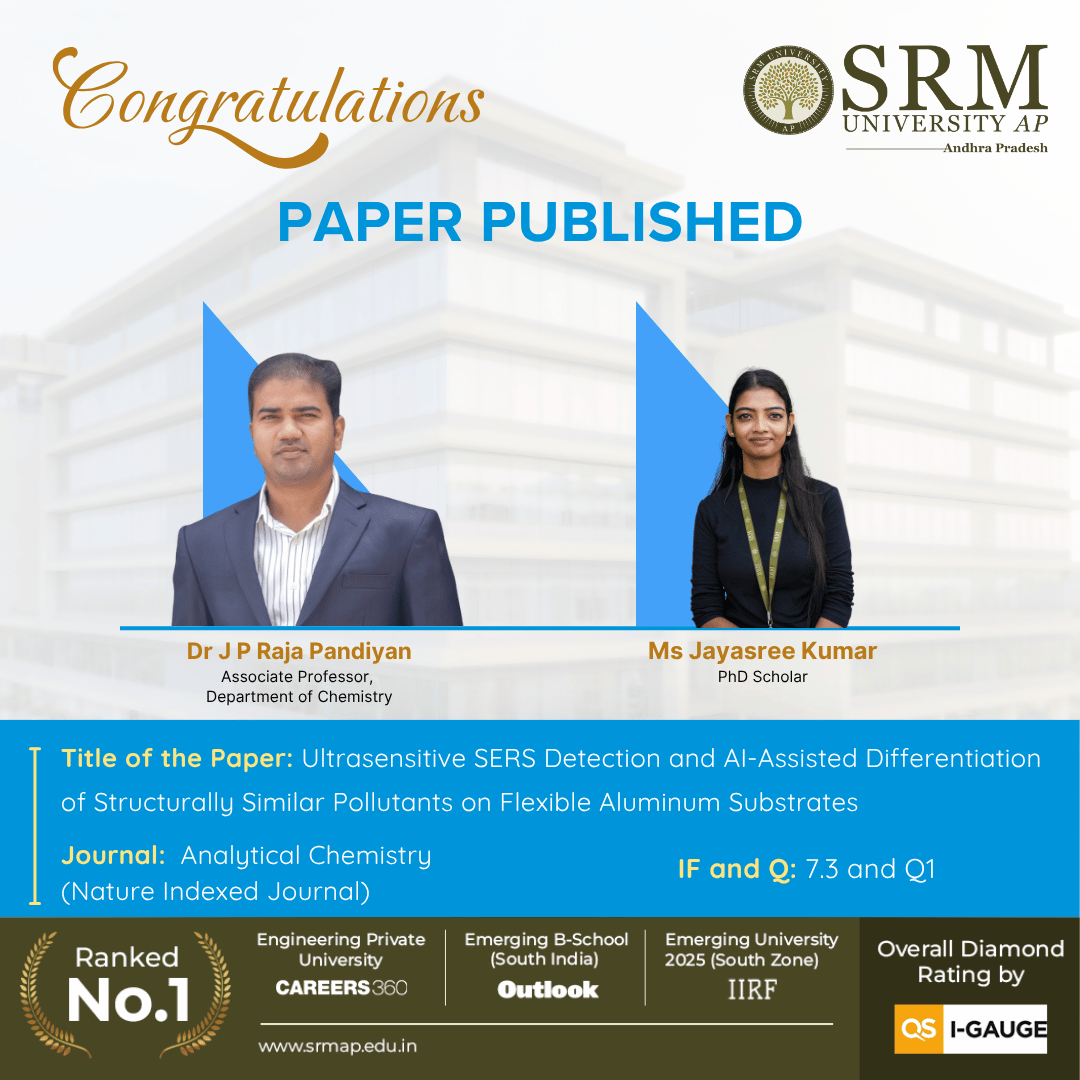
 Testing food and water for contamination is difficult when the pollutants of concern are chemically almost identical and present in vanishingly small amounts. Researchers at SRM University-AP have developed a flexible aluminium-based platform that addresses both problems. In research published in Analytical Chemistry, a Nature Indexed Q1 journal with an impact factor of 7.3, Dr Rajapandiyan Panneerselvam, Associate Professor, Department of Chemistry, and Ms Jayasree Kumar, PhD Scholar, report a surface-enhanced Raman spectroscopy (SERS) substrate that detects multiple pollutants at extremely low concentrations and tells structurally similar compounds apart. The paper is titled “Ultrasensitive SERS Detection and AI-Assisted Differentiation of Structurally Similar Pollutants on Flexible Aluminum Substrates“.
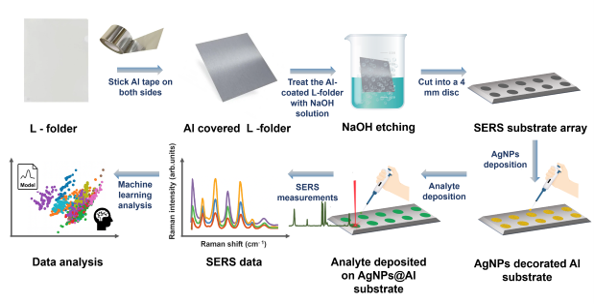
SERS is valued for its speed and ease of use, and it is becoming an important tool in food safety and environmental monitoring. Real samples, however, contain many unwanted materials that interfere with the readings. The team’s chemically etched aluminium substrate improves sensitivity, and machine learning then classifies the detected substances, which makes the method fast, reliable and suited to practical use. The work was carried out in collaboration with Dr Hemanth Noothalapati of the Raman Project Center for Medical and Biological Applications, Shimane University, Japan, and Dr Murali Krishna C. of the Advanced Centre for Treatment, Research and Education in Cancer, Tata Memorial Centre, Navi Mumbai.
Abstract
Surface-enhanced Raman spectroscopy has emerged as one of the most promising analytical tools in recent years, owing to its high sensitivity, specificity, ease of operation and rapid analysis. Detecting target analytes in real samples remains challenging because of matrix interference, low analyte concentrations, complex sample preparation and reproducibility issues. This study reports a chemically etched flexible aluminium substrate as a SERS platform for the ultrasensitive detection of multiple analytes, and highlights the detection of structurally similar and resonance-matched analytes. Machine learning-based classification models, namely principal component analysis (PCA) and support vector classification (SVC), are employed to differentiate the SERS spectra. The platform enables sensitive and effective detection and differentiation of analytes in real-world samples.
Practical Implementation/Social Implications of the Research
For the SERS community, the work introduces a facile fabrication method for filter paper-based substrates, using evaporation-induced self-assembly with the aid of 96-well plates. These substrates offer exceptional sensitivity and uniformity, with a relative standard deviation (RSD) of 8.2%, and are easy to fabricate, making them effective for a range of applications.
For industry and government bodies, the work is a valuable tool for assessing contamination in food and water bodies. Used with portable instruments, it supports on-site monitoring of environmental contamination, helps ensure adherence to regulatory standards and safeguards public health.
For the wider research community, the work supports studies aimed at identifying microplastic contaminants in real-world samples using portable Raman spectrometers. It aids ongoing research and paves the way for future studies in this important field.
Future Plans
Future research will focus on validating the platform with diverse real-world samples and expanding AI-assisted classification for rapid on-site pollutant detection.
Read the full article here