


 The world generates enormous volumes of waste every year, and much of it moves through supply chains that are difficult to trace, monitor, or verify. Traditional waste management systems often struggle with limited transparency, weak accountability, and inefficient recycling processes, making it hard to track where waste actually goes or whether it is disposed of responsibly. Emerging digital technologies such as blockchain, Artificial Intelligence (AI), and the Internet of Things (IoT) are increasingly being explored as tools to address these gaps, offering the potential to create secure, decentralised, and transparent systems for managing waste more sustainably.
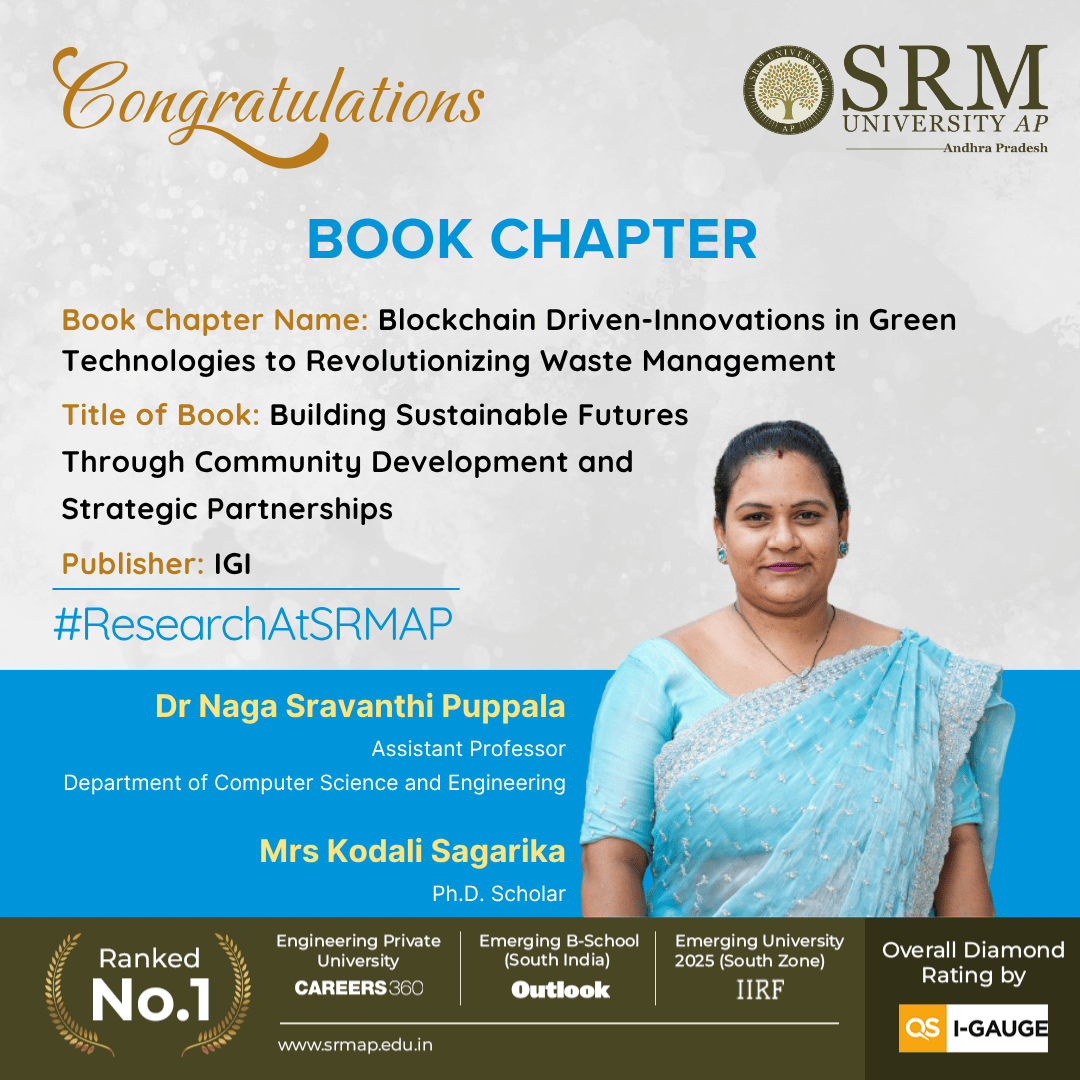
Dr Naga Sravanthi Puppala, Assistant Professor in the Department of Computer Science and Engineering at SRM University-AP, examines this potential in her book chapter titled Blockchain Driven-Innovations in Green Technologies to Revolutionizing Waste Management, co-authored with Mrs Kodali Sagarika, a PhD Scholar. The chapter appears in Building Sustainable Futures Through Community Development and Strategic Partnerships, published by IGI Global.
The chapter begins by discussing the growing global waste crisis and the limitations of traditional waste management systems, before explaining how blockchain, together with AI and IoT, can create secure, decentralised, and transparent waste management ecosystems. It presents several practical applications, including waste traceability, smart recycling systems, token-based incentive mechanisms, hazardous waste monitoring, e-waste tracking, and circular economy frameworks, and discusses real-world case studies such as Plastic Bank, RecycleGO, IBM-VeChain, Circularise, and SAP’s blockchain initiatives. It concludes by highlighting current challenges, policy implications, future research opportunities, and emerging trends in blockchain-enabled sustainable waste management.
Why This Chapter Matters
This chapter is significant because it addresses one of the world’s most urgent environmental challenges: sustainable waste management through the application of emerging digital technologies. It provides a comprehensive review of blockchain applications in waste management, explains how blockchain enhances transparency and trust across waste supply chains, and demonstrates the integration of blockchain, AI, and IoT for smart waste management. Drawing on real-world international case studies, the chapter bridges the gap between theoretical concepts and industrial applications, and supports the Sustainable Development Goals, particularly those relating to responsible consumption, sustainable cities, climate action, and circular economy initiatives. It further offers future research directions for researchers, policymakers, and industry practitioners.
Target Audience
This chapter is intended for a broad audience interested in blockchain technology, environmental sustainability, and smart city development. It will be especially useful for researchers in blockchain technology, computer science, and the circular economy, as well as environmental scientists, waste management professionals, smart city developers, and IoT and AI researchers. Government policymakers, municipal authorities, urban planners, and environmental NGOs will also find it relevant, alongside graduate and postgraduate students, PhD scholars, and industry professionals working in sustainability and green technologies. The chapter serves as a valuable reference for universities, research laboratories, environmental organisations, and policymakers seeking practical insights into technology-driven waste management solutions.