Ethical Governance, Safe Campus, Civic Values and Research on Rights and Democracy
OVERVIEW
Peace, Justice and Strong Institutions
SDG 16 calls for peaceful and inclusive societies, access to justice for all, and effective, accountable and transparent institutions. Its targets cover reducing violence, the rule of law, preventing corruption and bribery, responsive and participatory decision-making, protecting fundamental freedoms, and non-discriminatory laws. A university contributes through how it is governed and through what it teaches and convenes.
This page brings together safety and sensitisation programmes for students and staff, constitutional and democratic-literacy events, a child-safety programme at a government primary school, a national sociology conference and a conference on democracy in South Asia, and research on corruption, representation and violence.
SAFE AND ACCOUNTABLE CAMPUS
Safety, Sensitisation and Child Protection
On August 20, 2025, the Directorate of Student Affairs held a university-wide online sensitisation programme on the Prevention of Sexual Harassment (POSH), “Creating a Safe, Inclusive and Respectful Campus for All”, reaching 3,536 students and staff. The same day university counsellors ran a gender-sensitivity session, “Respecting Differences, Embracing Equality”, for 3,556 participants. Anti-Ragging Week and an Anti-Ragging Awareness and Enforcement Meeting, attended by the Pro Vice-Chancellor, the Associate Director of Student Affairs, wardens, counsellors and security staff, set conduct expectations at the start of the 2025-26 year.
Towards Greener Phenolic Resins (November 27, 2025)
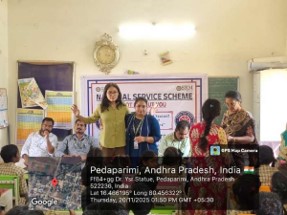
The Directorate of Student Affairs ran a personal-safety programme at the MPPS government primary school, Pedaparimi, delivered by Alekhya Sankara, a trained psychologist and university counsellor. Through storytelling and interactive discussion, about 150 children in classes 1-5 learned to recognise appropriate and inappropriate touch, to say “no” confidently, and to tell a trusted adult about unsafe situations. Four faculty members attended and the response from students and teachers was strongly positive.
Image 1: Good Touch and Bad Touch session with primary school children, Pedaparimi (November 20, 2025).
LAW, RIGHTS AND DEMOCRACY
Constitutional Literacy and Academic Dialogue
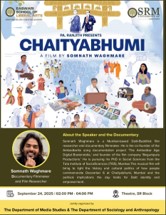
Chaityabhumi (September 24, 2025)
The Department of Media Studies and the Department of Sociology and Anthropology screened Somnath Waghmare’s documentary Chaityabhumi at the SR Block theatre, followed by a discussion with the director on caste, social justice, memory and political assertion, connecting classroom theory to Ambedkarite history.
Image 2: Poster for the Chaityabhumi screening and discussion.
Book Discussion on the Constitution of India (November 26, 2025)
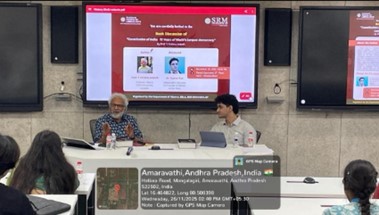
The Department of History, ESLA, hosted historian Prof V. Krishna Ananth (Sikkim University) and journalist Mr Saurav Das to discuss India’s constitutional journey at its 76-year milestone, deepening engagement with constitutionalism, democracy and institutional accountability. 109 people attended.
Image 3: Discussion session at the book discussion (November 26, 2025).
Constitution Day and National Unity Day
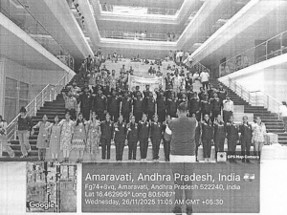
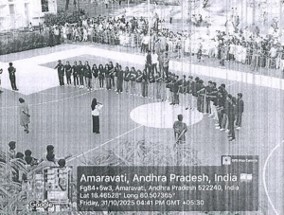
The Constitution Day observance on November 26, 2025 (60 participants) and the Rashtriya Ekta Diwas observance on October 31, 2025, brought students and staff together around constitutional values and national unity.
Image 4: Gathering at the Constitution Day observance (November 26, 2025).
Democracy’s Undoing and State Formation Days (March 2025)
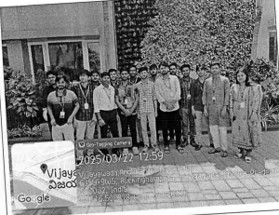
A two-day conference on democracy and politics in South Asia, “Democracy’s Undoing: South Asia and its Politics”, was held on March 20–21, 2025 without external funding. On March 22 (16 students) and March 29 (14 students), students took part in the Bihar, and Odisha and Rajasthan state formation day programmes at Rajbhavan.
Image 6: Students at Bihar State Formation Day, Rajbhavan (March 22, 2025).
50th All India Sociological Conference (December 28–30, 2025)
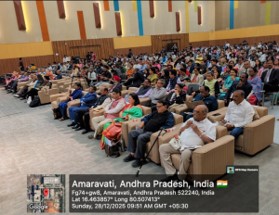
The Department of Sociology and Anthropology, ESLA, with the Indian Sociological Society, hosted the golden-jubilee conference on “Mobilities and Inequalities: Shifting Contexts, Changing Paradigms”, bringing scholars from across the country to examine how caste, class, gender, tribe and region shape unequal access to mobility and resources.
Image 7: Delegates at the inaugural session of the 50th All India Sociological Conference (December 28, 2025).
POLICIES AND REDRESS
Policy Framework and Complaint Routes
Published policies set out how conduct is governed and how complaints are heard. The Anti-Ragging Policy gives a broad definition of ragging, takes declarations and undertakings at admission, and provides an Anti-Ragging Committee with student members, a Squad and Mentoring and Monitoring Cells, confidential reporting and appeal to the Vice-Chancellor. The Policy on Prevention of Sexual Harassment provides an Internal Complaints Committee with at least half women, treats retaliation as an offence, protects confidentiality and sets time-bound steps to appeal.
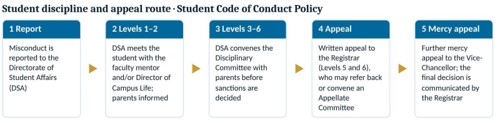
The Student Code of Conduct Policy (January 3, 2024) sets rights and standards for all students, graded misconduct and consequences, and a staged appeal ending with the Vice-Chancellor. The General Code of Conduct and Ethics (October 30, 2023) names bribery, fraud and falsifying records as misconduct and provides a natural-justice enquiry and appeal. The Workplace Code and Guidelines Policy sets out equal opportunity, zero tolerance for harassment and discrimination, and treats violence between employees as serious misconduct.
Other safeguards include web pages for the Anti-Ragging Committee, the Students’ Grievance Redressal Committee and the Faculty and Staff Grievance Redressal Committee, an Institutional Ethics Committee for research, plagiarism screening with Turnitin, research ethics in coursework and code of conduct training, with a 1:6 mentor-to-fresher ratio and a maximum fine of INR 2.5 lakh for ragging.
Image 8: Complaint and appeal route, Student Code of Conduct Policy.
RESEARCH AND PUBLICATIONS
Research on Corruption, Representation and Rights
The 2025-26 report counts 33 SDG 16-mapped outputs in Scopus/SciVal, with a field-weighted citation impact of 1.36, 7 collaborating countries, 711 views and 39 citations, led by corruption, human rights, right to privacy and decoloniality.
Six publications dated 2025 are highlighted: institutional corruption (FWCI 0.78); the intersection of culture and politics in women’s underrepresentation in Indian democracy (0.83); the role of nominated members of the Rajya Sabha in legislative processes (0); India’s Panchamrit climate policy and democratic contradictions in comparative South Asian perspective (0); advocacy and movement building for the health rights of LGBTIQ communities, drawing on EQUAL GROUND in Sri Lanka (3.07); and an interpretive phenomenological analysis of the experiences of pellet-gun victims in Kashmir (0).