Home About Us Sustainability SDG15 – Life on Land

OVERVIEW

Life on Land

SDG 15 calls for the protection, restoration and sustainable use of land ecosystems: managing forests sustainably, halting biodiversity loss and combating land degradation. Healthy land underpins water, food, livelihoods and resilience for people and wildlife alike.
For SRM University–AP, SDG 15 is expressed mainly through research on forests, invasive plants, habitat modelling, wetlands and wildlife, and through events that connect students to land and waste management in practice: a lecture on greener wood adhesives, and visits to a waste-to-energy plant, an environmental impact assessment hearing and a thermal power station.

LEARNING FROM LAND AND INDUSTRY

Lectures and Field Visits

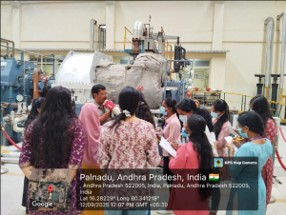
Jindal Urban Waste Management Ltd (September 12, 2025)

Students travelled to the integrated municipal solid-waste and waste-to-energy plant at Kondaveedu village, Guntur district. The visit covered contaminant generation and remediation, pollution-control and zero-discharge practices, and the regulatory standards for sustainable land and waste management, grounding classroom ideas on the circular economy and leachate treatment in a working facility. A total of 132 people took part.

Image 1: Inside the waste-to-energy processing facility (September 12, 2025).

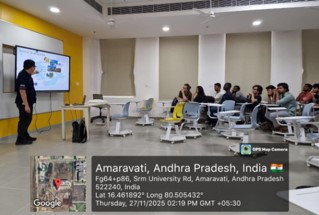
Towards Greener Phenolic Resins (November 27, 2025)

Dr Seng Hua Lee of the Department of Wood Industry, Universiti Teknologi MARA (Pahang Branch), Malaysia, spoke in the Department of Environmental Science and Engineering’s Guest Expert Lecture Series on replacing phenol with renewable precursors in sustainable wood adhesives. Fifteen PhD scholars, five faculty members and sixteen postgraduate students attended (57 participants in the register). The session linked laboratory materials research to forest and wood-industry questions and opened a channel for collaboration with the Malaysian institution.
Image 2: Dr Seng Hua Lee addressing students and scholars (November 27, 2025).

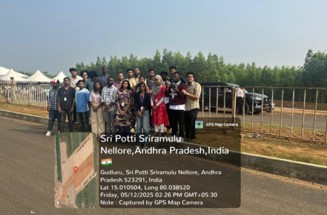
EIA Public Hearing, Nellore (December 05, 2025)

Students attended a live public hearing, a statutory part of an Environmental Impact Assessment, near the Ramayapatnam Port in SPSR Nellore District, seeing how baseline assessment, mitigation planning and stakeholder consultation shape decisions on large-scale industrial land use. Sixty-two people took part.

Image 3: Students at the EIA public hearing venue, Nellore (December 05, 2025).

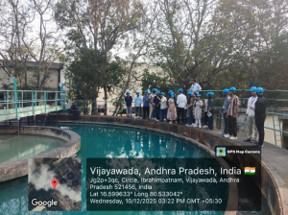
APGENCO Thermal Power Station (December 10, 2025)

At the Dr Narla Tatarao Thermal Power Station, Ibrahimpatnam, students examined air, water and solid-waste pollution-control technologies, ash utilisation and the rules on emissions and environmental compliance, giving a concrete picture of how industrial land use is regulated to limit ecological harm. Sixty-two people took part.

Image 4: Students at the water-treatment facility (December 10, 2025).

The university’s Disaster Management Plan lists upkeep of green spaces among its prevention measures, linking campus greenery to safety and resilience.

RESEARCH AND PUBLICATIONS

Forests, Invasive Species and Habitat Research

The 2024-25 report maps 55 publications to SDG 15 for 2024 and 2025 and lists 23, of which 19 carry a 2025 date. The 2025-26 report counts 65 SDG 15 outputs in Scopus/SciVal, with a field-weighted citation impact of 1.09, 33 internationally co-authored papers, 205 citations and 1,904 views, led by protected areas, tropical

Nineteen publications dated 2025 fall into four themes. On forests and carbon, papers study tropical dry forest structure in Central India (FWCI 2.74), treeline regeneration in the western Himalaya (2.13), diversity and carbon sequestration in a protected area of Uttarakhand (1.41) and carbon sequestration in industrial greenbelts (0.20). On invasive species, papers show how Lantana camara alters tree diversity and carbon pools (2.50) and map the habitat suitability of Solanum viarum (1.41), with a further paper on soil carbon in Madhya Pradesh.

On climate and biodiversity, species distribution models for Himalayan plants such as Podophyllum hexandrum (1.43) and Bergenia stracheyi sit alongside work on ecosystem vitality targets in India (0.63), species distribution modelling as a forest management tool (3.28) and an editorial on conserving plants in a changing climate. The remaining papers cover a morphometric method for discriminating leopard species and age, a Ramsar wetland converted into aquaculture ponds, satellite forest-change detection, soil-erosion risk mapping in Ethiopia, mine-spoil reclamation in the Godavari Valley coalfield, and pharmaceuticals in soil with myco-remediation strategies (2.20). Religion and ecology among the Bishnois of the Thar Desert (4.68) is also included.