SDG 11 asks for cities and human settlements that are inclusive, safe, resilient and sustainable. A university campus is a small city: it has streets, buildings, transport, waste, festivals and a resident community. How well it plans, runs and shares these things is a direct measure of the goal.
The cultural calendar gives students and staff regular occasions to celebrate together. Festivals from different regions, national days and state formation days make the community’s diversity visible and keep heritage alive.
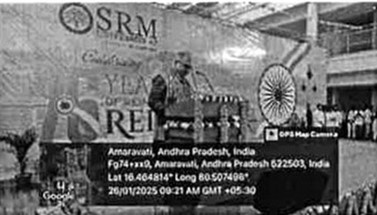
A morning programme at the flagpole and atrium with 1,750 participants (50 faculty and staff, 200 postgraduate and 1,500 undergraduate students). The Vice-Chancellor hoisted the flag, campus security personnel gave a parade, students performed and achievers were recognised. It was organised by the Directorate of Student Affairs and the Directorate of CLM.
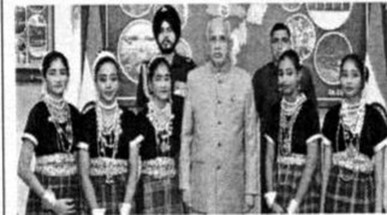
Students and staff took part in celebrations hosted by the Governor’s Office at Rajbhavan, Vijayawada, to strengthen national bonding and show each state’s heritage: Manipur, Meghalaya and Tripura on January 21, and Uttar Pradesh, Daman and Diu, and Dadra and Nagar Haveli on January 24.
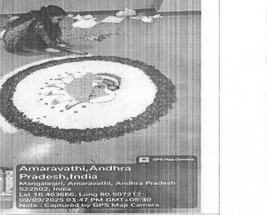
Saraswathi Puja on February 2 drew 500 participants and Holi on March 14 drew 470. In the autumn, Krishnastami was celebrated with a stage performance (August 13), Onam with the Aaravam programme and a Pookalam competition (September 9), and Diwali with sparklers (October 21). Ganesh Chaturthi was also held in 2025, with an eco-friendly clay idol-making activity.
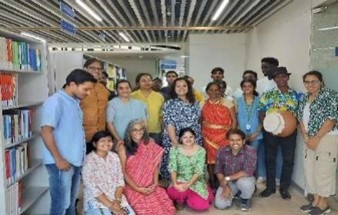
The Department of Arts held an invited talk and round table at the Central Library Conference Room, as part of a seed-grant project, on the ghumat, a percussion instrument declared Goa’s state cultural heritage in 2019. Six independent artists, among them musicians, a singer, a dancer, a documentary filmmaker and a researcher, discussed ecology, labour, social location and aesthetics with students of Sociology and Anthropology, and the session closed with the question of whether the ghumat can be a living archive.
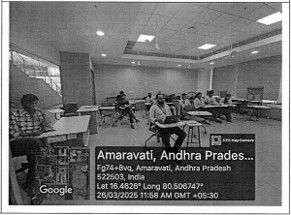
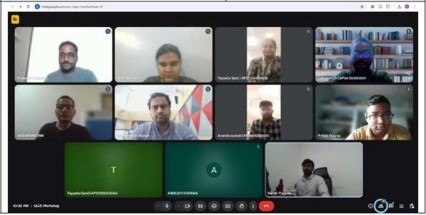
Departments hosted technical sessions on the building blocks of safe and resilient cities: vehicle communication, metro systems, road materials, geospatial mapping and drones. On February 6–7, Dr Pradeep Chennakesavula of the Hon Hai Research Institute (Foxconn), Taipei, spoke on how AI can support vehicle-to-everything communication to predict and ease traffic congestion and enable accident alerts. On March 19, Mr Sekh Samim, Deputy Chief Architect at Delhi Metro Rail Corporation, gave an online talk on Building Information Modelling in the Delhi Metro and on transit-oriented development.
Dr Nagabhushana M.N., former Senior Principal Scientist at CSIR-CRRI, presented the principles and composition of cold mix asphalt, its sustainability benefits and cost-effectiveness, its use in building and maintaining roads, and the government policies and specifications for adopting it.
A hands-on workshop run by Civil Engineering with the Centre for Drone Technology on assembling and deploying drones and collecting data for pavement monitoring and construction management, with resource persons from IIIT Hyderabad, Skyeris Aerotech and Vyomik Drones. On March 6 a panel of experts from APSAC, academia and start-ups discussed how drones are being adopted in India, including for smart cities, disaster response and infrastructure monitoring.
The Centre for Geospatial Technology and Civil Engineering ran ten online sessions on open-source GIS covering shapefiles, georeferencing, projections, spatial analysis and thematic mapping for environmental and infrastructure planning, plus Google Earth Engine, kriging, overlay analysis, UAV integration and the Drone Rules 2021.
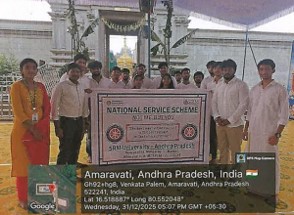
Volunteers of the NSS Cell cleaned parts of the campus on February 12, 2025, with 69 participants. NSS volunteers also organised a temple-seva activity at Venkatapalem on December 31, 2025, combining service with cultural and religious participation in the neighbouring community.
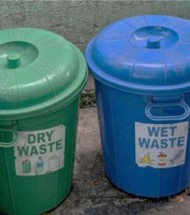
The campus has 860 waste bins, made up of 160 twin bins and 700 general bins. Twin bins separate wet and dry waste at the point of generation in academic and residential zones, while the general bins cover the wider campus, and organic waste goes to the on-campus composting facility. About 23,972 kg of solid waste is generated in a year. Waste from laboratories and technical facilities goes to a single dedicated storage facility, handled by eight trained staff, before safe disposal, and all 2,830 kg of hazardous waste generated in a year is disposed of.
The 2024-25 report maps 83 publications to SDG 11, concentrated on transport and mobility, vehicular and IoT networks, urban environment, structural safety and waste management. Seven selected publications dated 2025 cover urban flood monitoring with UAV-assisted sensor networks, aerial ropeway transit, low-carbon transport in emerging economies, carbon dioxide in the Krishna River basin, blockchain-enhanced trust in intelligent transport systems, automated medical services and earthquake prediction using machine learning.
Two start-ups list SDG 11 as their primary goal and were incubated during 2025: Back and Forth Solutions, an open-pooling service for student transport, and MRDOTS Solutions, a social app for neighbours to connect and help each other.