SDG 5 calls for an end to discrimination and violence against women and girls, recognition of unpaid care work, full participation of women in leadership, and equal access to resources and opportunity. At SRM University-AP the goal is pursued through the people who make up the community, the facilities that help them study and work, and the programmes that build awareness and confidence.
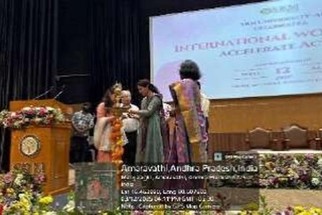
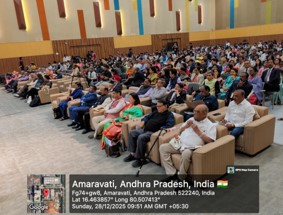
On 12 March 2025 the Student Council and the Directorate of Student Affairs hosted International Women’s Day at the APJ Abdul Kalam Auditorium, with 800 participants: 510 undergraduates, 20 postgraduates, 20 faculty and 250 external participants from the University’s housekeeping staff. Competitions on campus and online, including tug of war, debate, cooking without fire, arm wrestling, a push-up competition, themed posters and photography, led into the main programme.
Vice-Chancellor Prof. Manoj K Arora urged students to be multi-faceted, and the chief guest, Smt. Madhuri Nallapaneni, Group Director of Cadence-Invecas India, spoke on empowering women through knowledge and leadership. The Uttama Mahila Prathibha Award, an initiative of the Prof. V.S. Rao Foundation, recognised women working in landscaping, security and mess services. Prize distribution and a cultural programme of dance and music closed the day. External participants made up 31.3 percent of attendance, so the event reached women outside the student and faculty body.
Two sessions on 20 August 2025 set expectations of behaviour for the incoming first-year cohort. The first, “POSH: Creating a Safe, Inclusive and Respectful Campus for All”, was led by Ms Usha Pantula, Vice-Chairwoman of the CII Indian Women Network, Andhra Pradesh. This mandatory sensitisation programme on the POSH Act, 2013 reached 3,533 incoming students and 3 faculty. The second, “Respecting Differences, Embracing Equality”, was an interactive session led by university counsellors on gender diversity, unconscious bias and inclusive behaviour, with 3,553 attendees.
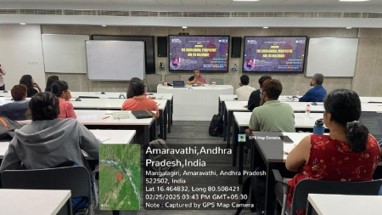
A special lecture in the Easwari School of Liberal Arts by Prof. Maitrayee Chaudhuri, President of the Indian Sociological Society and former professor at Jawaharlal Nehru University, showed how the sociological perspective helps analyse inequality, identity, culture and globalisation. Thirty-six people attended.
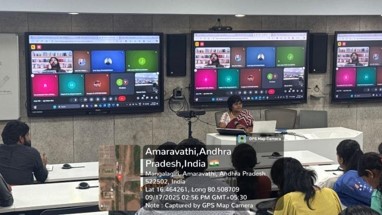
The Department of Political Science hosted a hybrid guest lecture by Julio Cesar Diaz Calderon, a trans/feminist activist-scholar, data scientist and poet. Using a Mexican fintech that expanded financial inclusion through AI and MIT projects such as Data Against Feminicide, the lecture argued that AI-led products should include women and LGBTQ people in design and deployment. Eighty-four faculty, PhD scholars and undergraduates attended.
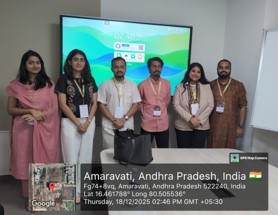
The Department of Literature and Languages held its Second International Conference with keynote speakers from Delhi University, the University of Alabama, King’s College London, Burdwan University and West Bengal State University. Sixty-two faculty, scholars and students attended, and tracks covered intersectionality and multilayered marginalisation, gender-based digital hierarchies and bias in large language models.
Hosted with the Indian Sociological Society, New Delhi, the conference on “Mobilities and Inequalities: Shifting Contexts, Changing Paradigms” examined how caste, class, gender, tribe, religion and region shape unequal access to mobility and resources, identifying gender as a key axis of inequality. It drew 422 participants from across India.
SRM University-AP runs a Day Care facility on campus for the children of faculty, staff and the university community. It is a bright, air-conditioned room with soft interlocking foam flooring in four colours, a swing-and-slide set, a rocking horse, ride-on toys and a toy house, with wall posters of animals, transport and fruits that support early learning. An outdoor play area shared with the residential blocks adjoins it.
In the academic year 2024-25 women made up 36.5 percent of the 9,063 students (3,305 women), 24.4 percent of the 451 teaching faculty (110 women) and 35.3 percent of the 385 non-teaching staff (136 women). Between 2022-23 and 2024-25 the number of women grew by 61.5 percent among students and 111.5 percent among teaching faculty. Women’s share is highest among postgraduate students (50.0 percent) and PhD scholars (51.6 percent), and lower among assistant professors (25.8 percent), associate professors (17.9 percent) and professors (12.1 percent), which is where attention is still needed. The 2025-26 report gives male-to-female ratios of 63:37 for the student body, 49:51 for PhD scholars, 79:21 for faculty and 66:34 for non-teaching staff.
Six gender-focused works dated 2025 are recorded in Scopus for SRM University-AP authors. They address women on corporate boards and business performance in Sub-Saharan Africa, women’s underrepresentation in Indian democracy, gender performativity in Indian comics, feticide and infanticide narratives in Hindi films, the female body in Baul philosophy, and goddesses in South Asia.
Two women’s-safety startups were in the University’s incubation programme during 2025. VHASS Softwares Private Limited, founded by a student and incubated from 3 March 2025 with a Rs 5,00,000 MeitY GENESIS grant, is building real-time tracking, secure communication and community emergency response for women’s safety. Project SWD, founded by an external entrepreneur, is developing a smart IoT-based safety device for women.
The annual SDG 5 report for January to December 2025 is available for all stakeholders.