Aquatic and Marine Research, Pollution Control and Industry Exposure
OVERVIEW
Life Below Water
SDG 14 aims to conserve and sustainably use oceans, seas and marine resources: reducing marine pollution, protecting coastal and marine habitats, and supporting the people who depend on healthy waters. Because rivers, wetlands, estuaries and seas are connected to the land, much of the progress comes from science, from controlling pollution at source, and from informed communities.
SRM University–AP’s contribution is mainly research, with the Department of Environmental Science and Engineering studying aquatic ecosystems through its curriculum and laboratories. In 2025, it also took students to an Environmental Impact Assessment public hearing and to industrial pollution-control sites and hosted a talk on marine bioactive compounds.
EXPERIENTIAL LEARNING
Pollution Control and Environmental Governance
APGENCO Thermal Power Station (December 10, 2025)
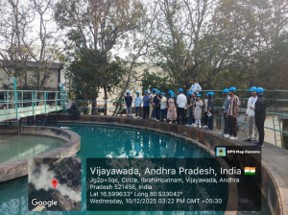
Students and researchers visited the Dr Narla Tatarao Thermal Power Station, Ibrahimpatnam, to study energy conservation, pollution pathways and industrial water treatment. They examined air, water and solid-waste pollution-control technologies, ash utilisation and the compliance rules for industrial water discharge, which bear on land-based sources of aquatic pollution. Sixty-two people took part.
Image 2: Students at the water-treatment facility (December 10, 2025).
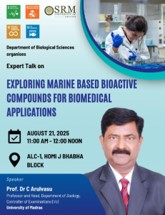
Prof C. Arulvasu, Professor and Head of Zoology at the University of Madras, spoke to 75 participants (PhD scholars and faculty) at ALC-1, Homi J. Bhabha Block, on discovering and characterising bioactive compounds from marine organisms for treating cancer, infection and inflammation, and on the challenges of sustainability and scale-up in marine bioprospecting. The talk was hosted by the Department of Biological Sciences.
Image 3: Flyer for the expert talk on marine bioactive compounds (August 21, 2025).
RESEARCH AND PUBLICATIONS
Aquatic and Marine Research
Twenty-nine SDG 14-linked publications in the 2025-26 institutional register carry a 2025 date. The 2024-25 report maps 55 publications for 2024 and 2025, and the 2025-26 report counts 41 outputs in SciVal, with a field-weighted citation impact of 0.83, 19 papers (46.3%) with international collaboration, 118 citations and 1,270 views.
The 2025 papers focus on microplastics and plastic waste, aquaculture technology, wastewater remediation, coral reef and underwater monitoring, and coastal wetlands. Among the most cited by field-weighted impact are a smart aquaculture system for oxygen and shrimp-health monitoring (FWCI 3.66), DeepFishNet for real-time fish disease classification (3.29), an underwater data transmission and object detection system using TinyML (2.98), biofilm-forming marine bacteria that degrade plastic (2.86) and surface-enhanced Raman spectroscopy for detecting microplastics (2.16). Other papers cover microbial degradation of microplastics, biochar for phosphorus and antibiotic removal from wastewater, oil and water separation membranes, a Ramsar wetland converted to aquaculture ponds, and detection of marine plastic waste from aerial and satellite images.
Research Spotlight: Microplastics and Antimicrobial Resistance
A review led by Dr Prasun Goswami (Department of Environmental Science and Engineering) with the National Institute of Animal Health, NARO, Tsukuba, Japan, published in NanoImpact (2025), explains how microplastics in oceans, rivers and lakes gather microbial communities, the “plastisphere”, which can carry antibiotic-resistant bacteria and resistance genes. It warns that these can spread through contaminated seafood or drinking water and calls for better waste management, less plastic use and policies to monitor microplastics and their microbial content. Future work will test how different polymers affect microbial communities and resistance genes.