Home About Us Sustainability New SDG13 – Climate Action

OVERVIEW

Climate Action

SDG 13 calls for urgent action against climate change and its impacts: cutting greenhouse-gas emissions, building resilience to climate hazards, and improving education and institutional capacity on mitigation and adaptation. A university contributes in three ways. It educates the people who will design low-carbon societies, it produces the evidence that climate policy rests on, and it shows through its own grounds and habits what responsible practice looks like.

CLIMATE RESEARCH AND DIALOGUE

Conferences, Exhibitions and Lectures

Water Elixir Meet 2025 (February 27 – March 01, 2025)

The Department of Environmental Science and Engineering hosted the first Water Elixir Meet, an international conference of researchers, engineers and policymakers on water scarcity, pollution and climate change impacts, from 9 am to 5 pm each day. Prof Rajasekhar Balasubramanian of the National University of Singapore was chief guest. Keynotes by three foreign delegates and six national experts covered climate-resilient water systems, membrane separation, digital innovations and community-led water stewardship. Outcomes included a compendium of research abstracts, a policy brief, and partnerships between academia, industry and policy bodies on PFAS contamination, saltwater intrusion and circular water economies. The meet drew 277 participants: 126 external, 27 faculty, 106 PhD scholars and others, 7 postgraduate and 11 undergraduate students.

Image 1: Stage with the banner for the 1st Water Elixir Meet 2025 (March 01, 2025).

Environmental Sustainability Exhibition, ESE-2025 (March 28, 2025)

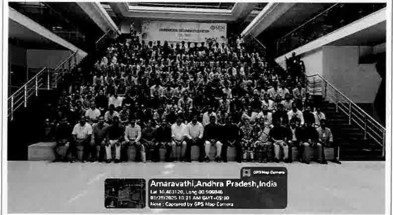
A day-long technical event (8:30 am to 5:30 pm, APJ Abdul Kalam Auditorium) where undergraduate students showed models, posters and projects on environmental sustainability. It drew 202 undergraduate students from eleven states, with exhibits across agriculture, biotechnology, electronics and computer science. Its aims were to inspire practical solutions, create a platform for sharing knowledge and promote the university as a hub for environment and sustainability education. It was organised with the Directorate of Admissions.

Image 2: Participants seated on the auditorium steps at ESE-2025 (March 28, 2025).

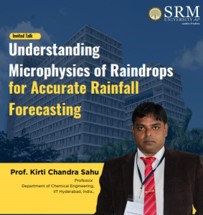
Understanding the Microphysics of Raindrops for Accurate Rainfall Forecasting (July 17, 2025)

Prof Kirti Chandra Sahu of the Department of Chemical Engineering, IIT Hyderabad, spoke to 475 participants on how raindrop formation affects rainfall forecasting. The lecture strengthened the department’s links with climate modelling and forecasting, which underpin early warning and resilience.

Image 3: Poster for the guest lecture on rainfall forecasting (July 17, 2025).

Green Hydrogen Summit 2025 (July 18, 2025)

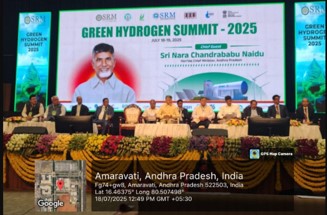
The department convened industry and government stakeholders on green hydrogen as a route to decarbonisation, with NREDCAP (Government of Andhra Pradesh), Greenko, AM Green, KPI Green Hydrogen and other partners. Sixty-two participants attended. The summit gave students direct exposure to the policy and technology behind India’s green hydrogen economy and strengthened the university’s links with the clean-energy sector.

Image 4: Stage at the Green Hydrogen Summit 2025 (July 18, 2025).

50th All India Sociological Conference (December 28, 2025)

The Department of Sociology and Anthropology hosted the goldenjubilee All India Sociological Conference, which also appears in the SDG 13 event register.

INDUSTRY ENGAGEMENT

Industry Co-teaching and Experiential Learning Visits

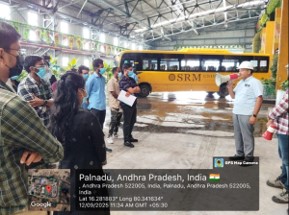
On October 6, 2025, industry co-teaching (ESE 505) with HP Green R&D, Hindustan Petroleum Corporation Limited, reached 150 participants. Students also made three exposure visits that let them see industrial operations and their emissions at first hand: an industrial exposure visit on September 12 (132 participants), a real-time exposure and experiential learning visit on December 05  and a visit to the APGENCO thermal power station on December 10.

Image 5: Students at an industrial exposure and experiential learning visit (September 12, 2025).

GREEN CAMPUS

Green Cover, Biogas and Plantation Drives

The campus spreads over 93.7 acres, of which 13.5 acres (about 14%) is green covered with lawns, trees and hedges. It has 60,200 trees, including about 800 mature trees older than 10 years. In the last reporting year 8,855 trees were planted, and 17,835 saplings were planted within and outside the campus.

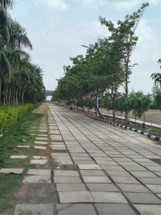
Image 6: Tree-lined walkway on the campus.

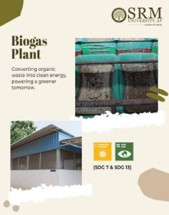
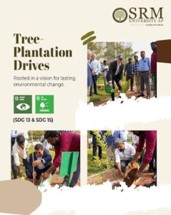
The campus biogas plant turns organic waste into clean energy, keeps biodegradable waste out of landfill and links waste management to low-carbon energy, supporting SDG 7 and SDG 13. Regular tree-plantation drives involving faculty and students add to the campus green cover and support SDG 13 and SDG 15 together.

Image 7: Biogas plant: converting organic waste into clean energy.
Image 8: Tree-plantation drives on campus. TEACHING AND DEPARTMENT

TEACHING AND DEPARTMENT

Courses and the Department of Environmental Science and Engineering

Two courses address climate change directly: EVS 501, Environmental Issues, Climate Change and Sustainable Development (odd semester), and LBA 251, Sustainable Cities and Climate Change (even semester). Climate research and teaching are anchored by the Department of Environmental Science and Engineering, which lists 337 publications and 17 patents to date, MSc, M.Tech and PhD programmes, and laboratories including a Net-Zero Lab, a Terrestrial Ecology and Modelling Lab, an Aquatic Biogeochemistry Lab and a Coastal and Environmental Hydrology Lab. The campus is close to the Eastern Ghats, the Bay of Bengal coast and Kolleru Lake, a Ramsar wetland.

RESEARCH AND PUBLICATIONS

Carbon, Methane and Climate Policy Research

The 2024-25 report maps 95 publications to SDG 13 for 2024 and 2025, with a field-weighted citation impact of 1.52, 41 papers with international co-authors and 1,520 citations. The 2025-26 report counts 103 publications, with a field-weighted citation impact of 1.29, 49.5% international collaboration and 492 citations.

Nine selected papers dated 2025 cover carbon dioxide supersaturation in South Asian river networks, from the Krishna River Basin (FWCI 1.35); salinity and phosphorus as regulators of methane emissions in tropical aquaculture ponds (0.97); microalgae as a negative emission technology for wastewater treatment (1.33); species diversity, biomass and carbon sequestration in a protected area of Uttarakhand (1.41); carbon sequestration in industrial greenbelts (0.2); a Drought Prone Index for India (0); India’s Panchamrit climate policy in a South Asian perspective (0); UAV-based forest-fire detection with CNN and YOLOv8 (3.96); and religious practice and ecology among the Bishnois of the Thar Desert (4.98).