Home About Us Sustainability SDG2 – Zero Hunger

OVERVIEW

Zero Hunger

SDG 2 aims to end hunger, achieve food security and improved nutrition, and promote sustainable agriculture. SRM University-AP works toward it through safe food on campus, training for rural women who run food businesses, student studies of farmers and markets, research on agriculture and food systems, and startups in food production and agri-technology.

SAFE FOOD ON CAMPUS

FSSAI Eat Right Campus Certification

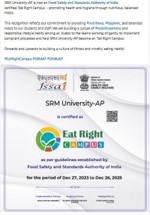
SRM University-AP is certified as an Eat Right Campus under guidelines established by the Food Safety and Standards Authority of India (FSSAI) for the period 27 December 2023 to 26 December 2025, so the certification was in force for almost the whole of 2025. Every hostel is served by a dedicated mess that offers a balanced menu for breakfast, lunch and dinner, prepared and served in a clean and hygienic environment.
Image 1: FSSAI Eat Right Campus certificate, SRM University-AP (valid 27 December 2023 to 26 December 2025)

TRAINING FOR FOOD ENTREPRENEURS

CSR ADITRI: Quality Training for Rural Women in Food Processing

In early 2025 the Directorate of Entrepreneurship & Innovation (CSR ADITRI Team) held two training sessions on quality and compliance for the food-processing sector, aimed at rural women building micro-enterprises. Both were led by Mr. MSV Phani Prakash, founder of Smart Food Lab, Hyderabad, and together they reached 112 participants.

Session 1: 9 January 2025 (offline)

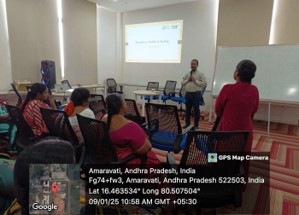
Held at X Lab 303, Student Corner, SRM AP, with 55 participants (48 external and 7 staff). The session included one-on-one interactions between the resource person and each entrepreneur, and covered food safety standards and quality control, hygiene and sanitation, labelling and packaging guidelines, testing and certification, and the effect of consumer trust and marketing on scaling up a business.

Image 2: Training session in progress at SRM AP (9 January 2025)

Session 2: 20-27 February 2025 (online)

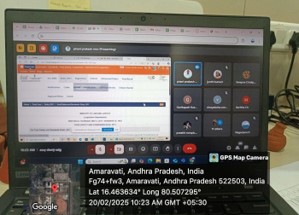
Held online with 57 participants (47 external and 10 staff). The objective was to equip rural women with knowledge of the licences, regulations and procedures required to run food-related businesses, including FSSAI certification, labelling requirements, compliance measures and product testing, followed by afternoon one-on-one sessions with individual ventures.
Image 3: Online training session facilitated from SRM AP (20 February 2025)

FARMERS AND MARKETS

Agri-Link: Connecting Farmers and Markets (5 September 2025)

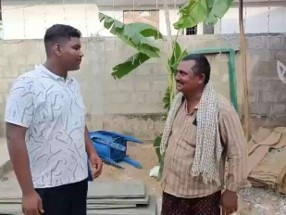
As part of a BBA Project Management course, a team of 8 students from the Paari School of Business studied why small farmers keep so little of the value of their crops. They visited the Attaluru Palem Organic Farmers Producer Company Ltd. on 5 September 2025 and interviewed 100 farmers across villages in the Guntur area. The students recorded input costs of Rs 30,000 to 45,000 per acre, payments delayed by more than 120 days when selling through intermediaries, and essentially no processing or value addition on the farm. They proposed a digital platform connecting farmers directly with markets.
Image 4: A student interviewing a farmer during the Agri-Link field study

KNOWLEDGE

Workshop on Econometrics and Large-Scale Data Analysis (13-17 October 2025)

The Department of Economics at the Easwari School of Liberal Arts trained 41 participants to analyse national datasets such as NSSO and IHDS using STATA, EViews, R and Nesstar, applying propensity-score matching, difference-in-differences and panel-data techniques to welfare-related questions.

RESEARCH

SDG 2 Research Published in 2025

Researchers at SRM University-AP published ten papers in 2025 that are mapped to SDG 2. They cover soil health and biochar, crop disease detection in food crops, microalgae-based nutritional supplements, small-scale irrigation for small farmers, nanochitin for agriculture, forecasting milk production in India, weed detection in precision agriculture using YOLOv11 and YOLOv12, food supply chains, bioactive compounds from food and agro-industrial wastes, and classification of soil nutrient deficiencies.

STARTUPS

Startups in Agriculture and Food Production

Two startups supported by the University’s entrepreneurship ecosystem began incubation in 2025. Greencrest Farms India Private Limited, founded by a student, runs farm-based country chicken production that promotes sustainable practices, and was incubated from 21 January 2025 with Rs 50,000 from the Directorate of Entrepreneurship. Secenai Semiconductors & Test Solutions Private Limited, founded by a faculty member, develops autonomous drones for agriculture covering crop monitoring, irrigation management and yield estimation, and was incubated from 11 March 2025 with a Rs 5,00,000 MeitY GENESIS grant.

CAMPUS INFRASTRUCTURE

Campus Food Infrastructure

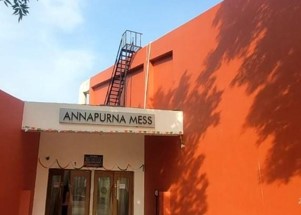
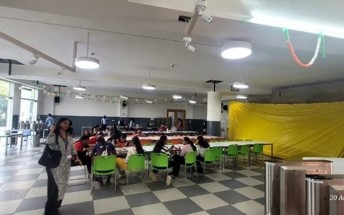
Every hostel is served by a dedicated mess offering a balanced breakfast, lunch and dinner in a clean, monitored dining space. The campus has three hostel mess halls with seating for 2,420 people, along with canteens, night canteens, cafeterias, a food court and refreshment areas that keep food accessible across the day. Food waste is collected at dedicated points on campus, and about 20 food suppliers, 15 of them local, serve the campus.

Image 5: Annapurna Mess entrance
Image 6: Mess dining hall

REPORT

SDG 2 Sustainability Report

The annual SDG 2 report for January to December 2025 is available for all stakeholders.