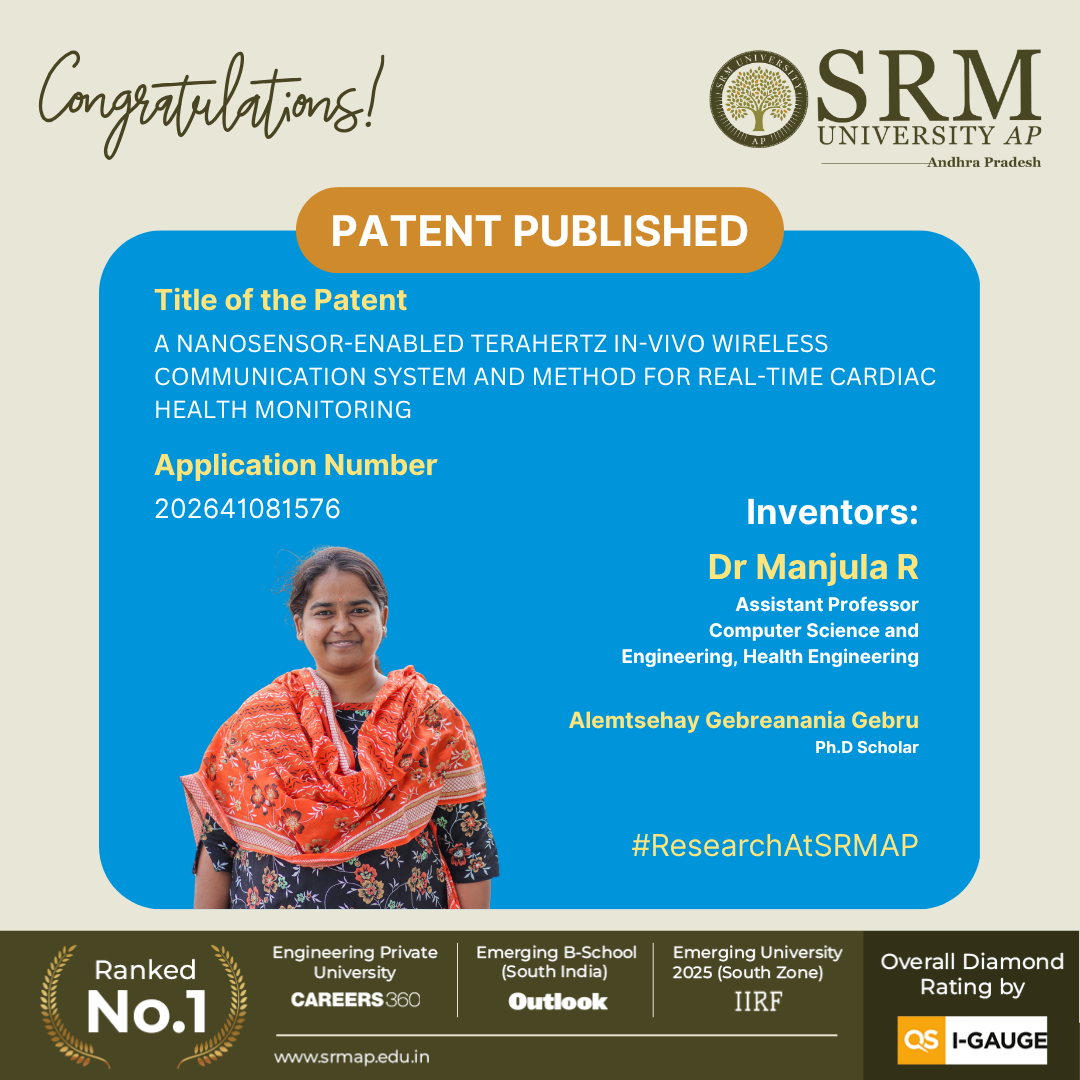
 Cardiovascular diseases remain among the leading causes of death worldwide, and continuous monitoring of the heart is central to catching them early. Nanosensors small enough to sit within arterial walls and cardiac tissue can now track pressure, flow, oxygen concentration, plaque development, electrical activity and biochemical markers. The difficulty lies in getting their readings out of the body. Dr Manjula Raja, Assistant Professor, Department of Computer Science and Engineering, along with Ms Alemtsehay Gebreanania Gebru (Ph.D. Scholar) at SRM University-AP, has developed a communication system that carries these vital signals from deep within the heart to a wearable device on the chest. The patent, titled “A Nanosensor-Enabled TeraHertz In-Vivo Wireless Communication System and Method for Real-Time Cardiac Health Monitoring” (Application No. IN-202641081576), was published on 10 July 2026.
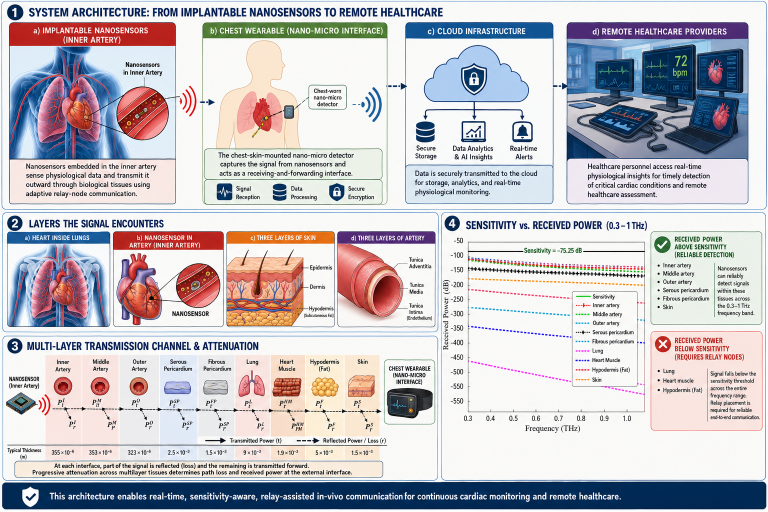
Terahertz communication is well suited to nanoscale devices because of its high bandwidth and its compatibility with nanoscale transceivers. Inside the human body, however, a direct link from the heart to the skin is not feasible, as biological tissue absorbs, scatters and weakens terahertz signals severely. The invention starts from this constraint. It places relay nodes within or across tissue layers, positioned according to receiver sensitivity, so that each node restores the weakened signal and passes it on. The signal stays above the sensitivity threshold at every stage and reaches the chest-mounted nano-macro interface device intact.
Abstract
The invention is a nanosensor-enabled terahertz in-vivo wireless communication system for cardiac sensing, designed to ensure reliable transmission of vital signals from nanosensors implanted in the inner arterial region of the heart wall to a chest-mounted nano-macro interface device. Its central premise is that direct end-to-end terahertz communication from the heart to the skin is infeasible because of extreme attenuation in biological tissues. To overcome this limitation, the invention introduces a sensitivity-aware adaptive relay architecture, in which intermediate relay nodes are strategically embedded within or across tissue layers.
Practical Implementation/Social Implications of the Research
The system is primarily developed for in-vivo cardiac monitoring. It supports real-time transmission of vital parameters such as biochemical markers, heart rate, blood pressure, stroke volume and oxygen saturation directly from internal cardiac tissue to wearable detectors on the chest. The sensitivity-aware placement of relay nodes strengthens weak electromagnetic signals by restoring and retransmitting them at tissue boundaries, which sustains reliable multi-hop nano-communication across high-loss tissue. Where direct transmission cannot succeed, the adaptive relays allow data to be transferred all the same.
The social value of the work lies in earlier and more informed intervention. Continuous sensing from inside the heart can enable timely detection of life-threatening conditions such as arrhythmias, arterial blockages and abnormal physiological changes. The approach also offers a consistent communication method for nanoscale biomedical devices operating inside the body, and it supports next-generation wearable healthcare systems in which external nano-macro interface devices enable uninterrupted data capture, signal processing and transfer of information to medical centres.
Future Plans
The next phase of the research is a comprehensive computational framework for implantable terahertz nanosensor communication in cardiovascular applications. Building on the current propagation and tissue-aware communication models, the team aims to bring anatomical modelling, electromagnetic propagation, relay-assisted communication, receiver sensitivity analysis, nanosensor placement optimisation and machine learning-based communication adaptation into a single simulation platform. The framework will allow end-to-end evaluation of implant-to-wearable communication under realistic physiological conditions and support the design of reliable in-vivo nano-networks for continuous cardiac monitoring. Ultimately, it will serve as a digital testbed for next-generation implantable healthcare systems before experimental and clinical validation.