


 Across India, Lord Rama is among the most widely worshipped deities, yet traditional Bengali folk songs heard at village gatherings, in the music of wandering Bauls, or during courtyard kirtans feature Krishna far more often than Rama. Bengal maintains its own Ramayana storytelling traditions, and in certain local retellings Sita even assumes the form of Goddess Kali to defeat the demon when Rama falters, reflecting deep reverence for the feminine divine. Bengali folk music, however, is built around personal emotions such as love, longing, heartbreak, play, and intimate closeness with God. Krishna, as both a playful child and the lover of Radha, fits naturally into this style of improvised, emotional singing, whereas Rama, revered as the duty-bound ideal king, remains more distant from such lyrical intimacy. Examining this contrast, Dr Sayantan Thakur at SRM AP shows that what a community chooses not to sing about carries as much cultural weight as what it sings, illustrating how regions adapt religious devotion to their own aesthetic and social worlds.
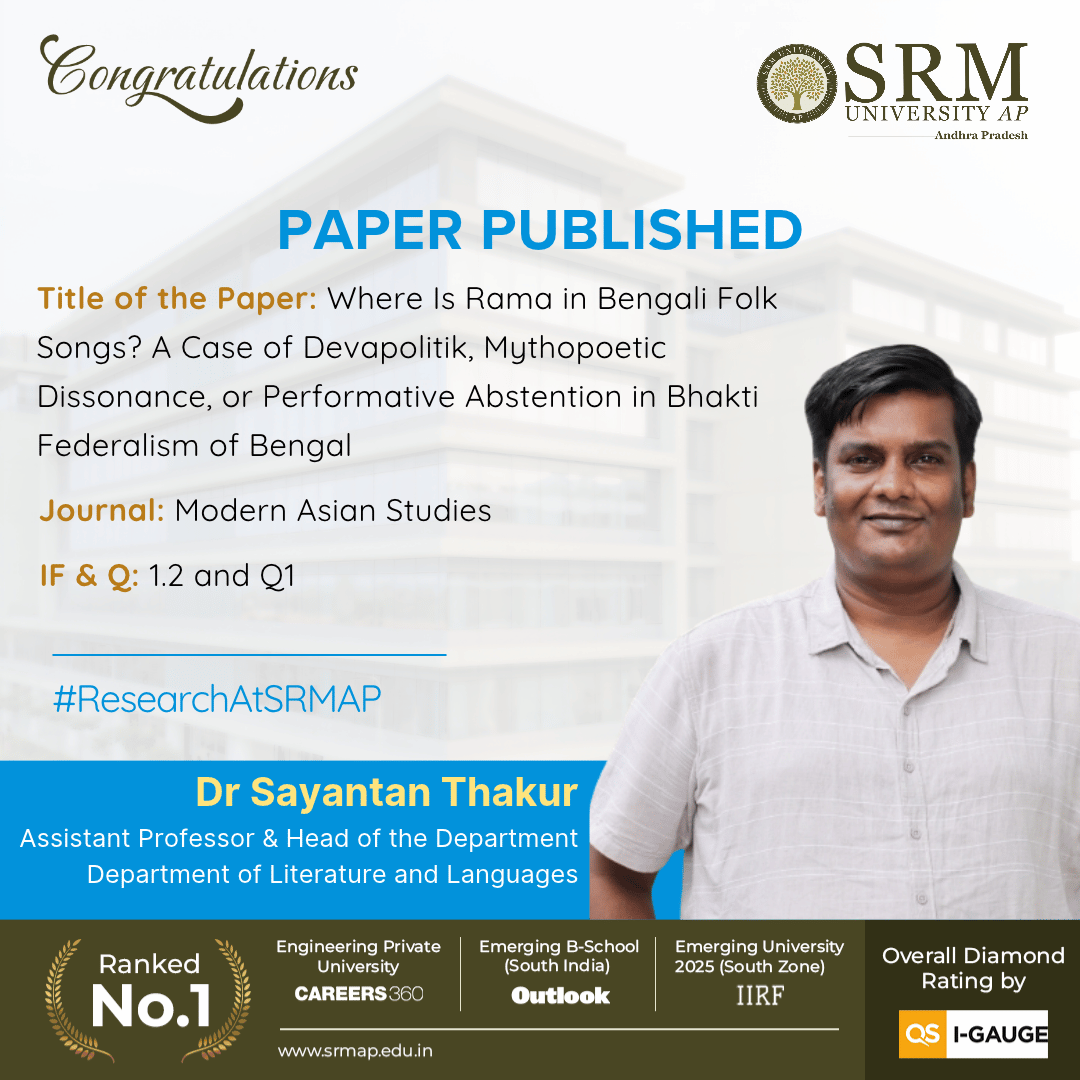
In a paper published in Modern Asian Studies, a Q1 journal with an impact factor of 1.2 published by Cambridge University Press, Dr Sayantan Thakur, Assistant Professor in the Department of Literature and Languages at SRM University-AP, investigates this regional dynamic. His study is titled “Where Is Rama in Bengali Folk Songs? A Case of Devapolitik, Mythopoetic Dissonance, or Performative Abstention in Bhakti Federalism of Bengal“.
This research examines why Lord Rama occupies such a marginal place in Bengali folk songs and performance-based devotional traditions, while Krishna dominates them. Rather than treating this as a simple omission, the article reads Rama’s absence as a culturally patterned silence shaped by regional aesthetics, vernacular religiosity and historical power formations. Focusing on Vaishnava-inflected song-worlds such as kirtan, padavali, baul, bhadu and jhumur, the study shows how Krishna (lover, child and playful divine) fits the emotional grammar of folk performance built on bhava, rasa, longing and separation, whereas Rama, the maryādā puruṣottama associated with duty, kingship and moral restraint, resists such improvisational intimacy. Drawing on folkloristics, performance theory, Foucault’s insights on discursive silence and critical approaches to cultural hegemony, and on scholars such as Dimock, Hawley, Nandy and Banerjee, the article proposes a set of interpretive concepts (devapolitik, mythopoetic dissonance, bhakti federalism, performative abstention and scriptural decentring) to explain how regional devotional cultures selectively remember, transform or sideline divine figures. It also notes Bengal’s own Rama traditions, such as Ramayan Gaan, Kushan Gaan and Chandrabati’s Sita-centred Ramayana, which sustain Rama in narrative and theatrical rather than lyrical forms. The article argues that devotional absence can itself be a mode of cultural agency: what is not sung still carries ideological weight, producing a distinctive devotional geography within Bengal’s plural religious landscape.
The study carries clear implications for understanding religion, regional culture, and identity in contemporary India. By showing that bhakti has always evolved into distinct local traditions shaped by language, music, and history, the research challenges the view of Hindu devotion as a single uniform practice. As Rama becomes more prominent in national political discourse, these findings offer an evidence-based perspective on why different regions relate to deities in their own ways, supporting thoughtful public dialogue around religious pluralism and cultural diversity. For researchers, educators, and cultural institutions, concepts such as bhakti federalism and performative abstention offer practical frameworks for studying how communities preserve and perform heritage. The work also points to the need to document, archive, and support Bengal’s living folk genres, including kirtan, padavali, baul, bhadu, jhumur, Ramayan Gaan, and Kushan Gaan, alongside the artists who sustain them, while encouraging policymakers and curriculum designers to recognise regional devotional traditions. Looking ahead, Dr Sayantan Thakur plans to expand his work into regional literature in translation, Tantric traditions and Eastern Indian literature, the folk music of Bengal, and the intersections of Indian philosophy, aesthetics, and literature.
Read the full article here