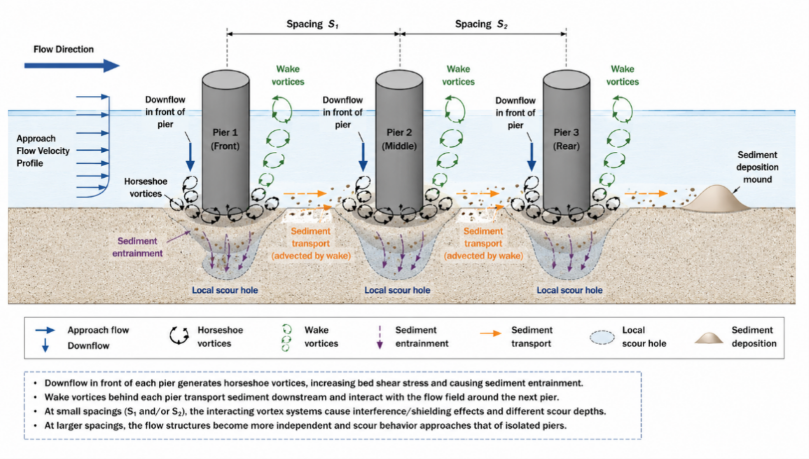

 When river water flows past a bridge’s support pillars, swirling currents carve holes into the riverbed around the base. This process, known as scour, is a leading cause of bridge failure worldwide. Because most bridges stand on multiple pillars arranged in a row, understanding how adjacent foundations alter local water currents is necessary for structural safety. Through laboratory experiments using ultrasonic sensors, Dr Geeta Devi at SRM AP tracked how scour holes form around three circular piers placed in a line under varying pier spacings, water speeds, and flow depths. Her work shows that closely spaced pillars act together like a single large obstacle, whereas widely spaced pillars each carve separate scour holes. Based on these measurements, she formulated a predictive equation for scour depth to help civil engineers design and maintain safer bridge foundations.
In a study published in Ocean Engineering, a Q1 journal with an impact factor of 6.3 published by Elsevier, Dr Geeta Devi, Assistant Professor in the Department of Civil Engineering at SRM University-AP, investigated this multi-pier interaction alongside Dr Vijay Kaushik, Assistant Professor in the Department of Civil Engineering at the National Institute of Technology, Delhi. Their paper is titled “Scour evolution and pier interaction in three-pier tandem arrangements“.
Scour around bridge piers is a complex flow-sediment process that is especially hard to predict in multi-pier systems due to vortex interference. This study investigated local scour around three circular piers in a tandem (in-line) arrangement under clear-water conditions. Covering a wide pier-spacing range (1D-5D), it tracked the time evolution of scour at all three piers using ultrasonic sensors and developed a spacing-dependent, PTT-inspired analytical model, while systematically varying pier spacing, flow rate, and flow depth. The results showed that scour shifts from group-controlled behaviour at close spacing to individual-pier behaviour at wider spacing, governed by horseshoe- and wake-vortex interactions. The proposed model was validated against experimental and literature data with strong accuracy (max R² = 0.98, low RMSE), offering improved understanding of tandem-pier scour and practical guidance for the design, assessment, and maintenance of bridge foundations.
Bridges carry people, goods, and emergency services, meaning sudden structural failures threaten lives and disrupt regional economies. By giving engineers a spacing-dependent formula to calculate expected scour depth before construction begins, this research allows foundations to be built deep enough for safety without the unnecessary expense of over-design. Knowing how scour develops over time and which piers in a tandem row face the greatest erosion risk also helps maintenance authorities prioritise inspections and install protective measures, such as riprap or pier collars, where they are needed most. As intense rainfall and severe flooding become more common, reliable scour prediction strengthens bridge resilience against high river flows, preventing costly collapses and protecting the communities that depend on these crossings.
Read the full article here