 Lithium-ion batteries generate substantial heat when discharging at high rates, which can degrade cells and create serious safety hazards if left unmanaged. To keep battery packs cool and reliable during demanding operation, researchers at SRM University-AP investigated a passive cooling method using paraffin wax, a phase-change material that absorbs heat as it melts. By testing a 48V lithium-ion battery pack across different discharge rates with and without paraffin wax, alongside an Artificial Neural Network model built to forecast temperature changes, Dr Lakshmi Sirisha Maganti and Dr P.S.N. Masthan Vali demonstrated how combined thermal regulation and predictive modelling can protect electric vehicle and energy storage batteries from overheating.
In a study published in Energy, a Q1 journal with an impact factor of 10.1 published by Elsevier, Dr Lakshmi Sirisha Maganti, Associate Professor and Head of the Department of Mechanical Engineering, and Dr P.S.N. Masthan Vali, Postdoctoral Research Fellow in the Department of Mechanical Engineering at SRM University-AP, presented these experimental and predictive findings. Their research paper is titled “Experimental investigation of thermal performance and artificial neural network prediction of a phase change material-based battery thermal management system“.
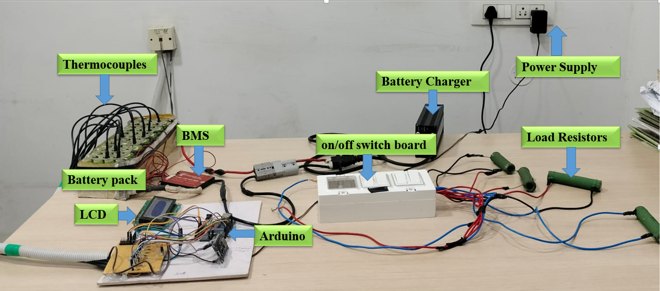
Efficient thermal management is essential to ensure the safety, reliability, and performance of lithium-ion battery (LIB) packs operating under high discharge conditions. This study experimentally investigates a phase-change material (PCM) based battery thermal management system (BTMS) for a 48V, 10 Ah battery pack composed of 52 cylindrical cells. Thermal behavior of the battery pack was evaluated at discharge rates of 1C, 2C, and 3C under ambient conditions, both without cooling and with cooling using a paraffin wax (PW) base PCM. Key performance metrics include maximum temperature (Tmax), maximum temperature difference (ΔTmax), average temperature (Tavg), and temperature uniformity. Without cooling, Tmax reached 53.75, 56.89, and 58.92 °C at 1C, 2C, and 3C, respectively. With PCM cooling, Tmax reached 48.77, 52.09, and 54.25 °C. Similarly, without cooling, the ΔTmax values were 5.64, 13.58, and 18.7 °C at discharge rates of 1C, 2C, and 3C, respectively. With PCM cooling, these values were reduced to 3.73, 5.81, and 6.6 °C, respectively, indicating enhanced thermal uniformity. Additionally, Tavg declined from 51.21 °C to 48.86 °C at 1C, with consistent reductions observed at high discharge rates. Temperature uniformity improved correspondingly, decreasing from 2.30 to 1.50 °C. Overall, the system achieved a maximum temperature reduction of 64.7 % under higher-discharge conditions. An Artificial Neural Network (ANN) model was developed for temperature prediction, achieving prediction errors within ±1 °C and a coefficient of determination (R2) of 0.99. The results confirm that integrating PCM-based BTMS with ANN modelling significantly enhances the thermal safety of LIBs and predictive capability.
The findings offer direct applications in electric vehicle battery packs and stationary storage units used for solar and wind power, where fluctuating charge and discharge cycles often cause heat buildup. Lowering peak operating temperatures helps prevent premature cell degradation, cuts replacement costs, and reduces the risk of thermal incidents, while passive wax cooling avoids the extra power draw of active cooling hardware. Integrating the neural network model into commercial Battery Management Systems also lets operators track temperature trends from voltage and current readings and spot abnormal heating early. Because paraffin wax alone cannot maintain full temperature uniformity during extreme discharge rates, future work will focus on combining phase-change materials with active air or liquid cooling, testing composite waxes enriched with expanded graphite or metallic additives to speed up heat transfer, and evaluating long-term durability over repeated charge cycles.
Read the full article here