
 Machining a very hard metal is a little like trying to cut a tough material while simultaneously keeping the cutting tool cool, maintaining a smooth surface, and removing material quickly. If the cutting conditions are not chosen properly, the tool can wear rapidly, the surface can become rough, and manufacturing can become inefficient.
The research published by Dr Krishnadas Narayanan Nampoothiri, Assistant Professor in the Department of Mechanical Engineering at SRM AP, in the Q1 journal of PLOS ONE, having an impact factor of 2.8, titled Optimization of CNC Milling Parameters for YXR7 Tool Steel Using Fuzzy MARCOS: A Multi-Response Approach to Improve Machining Productivity, presents a multi-response optimisation study of CNC milling of heat-treated YXR-7 tool steel, a hard-to-machine material widely used in precision tooling applications.
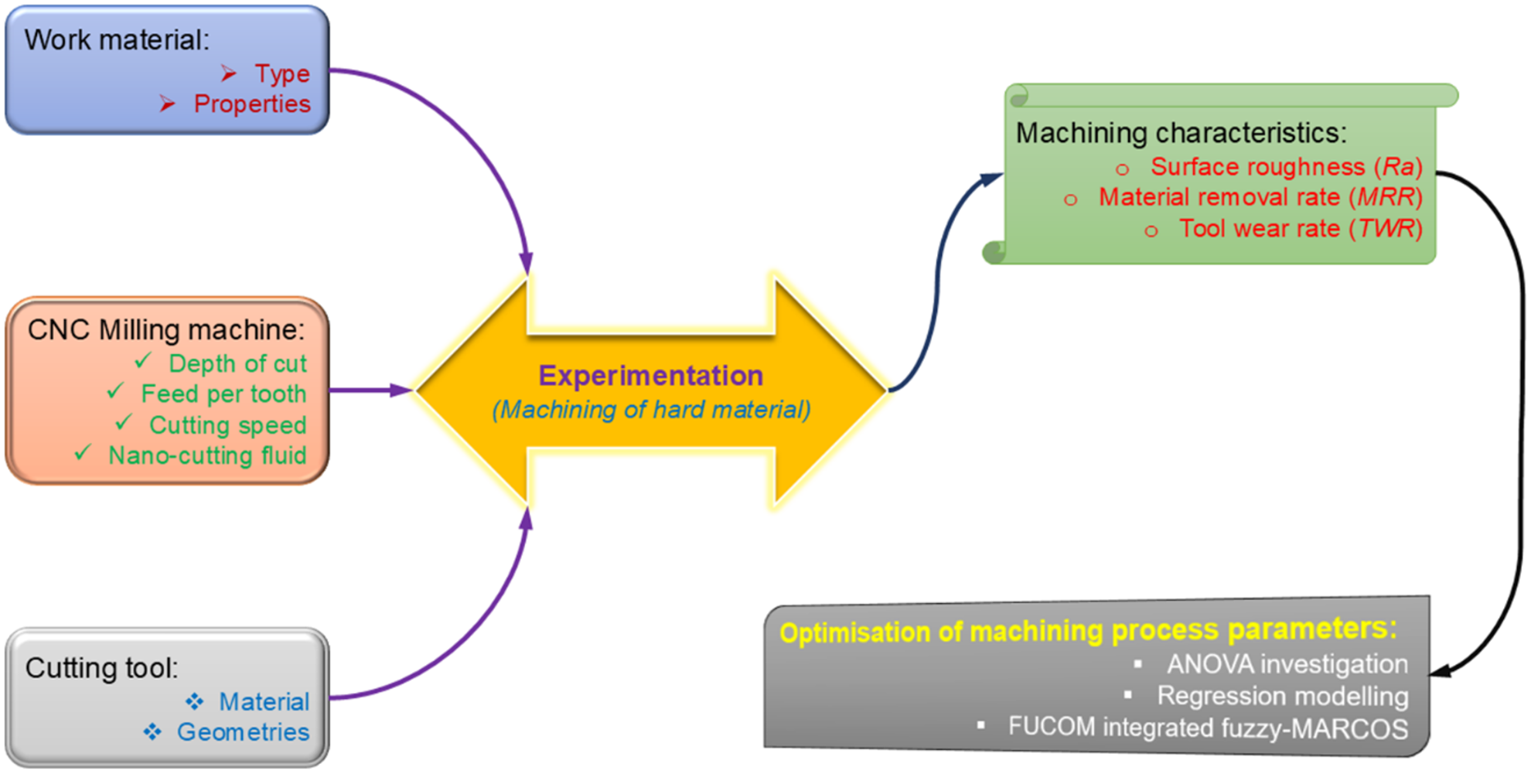
The study experimentally examined different combinations of cutting speed, feed rate, cutting depth, and nano-enhanced cutting fluids while milling YXR-7 tool steel, and applied an integrated FUCOM–fuzzy MARCOS decision-making framework to identify the best overall combination rather than optimising a single parameter. It identified a machining condition that offers a smooth surface, high material removal, and low tool wear, pointing towards a practical pathway for more efficient and sustainable manufacturing.
This research was carried out in collaboration with Amrita School of Engineering at Amrita Vishwa Vidyapeetham, Chennai, CVR College of Engineering, Hyderabad, and the Manipal Institute of Technology, Manipal Academy of Higher Education.
Abstract
This research focuses on the multi-response optimisation of CNC milling of heat-treated YXR-7 tool steel, a hard-to-machine material widely used in precision tooling applications. A systematic full-factorial experimental design was employed to investigate the effects of depth of cut, feed per tooth, cutting speed, and nano-cutting fluids on surface roughness, material removal rate, and tool wear. Regression analysis and ANOVA were used to identify significant parameters and their interactions. To address the conflicting objectives and uncertainties inherent in machining optimisation, an integrated FUCOM–fuzzy MARCOS multi-criteria decision-making framework was developed. The study demonstrates how intelligent multi-criteria optimisation can support more productive, precise, and sustainable machining of hard tool steels.
Practical Implementation and Social Implications
The research has direct relevance to precision manufacturing, tooling, automotive, aerospace, and other industries that require machining of hard tool steels. The identified machining conditions can help manufacturers simultaneously improve surface quality, material removal rate, and tool life, thereby reducing machining time, tool replacement, material wastage, and associated production costs. The use of Al₂O₃-based nano-cutting fluids also demonstrates the potential for improved heat dissipation, lubrication, and reduced tool degradation. More broadly, the proposed FUCOM–fuzzy MARCOS framework provides a flexible decision-support tool that can be adapted to different materials, cutting tools, cooling conditions, and manufacturing objectives, contributing towards more efficient and sustainable manufacturing practices.
Building on this work, future research will focus on developing intelligent and sustainable manufacturing systems that integrate experimental machining, advanced sensing, data-driven modelling, and artificial intelligence. Emphasis will be placed on real-time monitoring of machining processes, AI-assisted optimisation of cutting parameters, sustainable and nano-enhanced cooling strategies, and the simultaneous optimisation of productivity, surface integrity, tool life, energy consumption, and environmental impact.
Read the full article here.