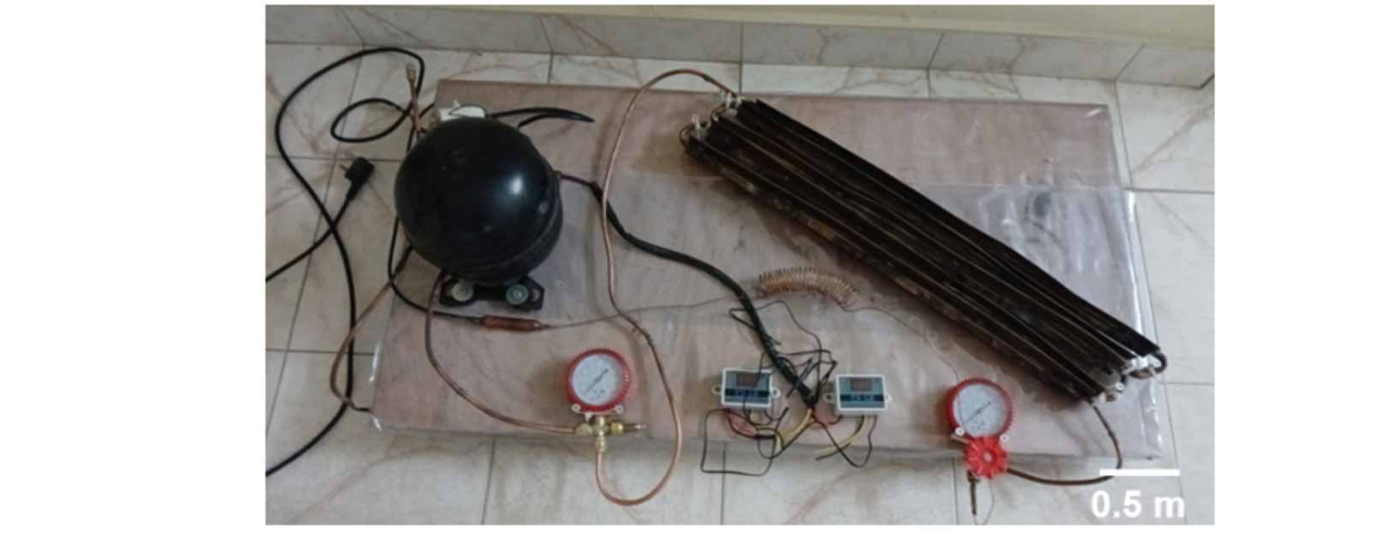

 One of its most important components of the refrigerator at home is the evaporator, which absorbs heat from the food compartment and keeps it cold. A common design used for this purpose is the longitudinal finned tube evaporator, where thin metal extensions, or fins, are attached to the tube much like the fins seen on a motorcycle engine or a room heater. These fins increase the surface area available for heat exchange, helping the evaporator remove heat more effectively and improving the overall cooling performance of the refrigeration system.
The research published by Dr Krishnadas Narayanan Nampoothiri, Assistant Professor in the Department of Mechanical Engineering at SRM AP, in the Q2 journal of Engineering Research Express, having an impact factor of 1.6, titled Experimental and Numerical Analysis of Longitudinal Finned Evaporators for Refrigeration System, presents an experimental and simulation-based study of a longitudinal finned tube evaporator, examining how volumetric flow rate influences its thermal performance.
Using a custom-built refrigeration setup, the study measured parameters such as temperature and volumetric flow rate under standard refrigeration conditions, and derived thermal parameters including refrigeration capacity and heat transfer coefficient. These experimental results were then compared against a simulation model built using ANSYS. Both thermal parameters were found to rise with increasing volumetric flow rate, consistent with theoretical expectations, and although some discrepancies were observed between the experimental and simulation results, the overall trend remained consistent across both approaches.
This research was carried out in collaboration with Amrita Vishwa Vidyapeetham, Chennai.
Abstract
In day-to-day human activities which involve cooling, humidification and preservation, refrigeration plays a pivotal role in building efficient systems. Since the evaporator deals with heat transfer processes, its performance has a direct impact on the vapour compression refrigeration system. Thus, it is essential to investigate the performance of the evaporator through various parameters like evaporator type, design and refrigerant type. The longitudinal finned tube evaporator is one such evaporator which is simple in design. But to improve the thermal performance, various parameters such as number of fins and fin geometry have to be optimised, which require detailed experimental and simulation studies. This manuscript mainly focusses on performance analysis of a longitudinal finned tube evaporator through experiments and compares those results through a simulation model built using ANSYS. A custom-built refrigeration setup was built, and by emulating standard refrigeration conditions, various parameters such as temperature and volume flow rates were measured. Based on various volumetric flow rates, derived parameters such as refrigeration capacity and heat transfer coefficient were measured and compared. Both thermal parameters were observed to have a positive rise with increase in volumetric flow rate, which is in line with theoretical concepts. A simulation model is built, and those experimental results are compared. Even though variation in discrepancies is observed between experimental and simulation results, the dependence of the thermal parameters on volumetric flow rate is seen to be consistent. These studies are expected to support further investigations into optimised fin designs for longitudinal fin evaporators, which is essential for developing efficient refrigeration systems across a range of applications.
Practical Implementation and Social Implications
This research contributes to the development of more energy-efficient refrigeration and cooling systems by improving the understanding and design of longitudinal finned tube evaporators. The experimental and simulation framework developed in this study can be used by engineers and manufacturers to optimise evaporator designs before large-scale production, reducing development time and cost.
Future work will focus on optimising fin geometry and evaluating alternative refrigerants, alongside integrating artificial intelligence and machine learning to develop predictive models for evaporator performance and to build high-efficiency refrigeration systems through sustainable approaches. The long-term goal of this research is to develop next-generation refrigeration technologies that are energy-efficient, environmentally sustainable, and economically viable, contributing to global efforts in energy conservation and climate change mitigation.
Read the full article here.