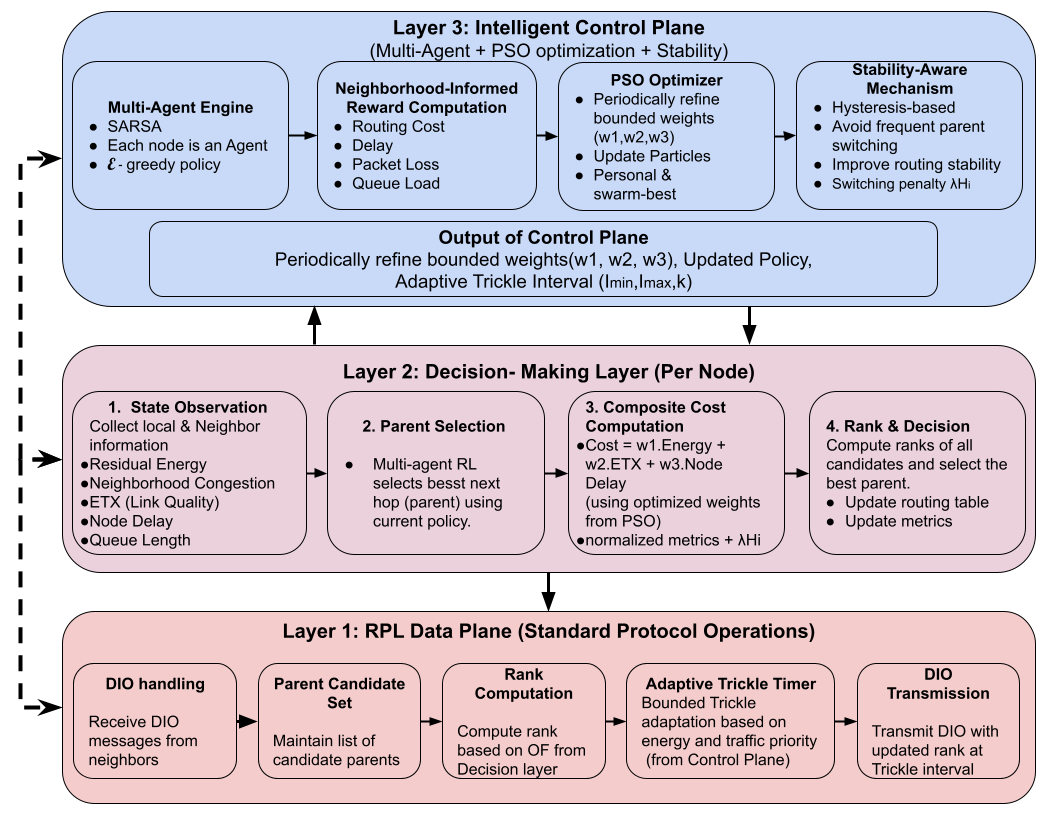

 Inside a large factory, hundreds of small wireless sensors continuously monitor machinery, temperature, pressure, and other operating conditions and send their readings to a central monitoring system. Wireless links in such industrial settings often weaken, sensor batteries drain unevenly, and data traffic can spike without warning. Sensors then repeatedly switch their communication paths, wasting battery power and delaying urgent alerts. To solve this problem, Dr Kshira Sagar Sahoo from SRM AP and his collaborators developed SMART-RPL, an intelligent routing framework that helps sensors select more dependable communication routes. By pairing artificial intelligence that learns from changing network conditions with optimisation techniques, the system refines routing choices and avoids unnecessary path changes so industrial networks stay stable.
In a study published in IET Networks, a Q2 journal with an impact factor of 1.9, Dr Kshira Sagar Sahoo, Associate Professor in the Department of Computer Science and Engineering at SRM University-AP, presented this framework with collaborators J. N. V. R. Swarup Kumar from GITAM Deemed to be University, Visakhapatnam, Saaketh Choudarapu from the Institute of Wireless and Internet of Things at Northeastern University, Boston, Dr Sourav Kumar Bhoi from Parala Maharaja Engineering College, Berhampur, and Byomakesh Mahapatra. Their paper is titled “SMART-RPL: Stability-Aware Multi-Agent SARSA-PSO Routing with Adaptive Trickle Control for Industrial IoT Networks“.
Industrial Internet of Things (IIoT) networks play a vital role in modern industrial automation, smart manufacturing, environmental monitoring, and intelligent infrastructure. However, these networks often operate under dynamic conditions with limited energy, unreliable wireless links, varying traffic loads, and changing network topologies. Conventional routing protocols may struggle to maintain reliable communication under such conditions, resulting in frequent route changes, increased communication overhead, and inefficient energy utilisation. To address these challenges, this research proposes SMART-RPL (Stability-Aware Multi-Agent Reinforced and Tuned RPL), an intelligent and distributed routing framework for IIoT networks. The proposed framework integrates multi-agent reinforcement learning using SARSA, periodic PSO, stability-aware parent selection, and adaptive Trickle control. Each network node independently adapts its routing decisions based on network conditions, including residual energy, link quality, communication delay, queue load, and neighbourhood congestion. The proposed framework was evaluated using the Cooja network simulator against several established routing protocols under diverse network conditions. The results demonstrate improvements in packet delivery, communication delay, network lifetime, and routing stability. In particular, SMART-RPL reduced parent switching by approximately 50-62.5% across the evaluated network sizes and improved packet delivery ratio by approximately 3.5% compared with LB-MRHOF under Rayleigh fading.
The framework has practical applications across industrial automation and smart manufacturing, smart infrastructure, environmental monitoring, and energy-efficient IoT networks where dependable wireless communication and longer sensor battery life are essential. Reducing unnecessary route switching lowers energy waste and keeps critical operational data moving smoothly across industrial and environmental sensing systems. For future work, the research team plans to deploy SMART-RPL on physical low-power IoT hardware to validate its performance outside simulation environments. They also plan to integrate security-aware routing mechanisms capable of detecting and mitigating compromised nodes, malicious activity, and routing attacks, while exploring lightweight adaptive intelligence techniques that maintain computational efficiency in rapidly changing industrial networks.