
 Machining a very hard metal is challenging, as the cutting tool experiences high forces and temperatures that can cause rapid wear and poor surface quality. This makes it difficult for manufacturers to decide the best combination of cutting speed, feed, and depth of cut for such materials.
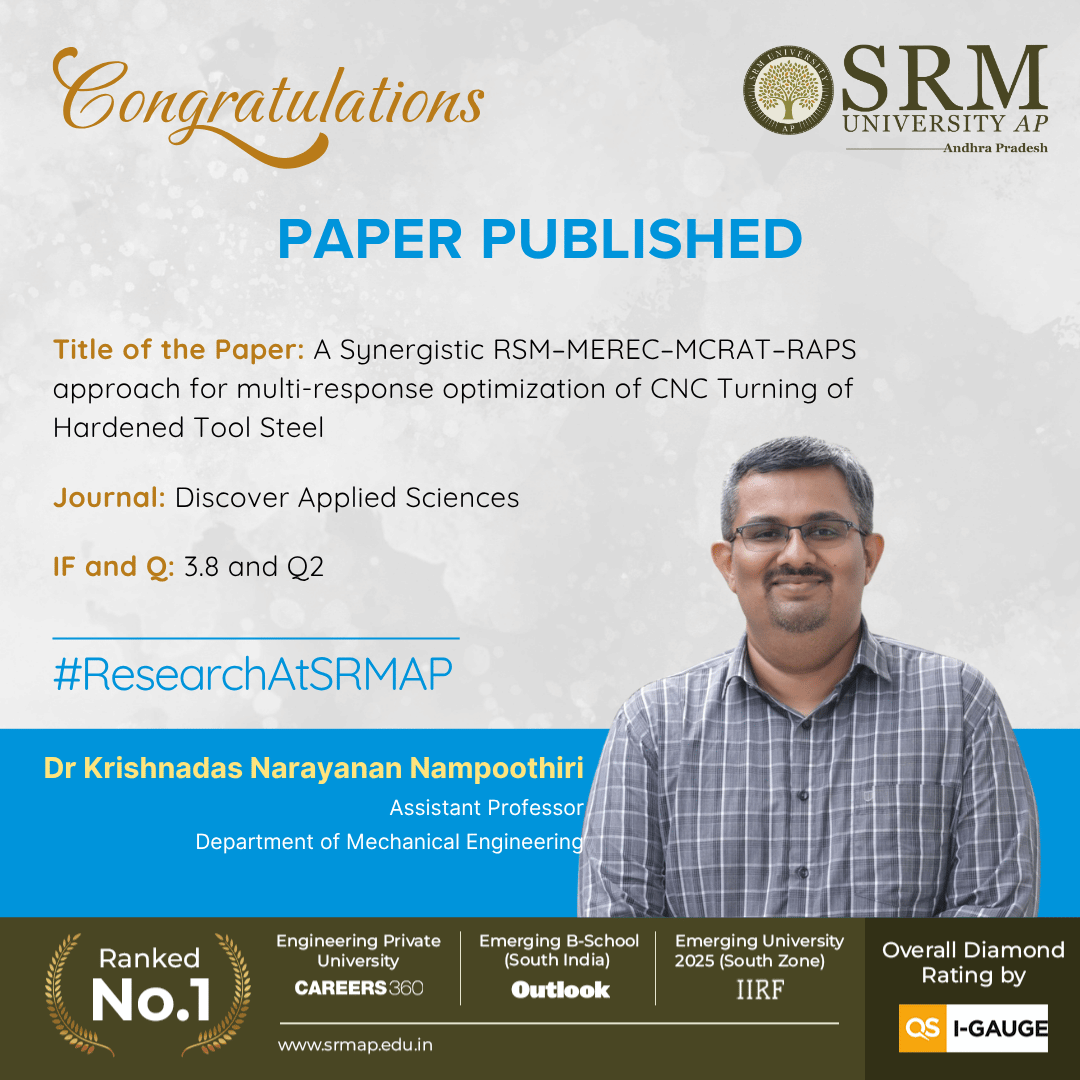
The research published by Dr Krishnadas Narayanan Nampoothiri, Assistant Professor in the Department of Mechanical Engineering at SRM AP, in the Q2 journal of Discover Applied Sciences, having an impact factor of 3.8, titled A Synergistic RSM–MEREC–MCRAT–RAPS Approach for Multi-Response Optimization of CNC Turning of Hardened Tool Steel, presents a multi-response optimisation study of CNC turning of hardened MDC-K tool steel, a material widely used in dies, moulds, automotive, aerospace, and precision engineering because of its high hardness and wear resistance.
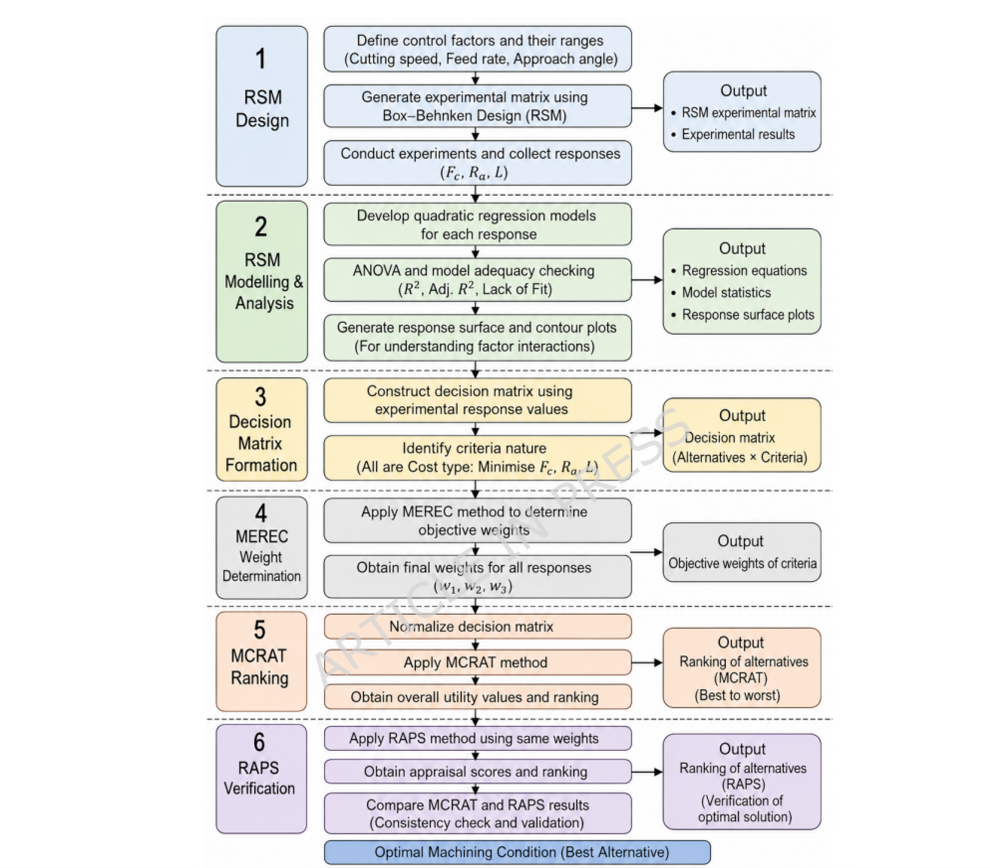
Rather than optimising a single outcome such as surface quality, the study developed a combined mathematical decision-making approach, an integrated Response Surface Methodology (RSM)–MEREC–MCRAT–RAPS framework, to simultaneously analyse and optimise multiple machining responses, including tool-chip contact length and surface-related performance. The approach helps identify a balanced set of machining conditions that can make the manufacturing process more efficient, reliable, and productive, while reducing problems associated with machining hardened materials.
This research was carried out in collaboration with Amrita School of Engineering at Amrita Vishwa Vidyapeetham, Chennai, and CVR College of Engineering, Hyderabad.
Abstract
This research focuses on the multi-response optimisation of CNC turning of hardened MDC-K tool steel, a material widely used in dies, moulds, automotive, aerospace and precision engineering because of its high hardness and wear resistance. The study investigates the influence of cutting parameters on important machining responses, particularly tool–chip contact length and surface-related machining performance. An integrated Response Surface Methodology (RSM)–MEREC–MCRAT–RAPS framework was developed to simultaneously analyse and optimise multiple machining responses. The work demonstrates the potential of integrated optimisation techniques for improving the efficiency and reliability of machining difficult-to-cut hardened tool steels.
Practical Implementation and Social Implications
The research has direct practical relevance to industries involved in precision manufacturing, tooling, automotive, aerospace, and die-mould production, where hardened tool steels are frequently machined. The developed multi-response optimisation framework can help manufacturers select appropriate cutting conditions while balancing machining quality, productivity, and tool performance. Such optimisation can potentially reduce unnecessary tool wear, machining time, energy consumption, and material wastage, thereby improving manufacturing efficiency and reducing production costs. More broadly, the methodology provides a systematic decision-support framework that can be extended to other difficult-to-machine materials and manufacturing processes, supporting the transition towards more intelligent and sustainable manufacturing.
Building on this work, future research will focus on developing intelligent, data-driven, and sustainable manufacturing systems, integrating advanced machining experiments with machine learning, real-time sensing, and AI-based optimisation for predictive tool-wear monitoring and adaptive control of machining processes. Particular attention will be given to simultaneously optimising surface quality, tool life, productivity, energy consumption, and environmental impact. The work will also investigate sustainable cooling and lubrication strategies, including nano-enhanced fluids and minimum-quantity lubrication, and extend multi-criteria optimisation approaches to advanced materials and emerging manufacturing processes, contributing towards smart, energy-efficient, and environmentally responsible manufacturing.
Read the full article here.