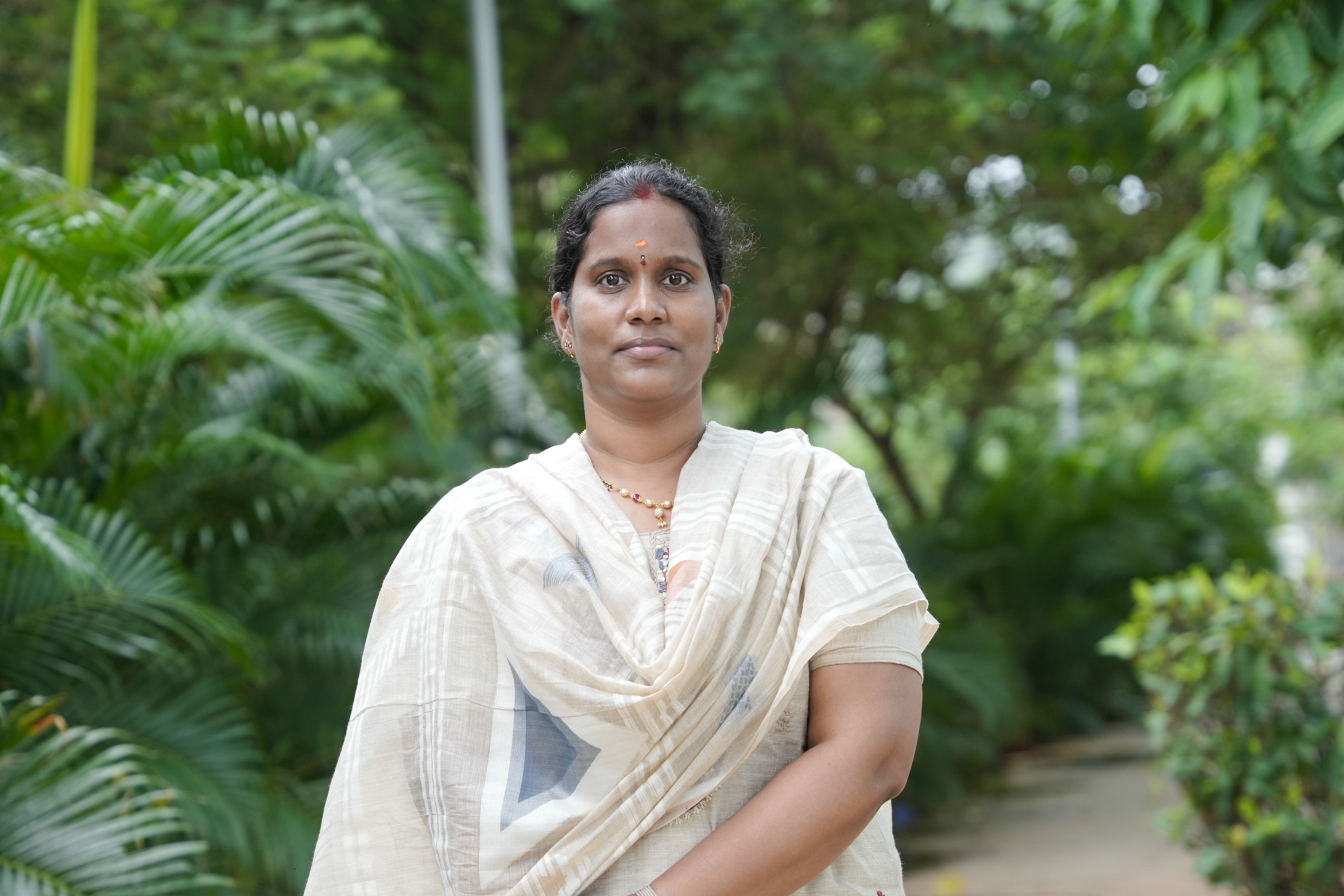
Faculty Ms Gudapati Maneesha
gudapati-maneesha

Ms Gudapati Maneesha

Assistant Professor

Department of Computer Science and Engineering

Contact Details

maneesha.g@srmap.edu.in

Office Location

CV Raman Block, Level II, Room: CV 210, Cubicle No: 6

Social Links

Education

2026
Ph.D.
University of Hyderabad, Telangana
India
2016
M.Tech.
VR Siddhartha Engineering College, JNTU Kakinada, Andhra Pradesh
India
2012
B.Tech.
DVR and Dr HS MIC College of Tech., JNTU Kakinada, Andhra Pradesh
India

Personal Website

Experience

  • Oct 2020 - Oct 2021 - Assistant Professor, Dhanekula Institute of Engineering and Technology
  • Jan 2020 - Sep 2020 - Assistant Professor, SRK Institute of Technology
  • Nov 2016 - Oct 2018 - Assistant Professor, Andhra Loyola Institute of Engineering and Technology

Research Interest

  • My research interests are Machine Learning, Semi-supervised Learning, and Data Streams. I am currently working on data streams in a semi-supervised environment to perform label propagation for abundant unlabeled data while detecting outliers among them. Additionally, the challenges associated with data streams, such as concept drift and concept evolution, are handled efficiently.

Memberships

Publications

  • Radial Expansion Based Semi-supervised Learning for Quality Compact Clusters

    Gudapati M., Murari M., Swarupa Rani K.

    Conference paper, Lecture Notes in Computer Science, 2026, DOI Link

    View abstract ⏷

    Machine learning methods involve both supervised and unsupervised learning. On the other hand, semi-supervised and self-supervised learning also play a crucial role, with many applications increasingly relying on these paradigms. Real-world applications such as healthcare, marketing, and digital media generate massive data. However, labeling this data is often impractical due to resource constraints. Consequently, there is an increasing need for techniques that can efficiently utilize limited labeled data to facilitate the labeling of large amounts of unlabeled data. Semi-Supervised Clustering (SSC) addresses this challenge by using available labeled data to guide the clustering process. However, maintaining clustering quality and handling outliers remain significant challenges. To tackle these issues, we proposed Radial Expansion Compact Clusters (RECC), a novel framework based on the label-based clustering paradigm to form quality compact clusters while efficiently assigning labels to unlabeled data. RECC also incorporates an outlier detection mechanism to minimize the impact of misleading data on clustering process. Extensive experiments on real-world datasets demonstrate that the proposed RECC method outperforms the conventional methods in improving clustering quality.
  • Incremental Approach: A Workflow Model for Semi-Supervised Learning Environment

    Gudapati M., Borah A., K. S.R.

    Article, Engineering Applications of Artificial Intelligence, 2025, DOI Link

    View abstract ⏷

    Semi-supervised learning plays an important role by combining both labeled and unlabeled data, bridging the gap between supervised and unsupervised learning. In today's fast-changing data streams, an efficient classifier is essential to adapt to evolving patterns. It is also important to address challenges like concept drift and concept evolution to maintain consistent model performance. However, handling unlabeled data in semi-supervised data streams can be challenging, as it requires significant resources and can be costly. This paper introduces an Incremental Workflow Model (IWM) that effectively handles the underlying issues of the data stream in a semi-supervised environment while using minimal labeled information. The proposed model is designed to be highly adaptable, ensuring it can handle the concept drift and concept evolution challenges. One-Class Classifier (OC_Classifier) with a proposed confidence score is used to identify the novel data and to predict known data in the stream. Further, MicroClusters are employed to reduce the memory overhead in the Ensemble Model. Experiments are performed on benchmark datasets, and results are analyzed to demonstrate the effectiveness of the proposed workflow model.
  • Incremental Classifier in the Semi Supervised Learning Environment

    Gudapati M., Swarupa Rani K.

    Conference paper, Lecture Notes in Computer Science (including subseries Lecture Notes in Artificial Intelligence and Lecture Notes in Bioinformatics), 2023, DOI Link

    View abstract ⏷

    Due to rapid growth in information technologies, millions of data are being generated at every time span. Data storage and processing are more expensive in terms of memory, resources, and time. The traditional machine learning classifier performs well when all the data is available along with the label information at the time of training, which may not be possible in every circumstances. Semi-supervised techniques overcome this limitation. With limited labeled data, semi-supervised learning makes use of both classification and clustering techniques for constructing efficient classifiers, and there is a demand to update the classifier periodically. Unlike traditional approaches, which use the entire data set for updating the classifier, our method updates in an incremental fashion. This paper proposes a framework for incremental classifiers in a semi-supervised environment. Experiments are conducted on benchmark datasets with the proposed approach and compared to the conventional method.

Patents

Projects

Scholars

Interests

  • Data Streams
  • Machine Learning
  • Semi-supervised Learning

Thought Leaderships

There are no Thought Leaderships associated with this faculty.

Top Achievements

Research Area

No research areas found for this faculty.

Computer Science and Engineering is a fast-evolving discipline and this is an exciting time to become a Computer Scientist!

Computer Science and Engineering is a fast-evolving discipline and this is an exciting time to become a Computer Scientist!

Recent Updates

No recent updates found.

Education
2012
B.Tech.
DVR and Dr HS MIC College of Tech., JNTU Kakinada
India
2016
M.Tech.
VR Siddhartha Engineering College, JNTU Kakinada
India
2026
Ph.D.
University of Hyderabad
India
Experience
  • Oct 2020 - Oct 2021 - Assistant Professor, Dhanekula Institute of Engineering and Technology
  • Jan 2020 - Sep 2020 - Assistant Professor, SRK Institute of Technology
  • Nov 2016 - Oct 2018 - Assistant Professor, Andhra Loyola Institute of Engineering and Technology
Research Interests
  • My research interests are Machine Learning, Semi-supervised Learning, and Data Streams. I am currently working on data streams in a semi-supervised environment to perform label propagation for abundant unlabeled data while detecting outliers among them. Additionally, the challenges associated with data streams, such as concept drift and concept evolution, are handled efficiently.
Awards & Fellowships
Memberships
Publications
  • Radial Expansion Based Semi-supervised Learning for Quality Compact Clusters

    Gudapati M., Murari M., Swarupa Rani K.

    Conference paper, Lecture Notes in Computer Science, 2026, DOI Link

    View abstract ⏷

    Machine learning methods involve both supervised and unsupervised learning. On the other hand, semi-supervised and self-supervised learning also play a crucial role, with many applications increasingly relying on these paradigms. Real-world applications such as healthcare, marketing, and digital media generate massive data. However, labeling this data is often impractical due to resource constraints. Consequently, there is an increasing need for techniques that can efficiently utilize limited labeled data to facilitate the labeling of large amounts of unlabeled data. Semi-Supervised Clustering (SSC) addresses this challenge by using available labeled data to guide the clustering process. However, maintaining clustering quality and handling outliers remain significant challenges. To tackle these issues, we proposed Radial Expansion Compact Clusters (RECC), a novel framework based on the label-based clustering paradigm to form quality compact clusters while efficiently assigning labels to unlabeled data. RECC also incorporates an outlier detection mechanism to minimize the impact of misleading data on clustering process. Extensive experiments on real-world datasets demonstrate that the proposed RECC method outperforms the conventional methods in improving clustering quality.
  • Incremental Approach: A Workflow Model for Semi-Supervised Learning Environment

    Gudapati M., Borah A., K. S.R.

    Article, Engineering Applications of Artificial Intelligence, 2025, DOI Link

    View abstract ⏷

    Semi-supervised learning plays an important role by combining both labeled and unlabeled data, bridging the gap between supervised and unsupervised learning. In today's fast-changing data streams, an efficient classifier is essential to adapt to evolving patterns. It is also important to address challenges like concept drift and concept evolution to maintain consistent model performance. However, handling unlabeled data in semi-supervised data streams can be challenging, as it requires significant resources and can be costly. This paper introduces an Incremental Workflow Model (IWM) that effectively handles the underlying issues of the data stream in a semi-supervised environment while using minimal labeled information. The proposed model is designed to be highly adaptable, ensuring it can handle the concept drift and concept evolution challenges. One-Class Classifier (OC_Classifier) with a proposed confidence score is used to identify the novel data and to predict known data in the stream. Further, MicroClusters are employed to reduce the memory overhead in the Ensemble Model. Experiments are performed on benchmark datasets, and results are analyzed to demonstrate the effectiveness of the proposed workflow model.
  • Incremental Classifier in the Semi Supervised Learning Environment

    Gudapati M., Swarupa Rani K.

    Conference paper, Lecture Notes in Computer Science (including subseries Lecture Notes in Artificial Intelligence and Lecture Notes in Bioinformatics), 2023, DOI Link

    View abstract ⏷

    Due to rapid growth in information technologies, millions of data are being generated at every time span. Data storage and processing are more expensive in terms of memory, resources, and time. The traditional machine learning classifier performs well when all the data is available along with the label information at the time of training, which may not be possible in every circumstances. Semi-supervised techniques overcome this limitation. With limited labeled data, semi-supervised learning makes use of both classification and clustering techniques for constructing efficient classifiers, and there is a demand to update the classifier periodically. Unlike traditional approaches, which use the entire data set for updating the classifier, our method updates in an incremental fashion. This paper proposes a framework for incremental classifiers in a semi-supervised environment. Experiments are conducted on benchmark datasets with the proposed approach and compared to the conventional method.
Contact Details

maneesha.g@srmap.edu.in

Scholars
Interests

  • Data Streams
  • Machine Learning
  • Semi-supervised Learning

Education
2012
B.Tech.
DVR and Dr HS MIC College of Tech., JNTU Kakinada
India
2016
M.Tech.
VR Siddhartha Engineering College, JNTU Kakinada
India
2026
Ph.D.
University of Hyderabad
India
Experience
  • Oct 2020 - Oct 2021 - Assistant Professor, Dhanekula Institute of Engineering and Technology
  • Jan 2020 - Sep 2020 - Assistant Professor, SRK Institute of Technology
  • Nov 2016 - Oct 2018 - Assistant Professor, Andhra Loyola Institute of Engineering and Technology
Research Interests
  • My research interests are Machine Learning, Semi-supervised Learning, and Data Streams. I am currently working on data streams in a semi-supervised environment to perform label propagation for abundant unlabeled data while detecting outliers among them. Additionally, the challenges associated with data streams, such as concept drift and concept evolution, are handled efficiently.
Awards & Fellowships
Memberships
Publications
  • Radial Expansion Based Semi-supervised Learning for Quality Compact Clusters

    Gudapati M., Murari M., Swarupa Rani K.

    Conference paper, Lecture Notes in Computer Science, 2026, DOI Link

    View abstract ⏷

    Machine learning methods involve both supervised and unsupervised learning. On the other hand, semi-supervised and self-supervised learning also play a crucial role, with many applications increasingly relying on these paradigms. Real-world applications such as healthcare, marketing, and digital media generate massive data. However, labeling this data is often impractical due to resource constraints. Consequently, there is an increasing need for techniques that can efficiently utilize limited labeled data to facilitate the labeling of large amounts of unlabeled data. Semi-Supervised Clustering (SSC) addresses this challenge by using available labeled data to guide the clustering process. However, maintaining clustering quality and handling outliers remain significant challenges. To tackle these issues, we proposed Radial Expansion Compact Clusters (RECC), a novel framework based on the label-based clustering paradigm to form quality compact clusters while efficiently assigning labels to unlabeled data. RECC also incorporates an outlier detection mechanism to minimize the impact of misleading data on clustering process. Extensive experiments on real-world datasets demonstrate that the proposed RECC method outperforms the conventional methods in improving clustering quality.
  • Incremental Approach: A Workflow Model for Semi-Supervised Learning Environment

    Gudapati M., Borah A., K. S.R.

    Article, Engineering Applications of Artificial Intelligence, 2025, DOI Link

    View abstract ⏷

    Semi-supervised learning plays an important role by combining both labeled and unlabeled data, bridging the gap between supervised and unsupervised learning. In today's fast-changing data streams, an efficient classifier is essential to adapt to evolving patterns. It is also important to address challenges like concept drift and concept evolution to maintain consistent model performance. However, handling unlabeled data in semi-supervised data streams can be challenging, as it requires significant resources and can be costly. This paper introduces an Incremental Workflow Model (IWM) that effectively handles the underlying issues of the data stream in a semi-supervised environment while using minimal labeled information. The proposed model is designed to be highly adaptable, ensuring it can handle the concept drift and concept evolution challenges. One-Class Classifier (OC_Classifier) with a proposed confidence score is used to identify the novel data and to predict known data in the stream. Further, MicroClusters are employed to reduce the memory overhead in the Ensemble Model. Experiments are performed on benchmark datasets, and results are analyzed to demonstrate the effectiveness of the proposed workflow model.
  • Incremental Classifier in the Semi Supervised Learning Environment

    Gudapati M., Swarupa Rani K.

    Conference paper, Lecture Notes in Computer Science (including subseries Lecture Notes in Artificial Intelligence and Lecture Notes in Bioinformatics), 2023, DOI Link

    View abstract ⏷

    Due to rapid growth in information technologies, millions of data are being generated at every time span. Data storage and processing are more expensive in terms of memory, resources, and time. The traditional machine learning classifier performs well when all the data is available along with the label information at the time of training, which may not be possible in every circumstances. Semi-supervised techniques overcome this limitation. With limited labeled data, semi-supervised learning makes use of both classification and clustering techniques for constructing efficient classifiers, and there is a demand to update the classifier periodically. Unlike traditional approaches, which use the entire data set for updating the classifier, our method updates in an incremental fashion. This paper proposes a framework for incremental classifiers in a semi-supervised environment. Experiments are conducted on benchmark datasets with the proposed approach and compared to the conventional method.
Contact Details

maneesha.g@srmap.edu.in

Scholars