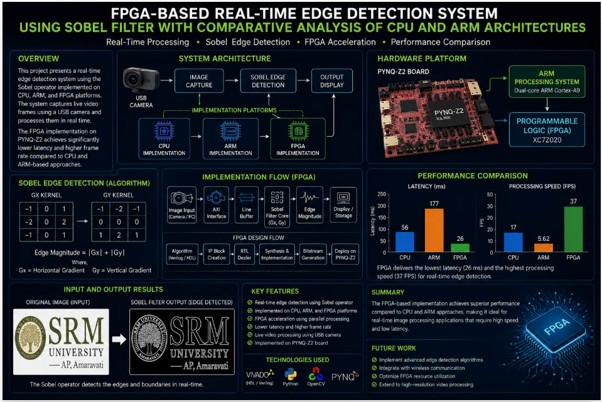


As technology advances, traditional processors struggle to keep up with the massive amounts of data required for real-time images analysis. To overcome this limitation, Dr Patta Supraja, Assistant Professor, Department of Electronics and Communication Engineering, along with Ms Mogili Sai Meghana and Ms Bollimuntha Satya Sri (B.Tech. students) has developed a high-speed computing framework designed to process live imagery instantly, which focuses on making image processing systems faster and more efficient using advanced hardware technologies. Their patent “Real-time Vision Processing System for Heterogeneous Computing Architecture Evaluation” has been filed and published in the Indian Patent Office Journal.
This system captures live images from a camera and detects the edges of objects in real time using a technique called Sobel edge detection. The project compares how fast this processing works on three different platforms: a normal computer processor (CPU), an embedded ARM processor, and an FPGA hardware accelerator. The main goal was to demonstrate that FPGA hardware can process images much faster and with lower latency than traditional methods. This type of technology can be useful in applications such as smart surveillance systems, robotics, autonomous vehicles, industrial inspection systems, and real-time intelligent devices.
Abstract
The patented work titled “Real-Time Vision Processing System for Heterogeneous Computing Architecture Evaluation” presents a real-time image processing framework developed using heterogeneous computing architectures integrating CPU processing, ARM embedded processing, and FPGA hardware acceleration. The proposed system performs real-time Sobel edge detection on live camera inputs using the PYNQ-Z2 FPGA development platform. The research focuses on evaluating and comparing the processing performance of different architectures by measuring latency and
frame processing speed (FPS). The FPGA implementation utilizes parallel hardware acceleration to achieve significantly improved real-time performance compared to conventional sequential processing methods. The system demonstrates reduced latency, higher processing speed, and efficient hardware-software co-design for real-time vision applications. This work contributes to the fields of FPGA-based embedded systems, hardware acceleration, computer vision, and real-time image processing.
Practical Implementation/Social Implications of the Research
The proposed system has significant practical applications in modern real-time intelligent systems where fast image processing is essential.
The framework can be applied in:
• Smart surveillance and security systems
• Robotics and automation
• Autonomous vehicles
• Industrial defect detection and quality inspection
• Embedded vision systems
• AI-based edge computing applications
By reducing processing latency and improving frame processing speed through FPGA hardware acceleration, the system enables faster and more efficient real-time decision-making.
The research also highlights the importance of hardware-software co-design in developing energy-efficient and high-performance embedded systems for future intelligent technologies.
Future Plans
The future scope of this work includes extending the system toward advanced real-time computer vision and AI-based embedded applications.
Future developments may involve:
• Integration of deep learning-based vision algorithms
• Real-time object detection and tracking
• Optimization for low-power embedded hardware
• High-resolution image and video processing
• Advanced FPGA acceleration techniques for AI applications
The research can further contribute to the development of intelligent embedded systems for smart automation, healthcare, autonomous systems, and edge AI technologies.