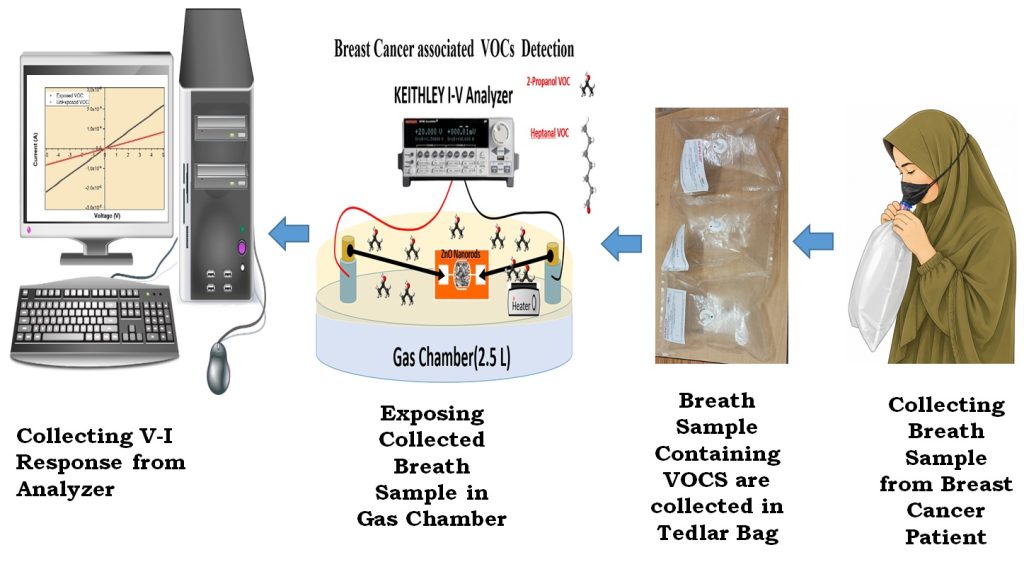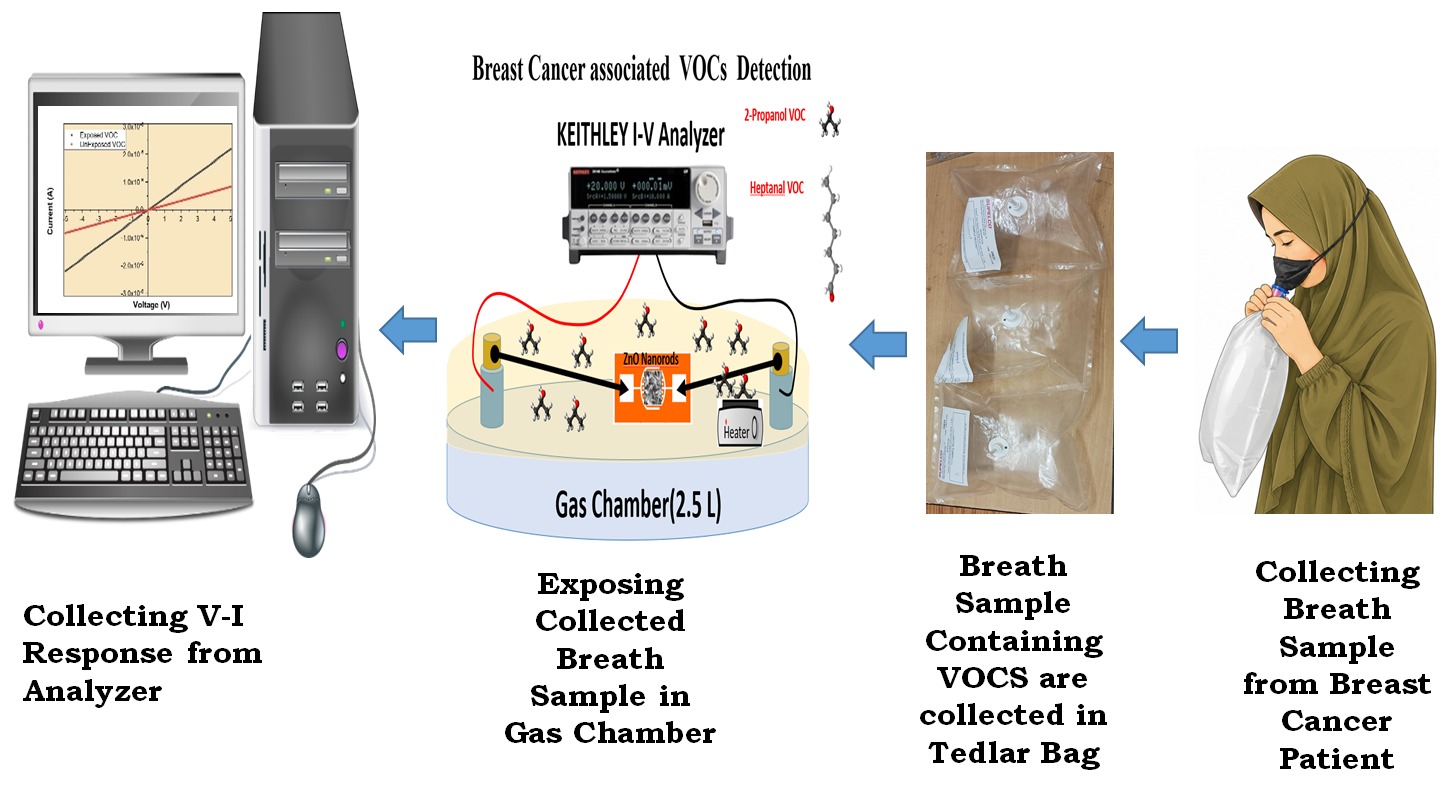

What if we could identify breast cancer in patients by examining their breath sample? Dr Anirudh Bahadur Yadav, Associate Professor, Department of Electronics and Communication Engineering, is developing a sensor that works by analysing a patient’s breath sample in a simple, painless procedure, without laboratory tests or tissue biopsies.
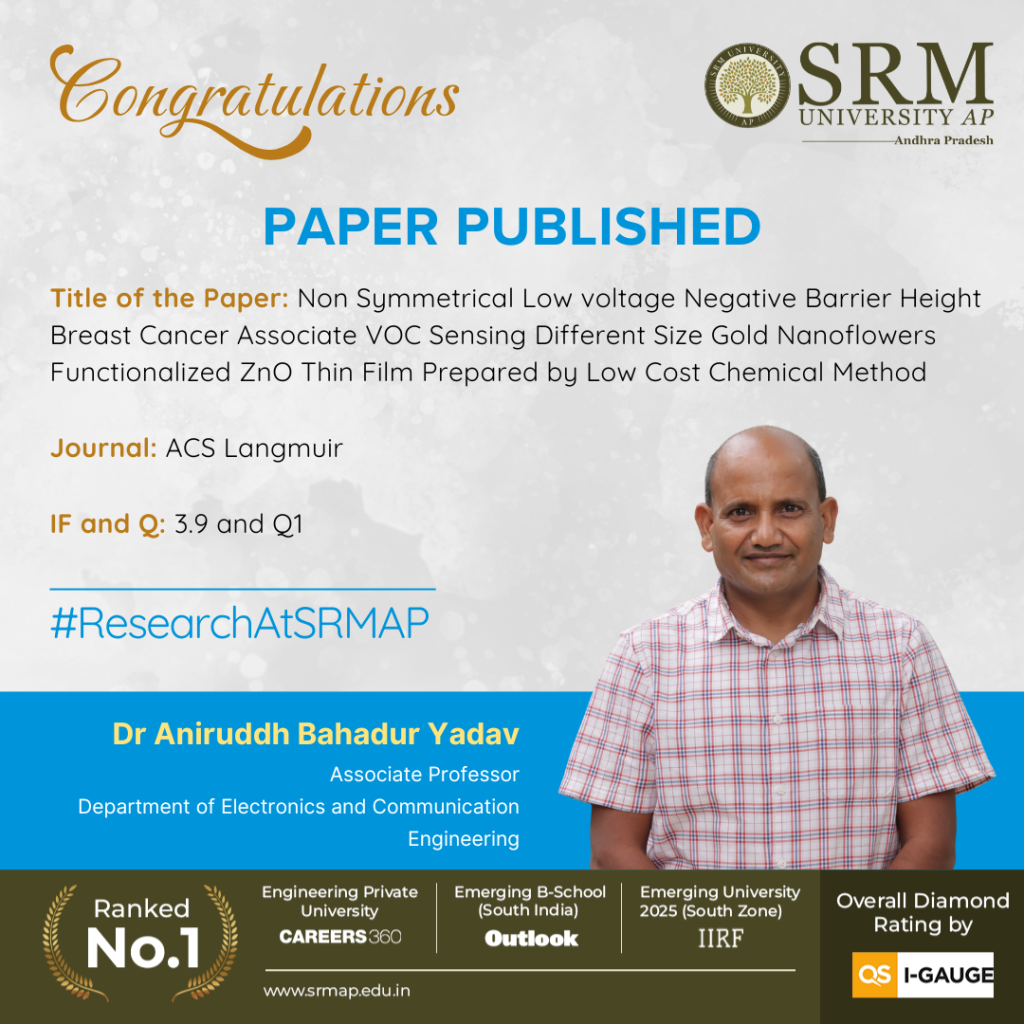
In his paper “Non Symmetrical Low voltage Negative Barrier Height Breast Cancer Associate VOC Sensing Different Size Gold Nanoflowers Functionalized ZnO Thin Film Prepared by Low Cost Chemical Method” published in the journal ACS Langmuir, Dr Yadav states that the sensor can help in the early screening of the disease by identifying specific VOC patterns associated with breast cancer. This approach is fast, safe, cost-effective, and convenient for patients. Early detection greatly improves the chances of successful treatment and increases survival rates.
Abstract
This research aims to develop a sensor device for the early detection of breast cancer by identifying volatile organic compounds (VOCs) present in the breath of patients. The sensor is based on ZnO nanostructures modified with noble metals to improve its response, sensitivity, and selectivity toward breast cancer-related VOCs. Different material characterisation techniques will be used to understand and optimise the sensing properties of the developed materials. The sensor will be tested under various humidity and temperature conditions to ensure reliable performance and long-term stability over several months. In addition, machine learning techniques will be used to analyse the VOC data and improve the accuracy of detection. The overall goal is to create a simple, non-invasive, fast, and cost-effective screening tool that can help in the early diagnosis of breast cancer and support timely treatment.
Practical implementation / Social implications of your Research
Potential for the early detection of breast cancer in women through a non-invasive approach that avoids the pain, discomfort, and risks associated with surgery, while reducing patient anxiety and improving screening compliance. Such a method can also reduce healthcare costs and resource utilisation compared with invasive diagnostic procedures, enabling faster, more accessible screening for large populations.
Future Research Plans
Future research will focus on designing and developing a portable sensor device for the non-invasive diagnosis of breast cancer using exhaled breath samples from patients. The aim is to detect volatile organic compounds (VOCs) associated with breast cancer, which serve as potential biomarkers for early disease detection. Particular emphasis will be placed on achieving high sensitivity, selectivity, and long-term stability under varying humidity conditions while maintaining room-temperature operation. Furthermore, machine learning algorithms will be integrated with the sensing platform to analyse VOC patterns and accurately distinguish malignant breast tissues from normal tissues. This approach has the potential to provide a rapid, cost-effective, and patient-friendly tool for the early screening and diagnosis of breast cancer.