


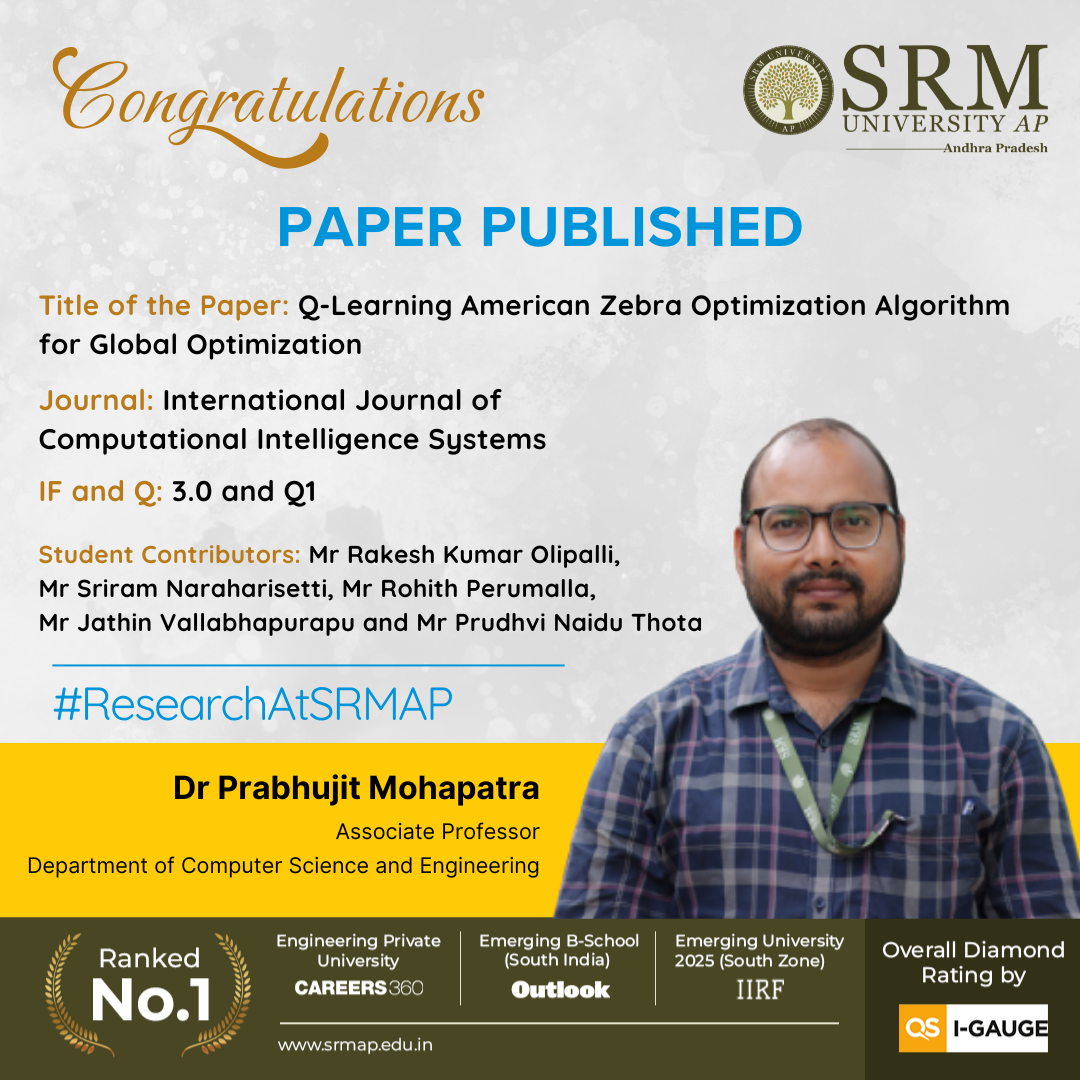
 Dr Prabhujit Mohapatra, Associate Professor, Department of Computer Science and Engineering, along with B.Tech students Mr Rakesh Kumar Olipalli, Mr Sriram Naraharisetti, Mr Rohith Perumalla, Mr Jathin Vallabhapurapu, and Mr Prudhvi Naidu Thota, has published a research paper titled “Q-Learning American Zebra Optimization Algorithm for Global Optimization” in the Q1-ranked International Journal of Computational Intelligence Systems (Impact Factor: 3.0).
The research addresses complex real-world design and decision-making problems that are often difficult to solve using exact computational methods. To overcome these challenges, the team developed an advanced optimisation approach by integrating a zebra-inspired metaheuristic algorithm with Q-learning.
The proposed model enables each virtual “zebra” to learn from previous search experiences and identify movement patterns that lead to better outcomes. By continuously adapting and avoiding less effective solution spaces, the collective system improves its ability to locate high-quality solutions efficiently.
This work demonstrates the potential of combining nature-inspired computing with reinforcement learning to solve challenging global optimisation problems across engineering and practical decision-making applications.
Brief Abstract :
This document summarises the research work on the Q-Learning Assisted American Zebra Optimization Algorithm (QLAZOA). QLAZOA is a learning-augmented variant of the American Zebra Optimization Algorithm (AZOA) for complex numerical optimisation problems. By embedding a Q-learning-based adaptive decision mechanism, each zebra (agent) learns from previous actions and selects movement strategies based on reward feedback to achieve a better balance between exploration and exploitation.
Practical Implementation / Social Implications
The proposed QLAZOA framework has direct relevance for constrained engineering design and other complex optimisation scenarios. It has been evaluated on standard CEC benchmark suites as well as engineering case studies, indicating its ability to handle non-linear, multi-dimensional search spaces while satisfying design constraints. Improved optimisation performance can translate into more efficient, robust and cost-effective designs in domains such as mechanical components, energy systems, communication networks and data-driven applications.
Collaborations
This research is an outcome of the collaboration between SRM University, Andhra Pradesh and Amrita University, Bangalore. From SRM university, the author team includes Rakesh Kumar Olipalli, Sriram Naraharisetti, Rohith Perumalla, Jathin Vallabhapurapu, Prudhvi Naidu Thota, and corresponding author Prabhujit Mohapatra. From Amrita University, the sole author is Dr. Sarada Mohapatra who works as an Assistant Professor at Amrita University.
Future Research Plans
Future research directions include applying QLAZOA to additional real-world domains such as renewable energy systems, smart grids and complex scheduling problems; incorporating complex network analysis to study agent interactions and convergence behaviour; and developing hybrid learning strategies that further enhance robustness on highly complex optimisation landscapes. Another important direction is exploring scalable and parallel implementations of QLAZOA for large-scale industrial applications.