

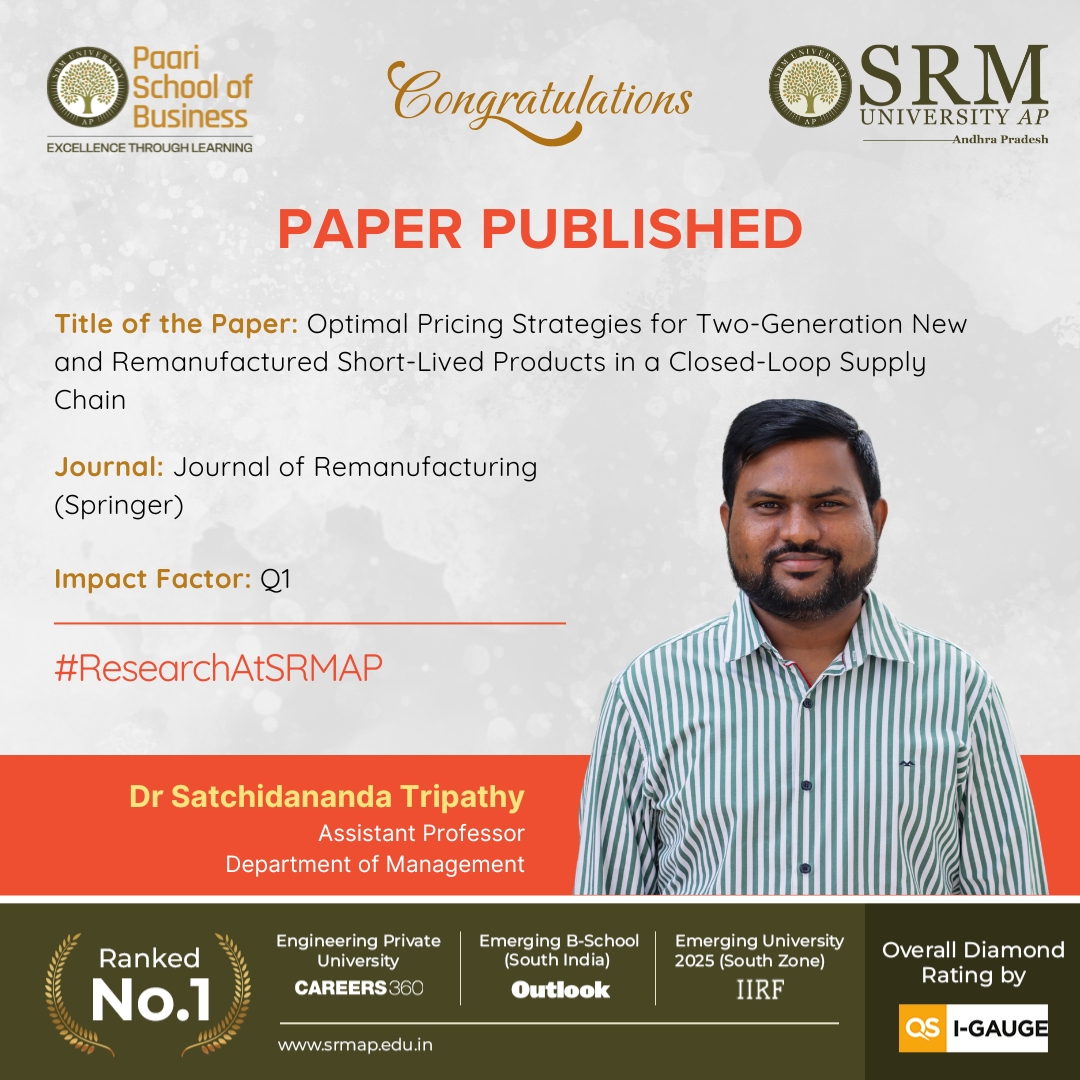
 Dr Satchidananda Tripathy, Assistant Professor in the Department of Management, Paari School of Business has published a research paper titled “Optimal Pricing Strategies for Two-Generation New and Remanufactured Short-Lived Products in a Closed-Loop Supply Chain” in the Q1 journal Journal of Remanufacturing (Springer).
The research addresses a growing challenge in today’s technology-driven world: electronic products such as smartphones and laptops become obsolete rapidly, even while they remain fully functional, leading to a significant increase in electronic waste. The study develops an advanced optimisation framework to help manufacturers determine optimal pricing for both new and remanufactured products when multiple product generations coexist in the market.
By modelling a closed-loop supply chain involving manufacturers, retailers, and collectors, the research analyses both coordinated and uncoordinated decision-making approaches while accounting for time-dependent and price-sensitive consumer demand. The findings demonstrate that effective pricing and remanufacturing strategies can reduce consumer costs, improve business profitability, and promote sustainable resource use by encouraging product reuse and recycling. The study offers valuable insights for businesses seeking to balance economic performance with environmental responsibility and supports the transition towards a circular economy.
Practical Implementation :
This research supports industries manufacturing short-lived electronic products by providing scientifically validated pricing strategies for new and remanufactured products. The findings help organisations:
- Increase profitability through optimised pricing decisions.
- Encourage remanufacturing and reuse of electronic products.
- Reduce electronic waste and conserve valuable resources.
- Support Extended Producer Responsibility (EPR) and circular economy initiatives.
- Offer consumers affordable, high-quality remanufactured products while reducing environmental impacts.
The study contributes directly to sustainable manufacturing and responsible consumption by promoting resource efficiency and reducing carbon emissions.
Future Research Plans
Future research will focus on developing more realistic closed-loop supply chain models by incorporating demand uncertainty, stochastic product returns, quality variations in returned products, and remanufacturing capacity constraints. Additional work will explore multi-objective optimisation that balances profitability, customer satisfaction, and environmental sustainability, while integrating emerging technologies such as artificial intelligence and data-driven decision-making into circular supply chains and E-waste management.