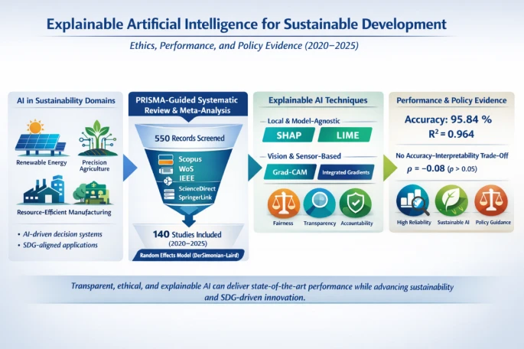
Artificial Intelligence is increasingly being used to address environmental and sustainability challenges, from managing renewable energy systems to improving farming practices and conserving water resources. However, many AI systems make decisions in ways that are difficult for people to understand.
Mr Kashif Mazhar, Assistant Professor, Department of Computer Science and Engineering, demonstrates a meta-analysis combining findings from 140 research studies to determine whether AI can be made more transparent and trustworthy. His paper titled “Ethical explainable artificial intelligence for green innovation: A systematic review and meta-analysis of transparency, fairness, and accountability in sustainable technologies” has been published in the journal Artificial Intelligence Review, with an impact factor of 13.9. The results show that explainable AI techniques help users understand how AI reaches its decisions without substantially reducing accuracy. By making AI systems easier to interpret, organisations, policymakers, and communities can make more informed decisions and confidently adopt AI solutions that support sustainable development.
Abstract
This research presents a comprehensive meta-analysis and systematic review of 140 empirical studies published between 2020 and 2025 that examined the application of Explainable Artificial Intelligence (XAI) in sustainability-focused domains. Using a PRISMA-based methodology, the study quantitatively and qualitatively synthesised evidence on the effectiveness of explainability techniques in enhancing transparency, fairness, accountability, and trust in AI systems. The findings demonstrate a positive relationship between explainability and responsible AI adoption across sectors such as smart energy, precision agriculture, water management, and sustainable manufacturing. Based on the synthesised evidence, the study proposes an Ethical Explainable AI framework to guide future sustainable and trustworthy AI development.
Practical Implementation/Social Implications of the Research
The meta-analysis highlights several practical applications of Ethical Explainable AI:
- Smart energy systems for transparent renewable energy forecasting and optimisation.
- Precision agriculture for explainable crop monitoring, yield prediction, and resource management.
- Water management systems for interpretable monitoring, conservation, and quality assessment.
- Sustainable manufacturing through accountable and transparent operational decision-making.
- Public policy and governance frameworks that encourage responsible and trustworthy AI deployment.
The synthesised evidence demonstrates that explainable AI can strengthen public trust, improve accountability, and reduce risks associated with opaque decision-making systems. The research supports the achievement of several United Nations Sustainable Development Goals (SDGs), including SDG 7 (Affordable and Clean Energy), SDG 11 (Sustainable Cities and Communities), SDG 12 (Responsible Consumption and Production), and SDG 13 (Climate Action). By promoting transparency and fairness, the study contributes to the development of socially responsible and environmentally sustainable AI technologies.
Collaborations
This research was conducted through an international collaboration involving scholars from:
- SRM University, Amaravati, India
- Integral University, Lucknow, India
- Abdullah Al Salem University, Kuwait
- Sharda University, India
- Al-Ahliyya Amman University, Jordan
Future Research Plans
Future research will focus on:
- Investigating hallucinations in Large Language Models (LLMs) used in sustainability applications and developing Explainable AI (XAI) frameworks to improve transparency, reliability, and trustworthiness.
- Designing explainable and fact-verification mechanisms to detect, interpret, and mitigate hallucinated outputs in LLMs for responsible decision-making in climate action, renewable energy, agriculture, and environmental management.
- Exploring Explainable AI solutions aligned with emerging global AI regulations and sustainability goals.
Read the full article – https://doi.org/10.1007/s10462-026-11566-x