

The Standard Model of particle physics has successfully explained many of nature’s fundamental particles and forces, yet some of the Universe’s biggest mysteries remain unsolved. Why is the Higgs boson much lighter than expected? What is dark matter made of? And why does the Universe contain more matter than antimatter?
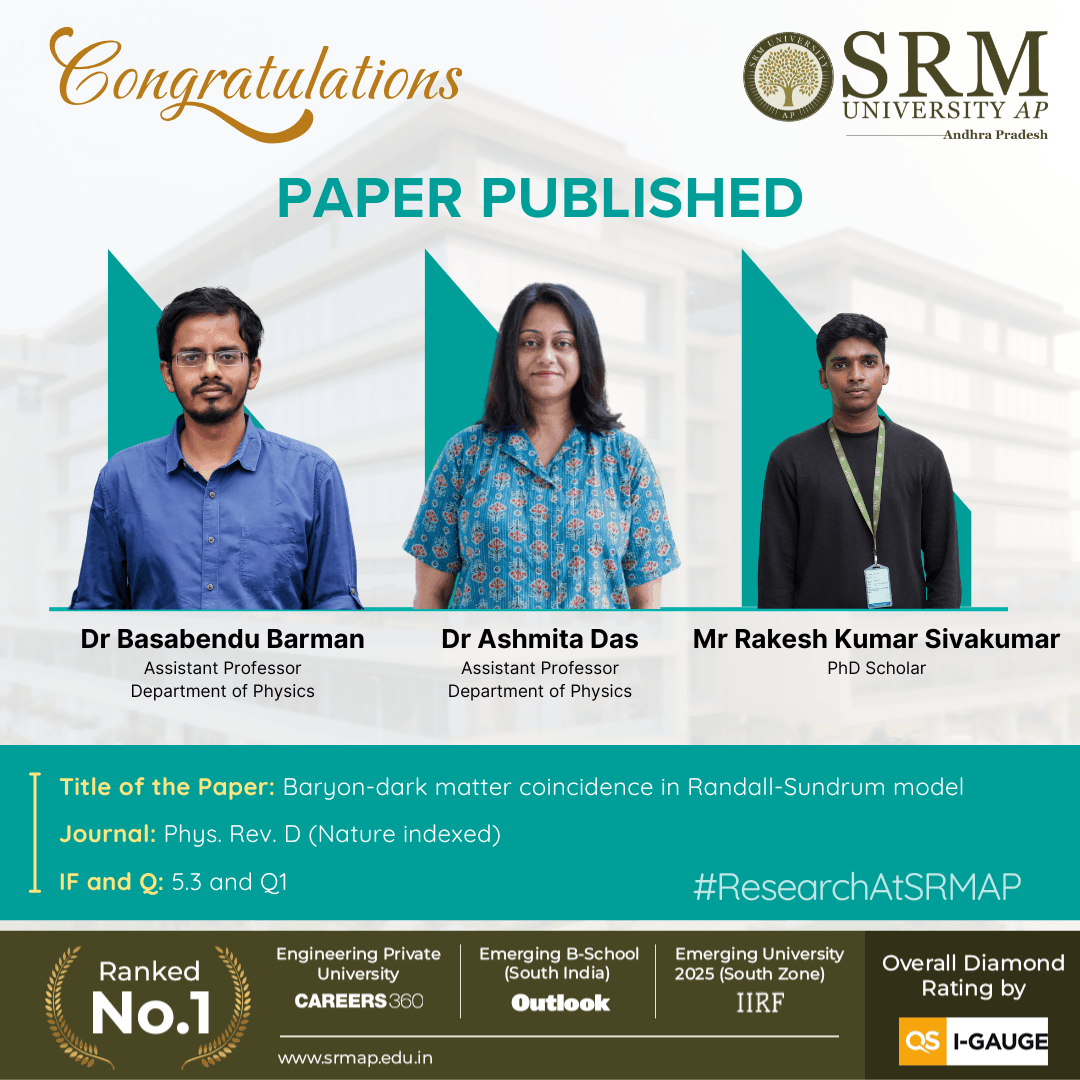
Dr Basabendu Barman and Dr Ashmita Das, Assistant Professors, Department of Physics and Mr Rakesh Kumar Sivakumar, Ph.D. scholar, have published a paper titled “Baryon-dark matter coincidence in Randall-Sundrum Model” in the Nature-indexed journal Phys. Rev. D, with an impact factor of 5.3. In the article, they have explored an innovative theory suggesting that our Universe may have additional hidden dimensions beyond the familiar three dimensions of space and one of time. Using the Randall–Sundrum model, the researchers demonstrate that these extra dimensions could provide a single, gravity-based framework to explain all three puzzles—offering a unified solution to the hierarchy problem, the nature of dark matter, and the origin of the matter–antimatter imbalance.
Abstract
Within the framework of the extra-dimensional Randall–Sundrum set-up, we investigate the freeze-in production of Standard Model (SM) gauge-singlet scalar, fermionic, and massive vector dark matter (DM). Assuming that both the DM and SM fields reside on the IR brane and interact solely through the graviton and radion portal, we demonstrate that the Planck-observed DM relic abundance can be achieved across a wide range of reheating temperatures, all while naturally addressing the hierarchy problem, satisfying constraints from collider and early Universe cosmology. We further show that the same set-up can accommodate TeV-scale leptogenesis capable of generating the observed baryon asymmetry of the Universe. Interestingly, we find that current graviton searches at the Large Hadron Collider (LHC) already impose strong constraints on the reheating temperature in this scenario, providing a complementarity between cosmological and collider probes.
Explanation in Layperson’s Terms
Imagine that our Universe has more than the familiar three dimensions of space and one dimension of time. Such a picture offers a compelling explanation for why the only fundamental scalar particle observed in nature—the Higgs boson—has a mass of about 125 GeV. This provides a solution to the long-standing hierarchy problem, a puzzle that remains unexplained within the Standard Model of particle physics. At the same time, two other major mysteries of the Universe remain unresolved: the particle nature of dark matter and the origin of the observed excess of matter over antimatter. Remarkably, theories with extra dimensions offer a common framework to address both problems through gravity, the one force that naturally connects the visible and invisible sectors of the Universe.
In this work, we show that a particular extra-dimensional framework—the Randall–Sundrum model—can simultaneously explain dark matter, generate the observed matter–antimatter asymmetry, and resolve the hierarchy problem, all through purely gravitational interactions.
Future Research Plans
- A closer look into early universe dynamics by performing more involved simulations.
- Connection between particle physics models and early Universe cosmology.
- Complementary searches from different experiments in unravelling new physics beyond the Standard Model.
- Searching for new physics at the energy and intensity frontiers.
Read the Article