

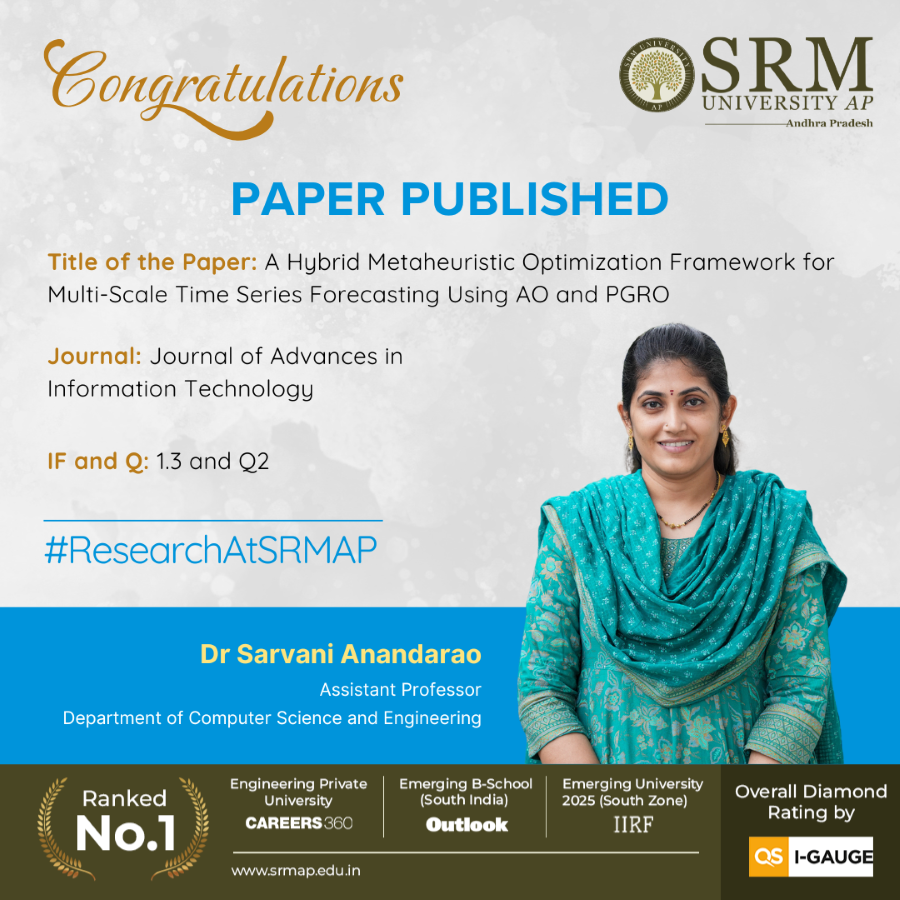
 Dr Sarvani Anandarao, Assistant Professor, Department of Computer Science and Engineering, SRM University–AP, Amaravati, has published a research paper titled “A Hybrid Metaheuristic Optimization Framework for Multi-Scale Time Series Forecasting Using AO and PGRO” in the Journal of Advances in Information Technology, Impact Factor: 1.3, Q2.
The research addresses one of the biggest challenges in forecasting, making accurate predictions in rapidly changing environments such as financial markets. Conventional forecasting models often rely on a single type of data or fail to adapt when conditions change unexpectedly. To overcome these limitations, Dr Sarvani’s work introduces a hybrid metaheuristic optimisation framework that enables artificial intelligence to learn from multiple sources of information simultaneously, including historical data, news, social media, and other relevant inputs.
The proposed optimisation technique helps AI models identify better solutions more efficiently while avoiding poor prediction paths. As a result, the framework delivers more accurate and reliable forecasts, even under dynamic and uncertain conditions.
Beyond financial forecasting, the methodology has broad real-world applications in healthcare, weather prediction, traffic management, energy demand forecasting, and smart city systems, where accurate time-series predictions are critical for informed decision-making.
Research Abstract
Time-series forecasting is fundamental to decision-making in finance, healthcare, economics, and intelligent systems. However, achieving high prediction accuracy across heterogeneous datasets and varying forecasting horizons remains a major challenge. This research proposes a novel hybrid forecasting framework that combines the global search capability of the Aquila Optimizer (AO) with the local refinement capability of the Proposed Guided Remora Optimization (PGRO) algorithm to optimise deep learning forecasting models.
The framework integrates numerical, textual, social media, and visual data through multimodal feature extraction and incorporates incremental learning with memory replay to continuously adapt to changing data while preventing catastrophic forgetting. Experiments conducted on six benchmark datasets demonstrate that the proposed framework consistently outperforms conventional statistical models, deep learning methods, and transformer-based forecasting approaches, providing accurate, robust, and generalisable predictions across multiple domains.
Practical Implementation / Social Impact
The proposed framework has applications in many real-world domains, including:
- Financial market prediction and investment decision support.
- Banking risk assessment and fraud detection.
- Economic forecasting for governments and policymakers.
- Healthcare monitoring and disease progression prediction.
- Energy demand forecasting for smart grids.
- Traffic flow prediction in intelligent transportation systems.
- Supply chain demand forecasting.
- Smart city analytics.
- Climate and weather prediction.
- Any application involving continuously changing time-series data.
By improving forecasting accuracy and adaptability, this research can help organizations make faster, more informed decisions while reducing uncertainty in dynamic environments.
Collaborations
This research was a collaborative effort among researchers from:
- Publicis Sapient, Minneapolis, USA
- Strategic Education Inc., Minneapolis, USA
- VIT- AP University, Amaravati, India
- SRM University-AP, Amaravati, India
The collaboration combined expertise in artificial intelligence, deep learning, optimisation algorithms, and financial time-series forecasting to develop a robust multimodal forecasting framework.
Future Research Plans
Future work will focus on:
- Extending the framework to real-time streaming data.
- Integrating additional optimisation algorithms for improved efficiency.
- Applying the model to healthcare, climate science, cybersecurity, and smart manufacturing.
- Developing lightweight versions suitable for edge and mobile AI devices.
- Incorporating explainable AI techniques to improve transparency and user trust.
- Exploring federated learning for privacy-preserving forecasting across distributed organisations.