

 What if we could use 3D printing to create materials that help repair damaged tissues, develop better medical implants, and build models of human organs for research?
The book Additive Manufacturing of Biomaterials and Their Behavior, published by Elsevier and co-edited by Dr Arunkumar Palaniappan, Associate Professor at the Department of Health Engineering, SRM University-AP, explores how advanced 3D printing and related manufacturing technologies are transforming healthcare. It explains how scientists and engineers can create materials designed to interact with the human body, from bone and cartilage scaffolds to innovative approaches for skin, heart, lung, and other tissue engineering applications.
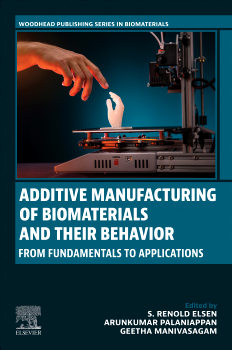
Additive Manufacturing of Biomaterials and Their Behavior: From Fundamentals to Applications, published by Elsevier, provides a comprehensive overview of how advanced manufacturing technologies can be used to design and fabricate biomaterials for healthcare and biomedical research. The book covers additive manufacturing techniques, biomaterial selection and properties, and applications in tissue engineering, medical implants, pharmaceutical delivery, and in vitro tissue and disease models. It also explores emerging developments in 4D printing and artificial intelligence for biomaterial design and manufacturing.
By connecting engineering principles with biological requirements and clinical applications, the book serves as a valuable resource for researchers, clinicians, engineers, and students working to advance biomedical technologies and next-generation healthcare solutions.
The book also looks at emerging technologies such as smart, shape-changing materials and artificial intelligence-assisted manufacturing. These advances could help researchers develop more personalized medical solutions, improve the design of implants, and create better models for studying human diseases and testing treatments.
By bringing together materials science, engineering, biology, and medicine, the book highlights the exciting possibilities of translating innovative manufacturing technologies into future healthcare solutions.
The book was published by Woodhead Publishing and edited by S Renold Elsen, Arunkumar Palaniappan, and Geetha Manivasagam