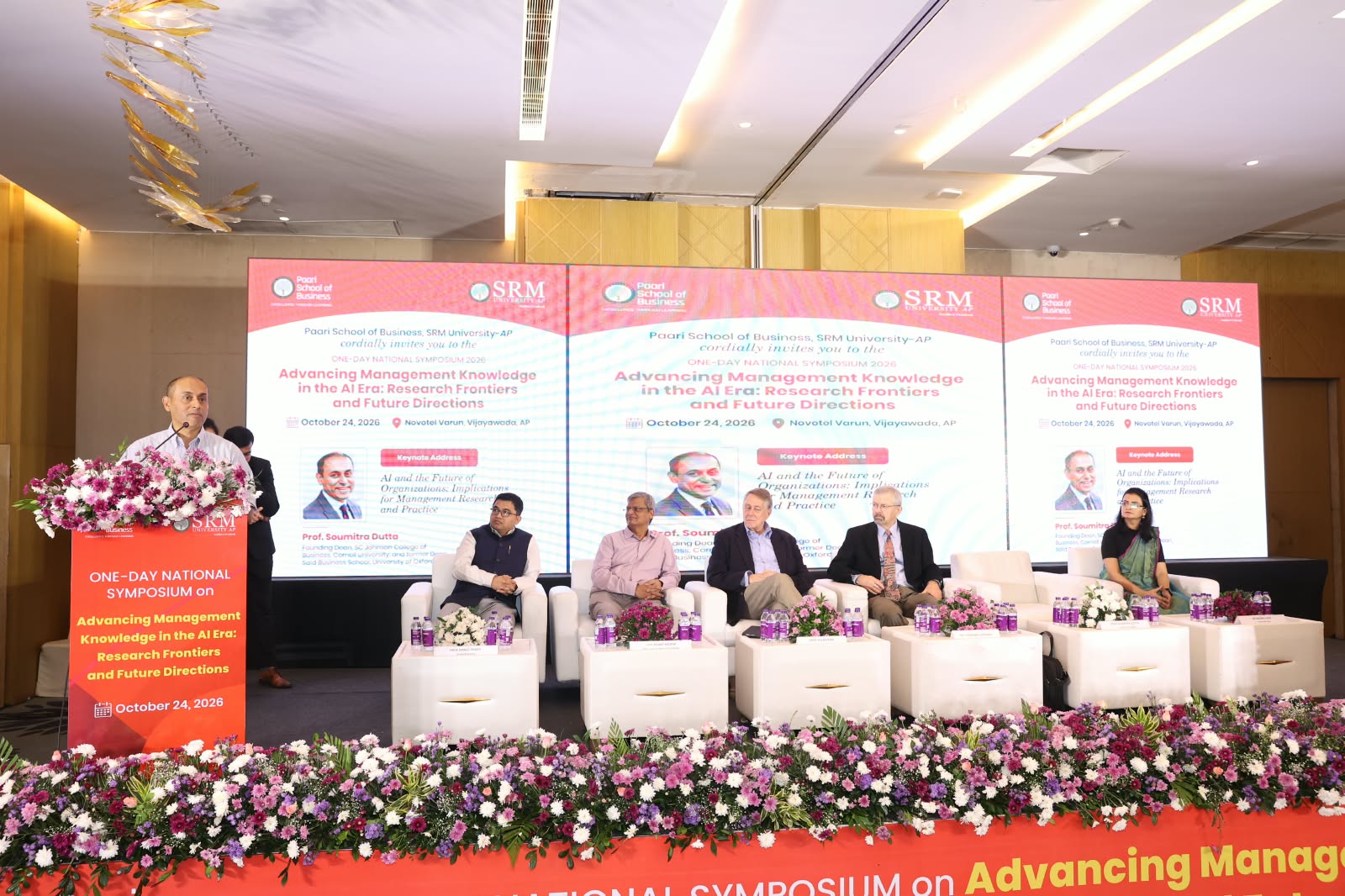
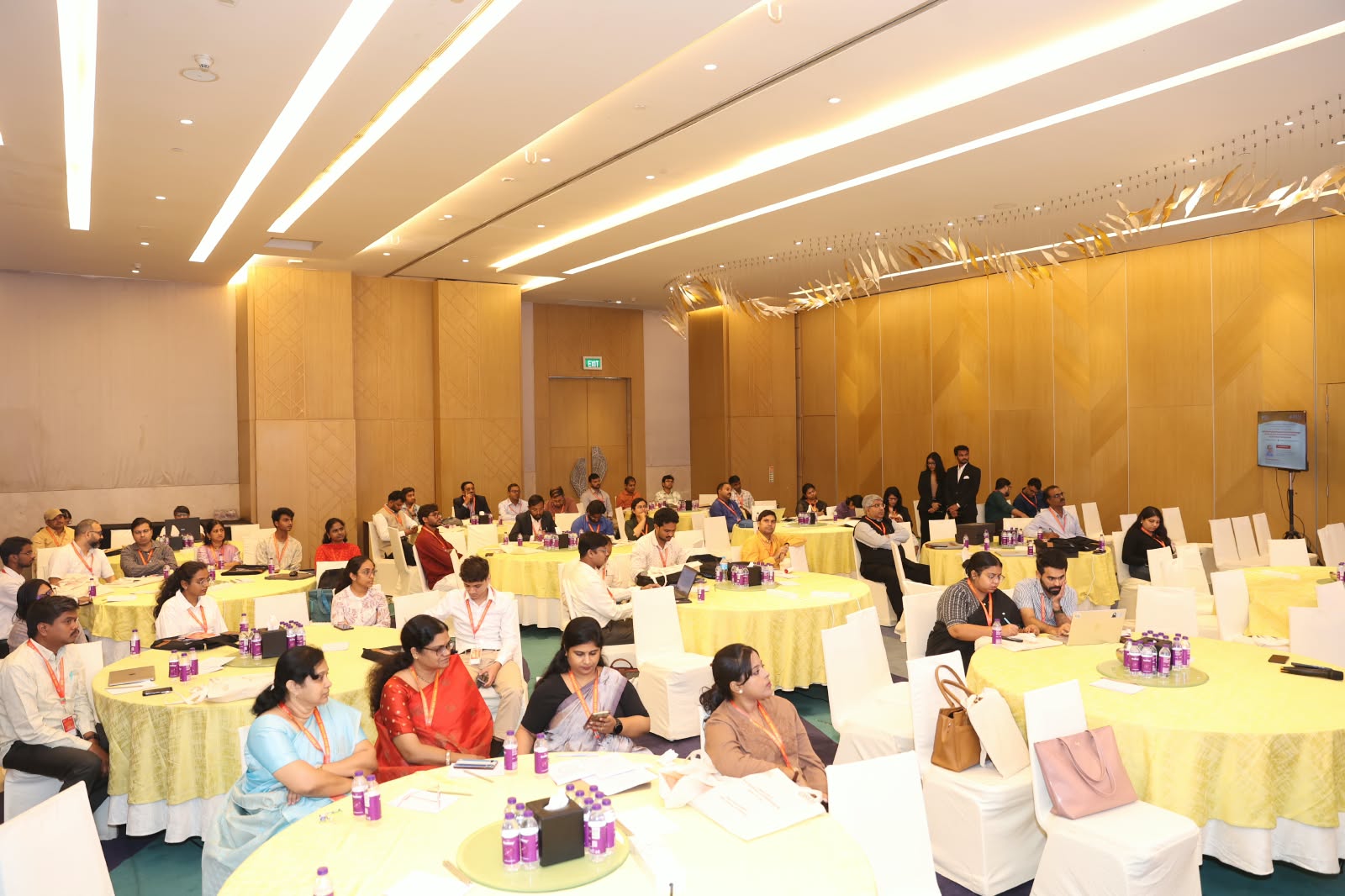
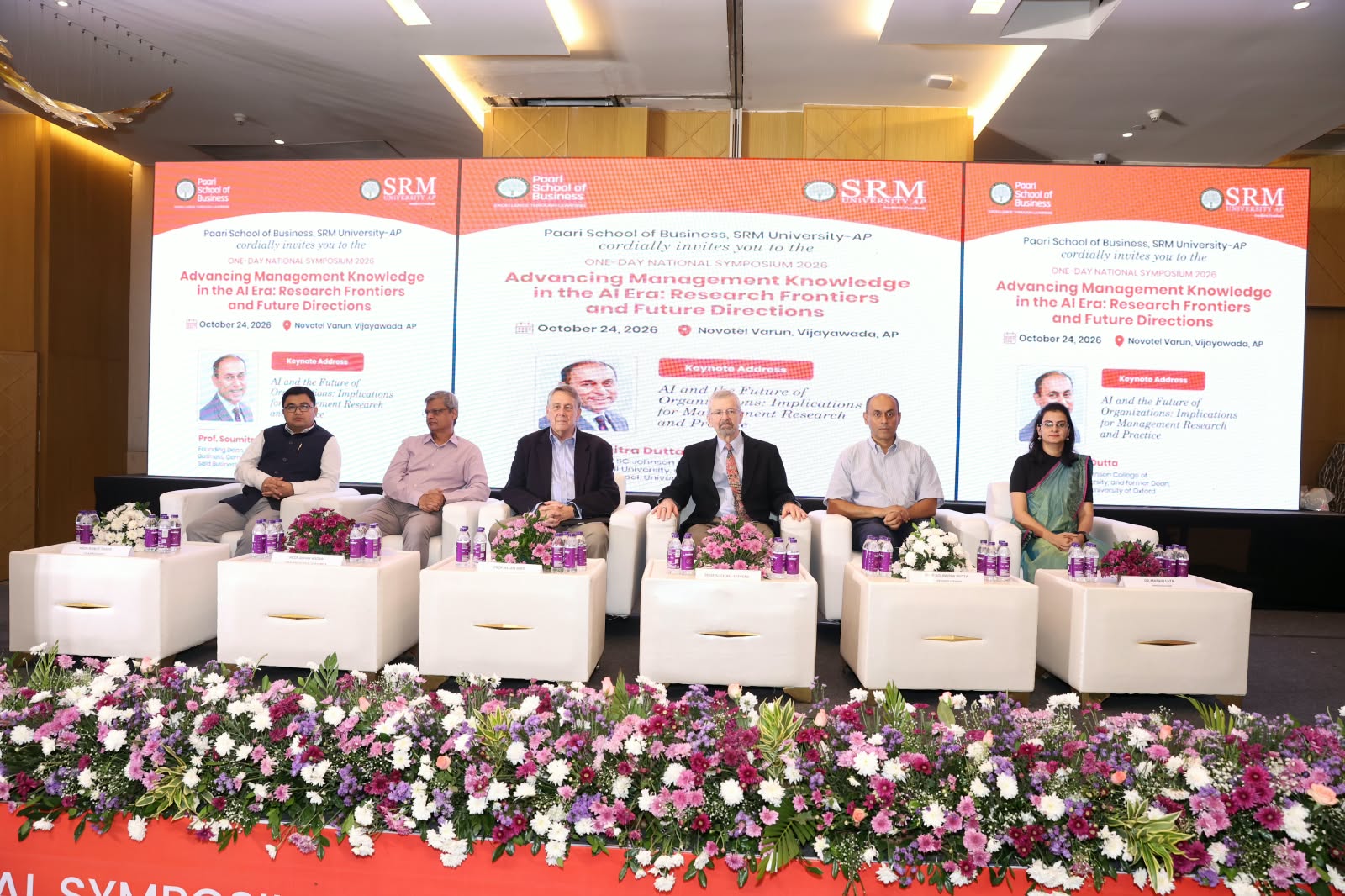
 Fostering a research-intensive environment that connects management thought with emerging technologies and global perspectives, Paari School of Business (PSB), SRM AP, hosted a Symposium on Advancing Management Knowledge in the AI Era: Research Frontiers and Future, themed Reimagining Management through AI on October 24,2026 . The symposium brought critical perspectives on the evolving relationship between artificial intelligence, economic models, and global organisational change, creating a platform to explore new research frontiers and rethink management practices in the rapidly transforming world of business.
Prof. Soumitra Dutta, Advisor, SRM Group, during his keynote address, examined the connection between engineering progress and modern digital ecosystems. He said, “As artificial intelligence advances at an exponential pace, universities must move beyond incremental change and embrace continuous learning, experimentation, and innovation.” Pointing to the concentration of computing infrastructure within a few wealthy economies, he stressed that developing nations like India need to strengthen technical capabilities and research networks to join global innovation efforts.
During a fireside chat on Human Capital, Leadership, and Organisational Transformation in the AI Era, Prof. Allan Bird, Goa Institute of Management and Prof. Michael Stevens, Weber State University, discussed the implications of AI for organisational strategy and decision-making. They categorised globalisation into three practical dimensions, namely communication ease, systemic interdependency, and operational complexity. They examined human volition and cognitive engagement, contrasting the “need for cognition” with “cognitive misers” who rely entirely on automated tools.
Emphasising that education should build the whole person, they spoke about teaching advanced AI interrogation skills across academic subjects. They cautioned against over-reliance on generative models in research, particularly in terms of academic integrity. They urged scholars to distinguish between automated generation and use of AI for research assistance, warning that uncritical adoption risks creating learned helplessness.
Prof. Ashay Kadam, Dean, PSB, explained how the business school is making the curriculum AI-integrated, embedding artificial intelligence directly into departmental workflows and using faculty development programmes to upskill the faculty on the use of AI tools in teaching and research. All of these, he mentioned, not only prepare students for the changing market needs but also take the business school further towards its goal of becoming AI native.
Highlighting the broader mission of the University, Prof. Ranjit Thapa, Dean-Research, SRM AP noted that adapting to intelligent environments is necessary for global research standing. He stated that academic work must extend past journal publications to bring direct societal value, adding that post-quantum financial systems must also update to withstand global computational shifts.
In the final session, Prof. Elizabeth L Rose, Pro-Vice Chancellor and Senior Professor at ICFAI Foundation for Higher Education, Hyderabad, said “AI can make research more efficient, but it must assist researchers rather than replace their judgement. Maintaining academic integrity and research credibility requires careful oversight, transparency, and clear disclosure of how AI tools are used. This symposium also provides a valuable platform for meaningful interaction among students, research scholars, early-career faculty, and experienced academics, fostering cross-generational dialogue and advancing management research in the AI era.”
The symposium will be followed by a five-day Early Career Researchers’ Publishing Boot Camp led by Prof. Allan Bird and Prof. Elizabeth L. Rose, offering specialised mentorship to help scholars prepare manuscripts for top-tier global academic publications.
The academic exchange brought together scholars, academic leaders, and researchers to discuss how rapid technological shifts affect higher education, financial systems, and human capital across emerging markets. By expanding international academic partnerships, building interdisciplinary research centres, and integrating intelligent technologies across management, humanities, and deep-tech fields, Paari School of Business at SRM University-AP is working towards solving practical challenges.