


 Coastal regions across the world are increasingly being reshaped by large-scale port and infrastructure projects, promoted as engines of economic growth under what is often called the blue economy. Yet for communities who have long depended on the sea for their livelihood, such development can bring displacement, loss of access, and disruption to ways of life built up over generations. These tensions raise fundamental questions about who has the right to use, manage, and care for coastal waters, and whose understanding of the sea, as an economic resource or as a shared inheritance, should shape its future.
One such case is unfolding around the Vizhinjam Seaport International Limited in Thiruvananthapuram, Kerala, where the growth of a major port has intersected with the lives of the Mukkuva (fishing) community, whose livelihood and identity remain closely tied to the coastal ecosystem.
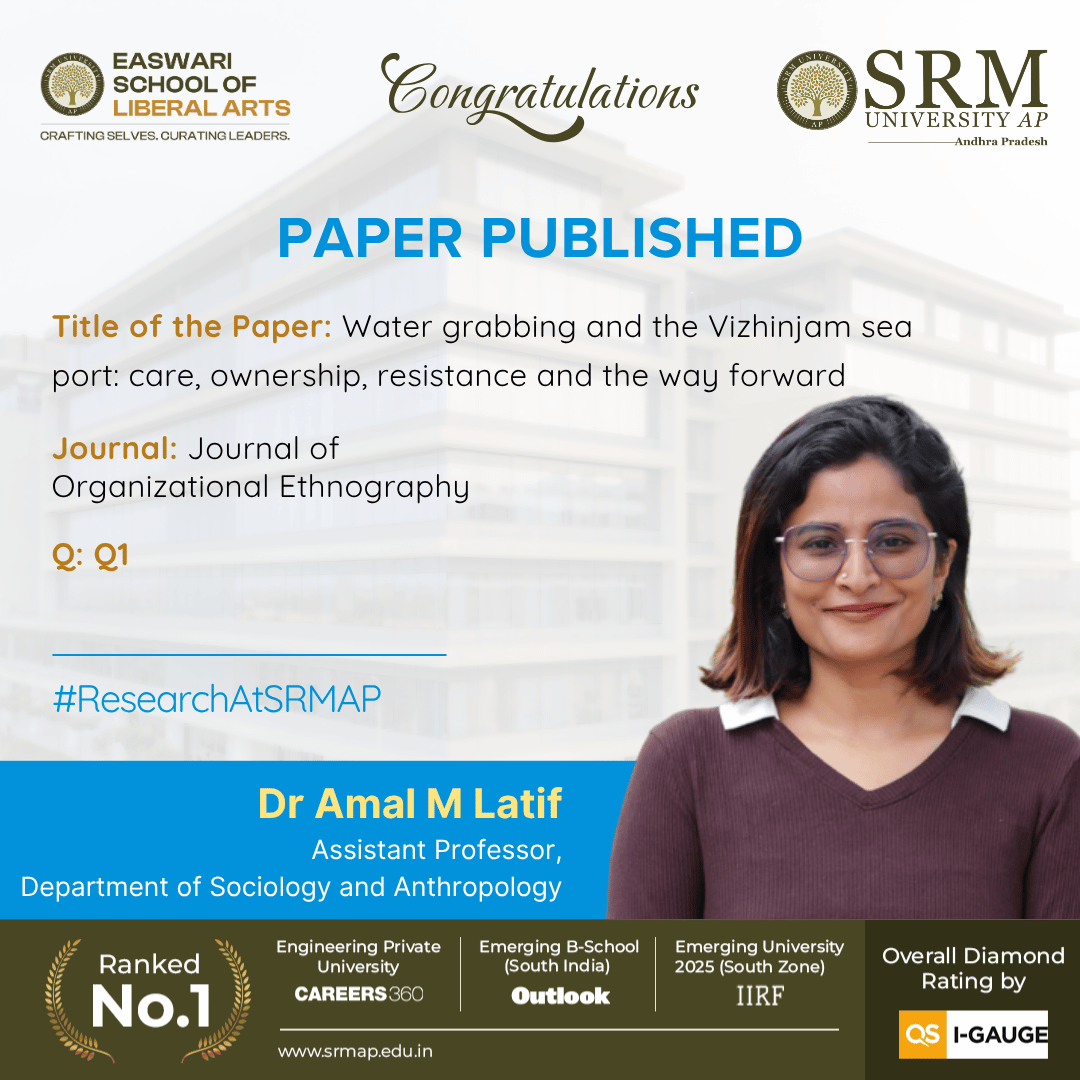
The research published by Dr Amal Latif, Assistant Professor in the Department of Sociology and Anthropology at SRM AP, in the Q1 journal of Journal of Organizational Ethnography, titled Water grabbing and the Vizhinjam sea port: care, ownership, resistance and the way forward, draws on ethnographic research to examine the socio-economic and environmental implications of this development for the Mukkuva community.
The study argues that the conflict is fundamentally a struggle over ownership, care, and rights to the sea. While the blue economy frames coastal waters as spaces of investment and infrastructural development, the Mukkuva community understands the sea as a commons sustained through intergenerational labour, care, and belonging. It further examines how port-led development produces dispossession and ecological uncertainty, and how the Church, as a civil society institution, enabled collective resistance and recognition.
Abstract
The study explores the socio-economic and environmental implications of the development of the Vizhinjam Seaport International Limited in Thiruvananthapuram, Kerala, particularly focussing on the marginalised Mukkuva (fishermen) community, who are largely dependent on the coastal ecosystem for their livelihood. Drawing on ethnographic research, it argues that the conflict is fundamentally a struggle over ownership, care and rights to the sea. While the blue economy frames coastal waters as spaces of investment and infrastructural development, the Mukkuva community understands the sea as a commons sustained through intergenerational labour, care and belonging. The study explores how port-led development produces dispossession and ecological uncertainty, while the Church, as a civil society institution, enabled collective resistance and recognition.
Social Impact and Practical Implications
This research carries important social implications for how coastal development is planned and governed. By foregrounding the perspective of the Mukkuva community, the study highlights the need to recognise traditional and community-based claims to coastal commons alongside commercial and infrastructural priorities. Its findings can inform more inclusive approaches to port-led development, ones that account for ecological uncertainty, the role of civil society institutions in community resistance, and the lived relationships of care and belonging that communities hold with the sea.
Read the full article here.