Traditional diagnostic procedures and manual inspection are frequently used in Automated Plant Disease Prediction, but they can be laborious and prone to human error. Dr Ashok Kumar Pradhan, Associate Professor, Department of Computer Science and Engineering, has developed a method that uses CNNs to automatically and precisely recognise images, increasing the efficacy and precision of plant disease diagnosis.
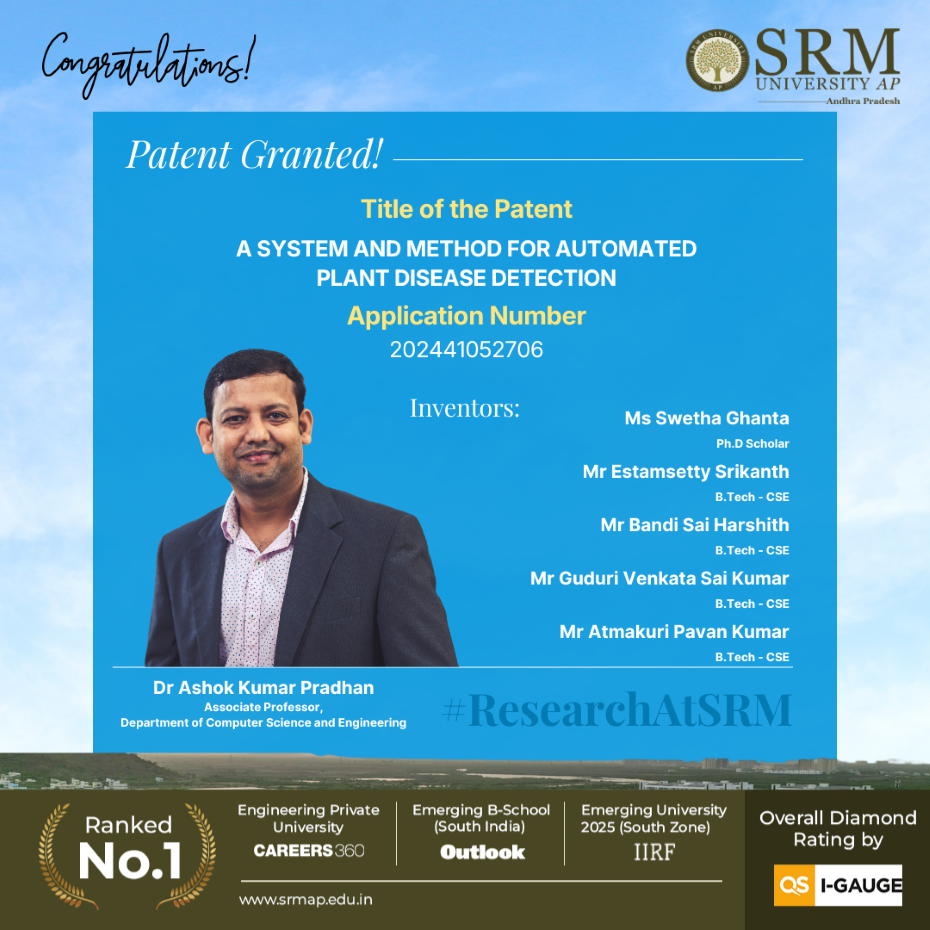
By providing farmers with access to up-to-date weather information, this invention helps them make decisions about crop management and disease prevention. Dr Pradhan and his team, Ms Swetha Ghanta (Ph.D. Scholar), Mr Estamsetty Srikanth, Mr Bandi Sai Harshith, Mr Guduri Venkata Sai Kumar and Mr Atmakuri Pavan Kumar (B.Tech Students) have patented their innovation titled “A System and Method for Automated Plant Disease Detection” granted under the application no. 202441052706.
The system uses transfer learning with pre-trained CNN architectures, enabling it to perform well even with a small amount of annotated data. Compared with typical machine learning models, which often require large datasets and intensive training, this is a major improvement.
This method combines disease prediction with smart agriculture systems, allowing for real-time monitoring and decision-making, in contrast to independent diagnostic instruments.
Abstract
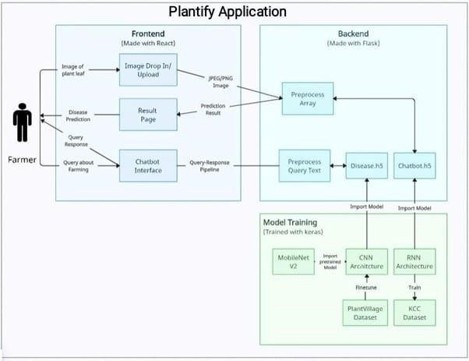
The innovation that is being presented in this project is a software-based system that is intended to help farmers by offering an automated way to identify plant diseases. This innovation combines a number of technological elements:
- Convolutional Neural Networks (CNNs): These networks are used to recognise and categorise plant diseases from images of both healthy and sick plants with high accuracy. This leverages transfer learning with pre-trained CNN architectures to improve performance even with sparsely annotated data.
- MobileNetV2 Architecture: Designed with the specific purpose of classifying agricultural diseases in mind, this model is effective and lightweight, making it ideal for use in resource- constrained settings such as farms.
- Weather API Integration: This helps farmers make decisions about crop management and disease prevention by giving them access to real-time weather data.
- AI-Powered Website: Acts as a user interface for farmers to communicate with the system, submit plant photos, post queries, and get weather and diagnostic updates.
- Chatbot: The invention provides a multilingual voice-enabled conversational interface that generates agriculture-specific procedural guidance in regional languages such as Telugu, Tamil and other regional Indian languages. The responses are dynamically generated based on outputs from the disease detection and decision engines, improving accessibility for non-English-speaking farmers. Utilizes Large Language Models (LLMs) to respond to user inquiries and provide guidance on crop management and disease prevention in regional Indian Languages.
All things considered, this innovation is a system that integrates various software components, artificial intelligence, and data integration to produce a complete tool for raising agricultural productivity and managing diseases
Practical Implementation/ Social Implications of the Research
- Field Diagnosis by Farmers: – Farmers can snap photos of their crops in the fields, use voice-enabled chat in their regional language, and instantly receive a disease diagnosis and treatment suggestions by using the platform.
- Agricultural Extension Services: – By using the system, agricultural extension agents may help farmers more effectively by offering guidance and support.
- Agricultural Research: Researchers can investigate plant diseases and create novel remedies and management techniques by utilising the extensive annotated picture library and diagnostic tools.
- Commercial Farming Operations: By incorporating the system into their precision agriculture techniques, large-scale farming operations can maximise crop health management and operational effectiveness.
- Policy Formation and Governance: Governmental organisations can monitor plant disease outbreaks and create regional or national plans for disease control and prevention using aggregated data from the platform.