
Antibiotics released from hospitals, pharmaceutical industries, and households frequently enter rivers and lakes, where they persist in the environment, threaten aquatic ecosystems, and contribute to the growing problem of antibiotic-resistant bacteria. Dr Akash Balakrishnan, Assistant Professor, Department of Energy Engineering, focuses on developing a simple, affordable, and environmentally friendly technology to remove these harmful contaminants from water.
In his research paper titled “Oxalic acid–assisted, metal-free light-driven activation of sodium percarbonate on kaolinite for tetracycline degradation in water: Kinetic, mechanistic, and toxicological insights”, published in the Journal of Environmental Management, he demonstrates how inexpensive, earth-abundant natural materials can be transformed into highly efficient water-treatment technologies. By providing a sustainable, low-cost, and environmentally benign solution for removing antibiotic pollutants, this work helps protect freshwater resources, reduce the spread of antibiotic resistance, and advance global efforts toward clean water, environmental sustainability, and public health.
Abstract
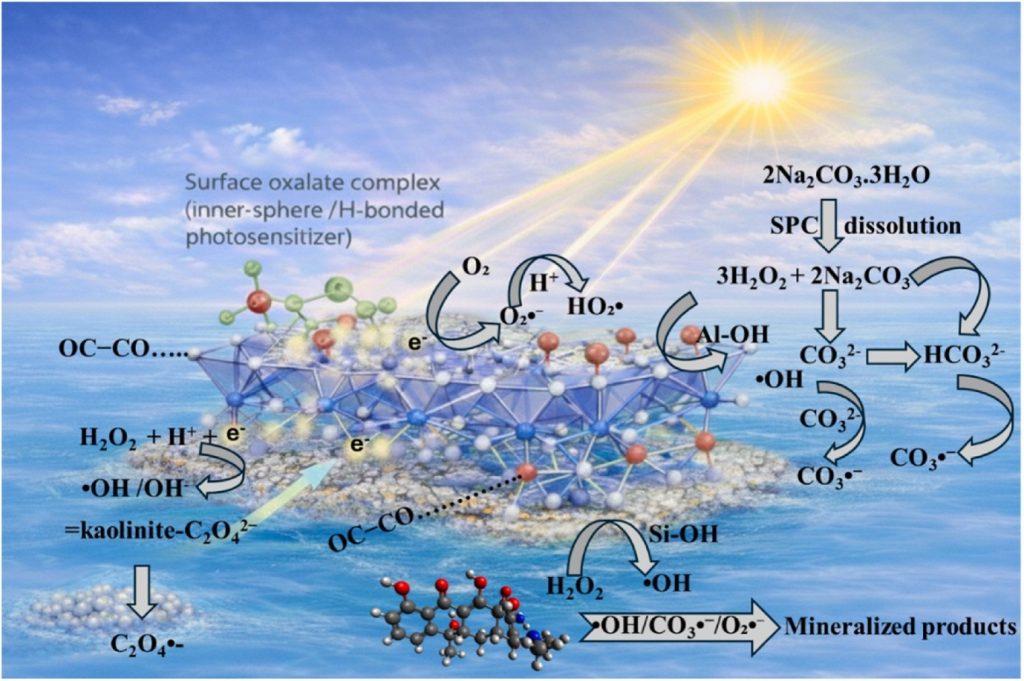
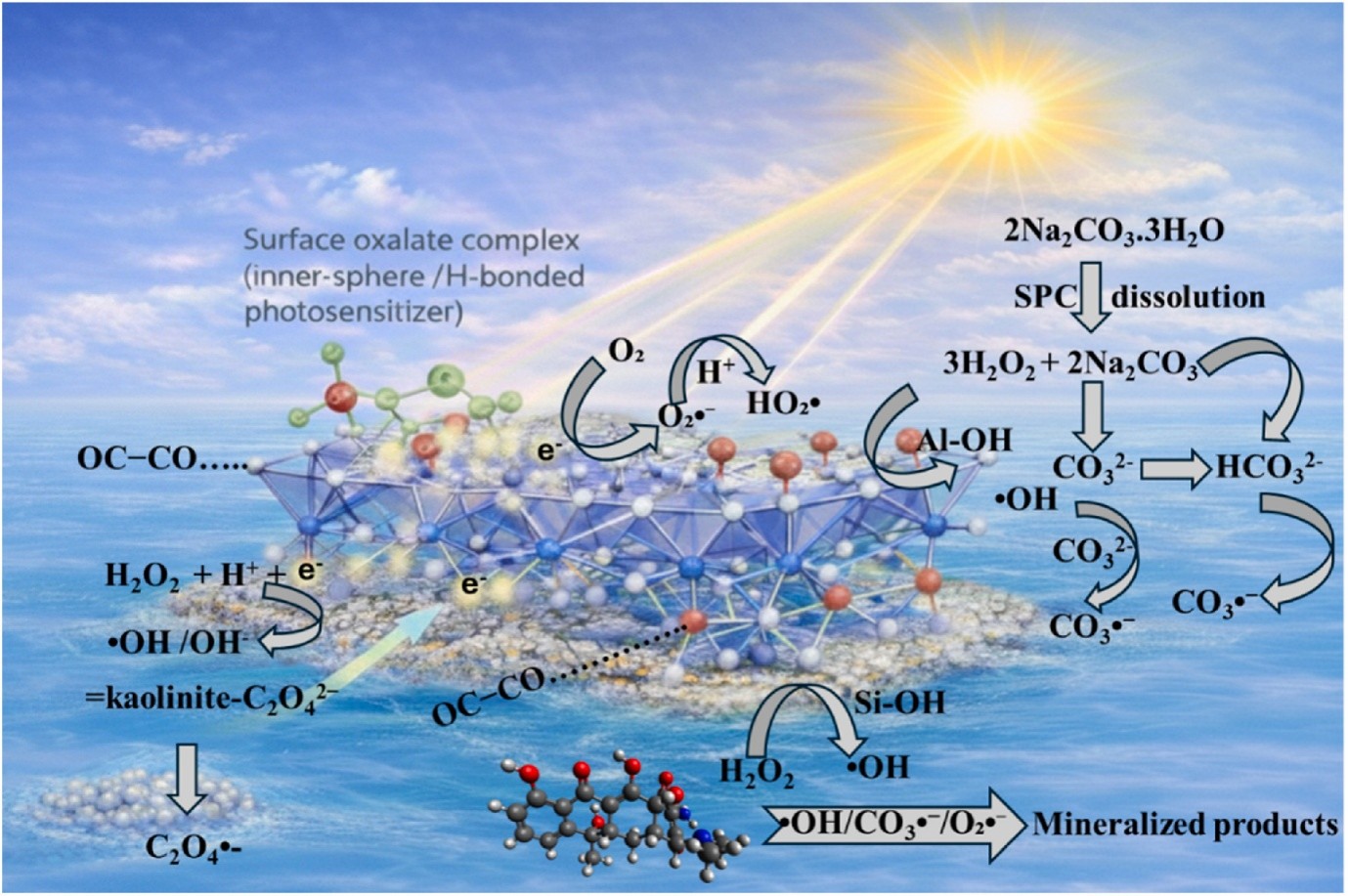
A UV-visible-light-driven hybrid advanced oxidation system based on oxalic acid-assisted (OA) activation of sodium percarbonate (SPC) using kaolinite was developed for tetracycline (TC) degradation in aqueous environmental matrices. The hybrid SPC/Kaolinite/OA (SPC/Kao/OA) system achieved TC degradation efficiency of 91% within 50 min and exhibited an apparent pseudo-first-order rate constant of 0.0464 min−1. The integrated kinetic-statistical and machine learning (ML) analysis demonstrated robustness and physical consistency in the degradation kinetics, with ensemble models such as random forests and gradient boosting accurately reproducing experimental trends (R2 > 0.95, RMSE <0.05) and converging toward a reliable rate constant prediction. The radical scavenging, time-resolved inhibition, ESR spectroscopy, and XPS revealed a surface-mediated activation mechanism primarily involving O2•- and •OH with secondary participation of CO3•-. The oxalic acid acted as an interfacial electron-transfer mediator, promoting surface charge transfer under UV-visible light and accelerating SPC-assisted H2O2 activation without altering the aluminosilicate lattice structure of kaolinite. The system demonstrated tolerance to common inorganic ions, appreciable performance in real water matrices, and a good reusability over 4 cycles, and effective detoxification of TC intermediates as confirmed by HRMS-guided pathway elucidation and ECOSAR/TEST toxicity studies. The energy and cost analysis further established the SPC/Kao/OA system as a low-energy and economically viable alternative to conventional peroxide-based AOPs. This study provides new insights into surface-confined, metal-free SPC activation and highlights the potential of integrating classical kinetics with data-driven validation for sustainable wastewater remediation.
Practical implementation/Social implications of the Research
The research offers a practical, sustainable, and cost-effective approach to treating antibiotic-contaminated wastewater in hospitals, the pharmaceutical industry, municipal wastewater treatment plants, and decentralised water purification systems. By utilising naturally abundant kaolinite, safe sodium percarbonate, and biodegradable oxalic acid, the developed metal-free process minimises secondary pollution, operates under mild conditions, and requires relatively low energy input, making it suitable for large-scale implementation, particularly in resource-limited regions. The technology effectively degrades antibiotics while detoxifying the resulting transformation products, thereby reducing risks to aquatic ecosystems and human health. Importantly, removing persistent antibiotic residues from wastewater can help curb the spread of antimicrobial resistance (AMR), a major global public health challenge. Overall, this research contributes to the development of greener and more affordable water-treatment technologies, supports sustainable water resource management, and aligns with the United Nations Sustainable Development Goals, particularly SDG 3 (Good Health and Well-being), SDG 6 (Clean Water and Sanitation), SDG 12 (Responsible Consumption and Production), and SDG 14 (Life Below Water).
Collaborations
- National Institute of Technology Rourkela, Odisha
- Global Institute for Water Environment and Health, Geneva, Switzerland
- Sohar University, Oman
Read the article