

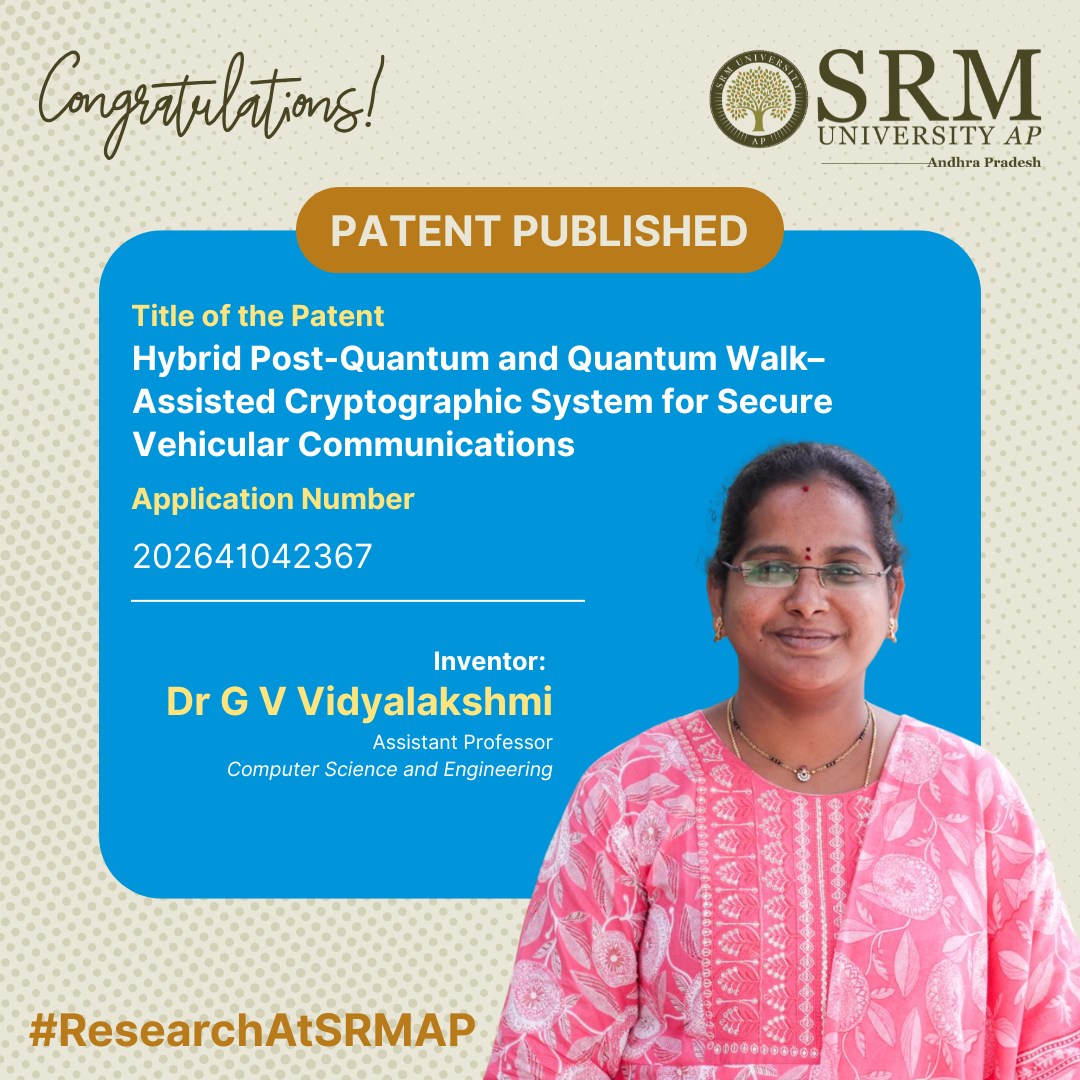
 Dr G V Vidyalakshmi, Assistant Professor, Department of Computer Science and Engineering, has filed and published an invention titled “ Hybrid Post-Quantum and Quantum Walk–Assisted Cryptographic System for Secure Vehicular Communications”.
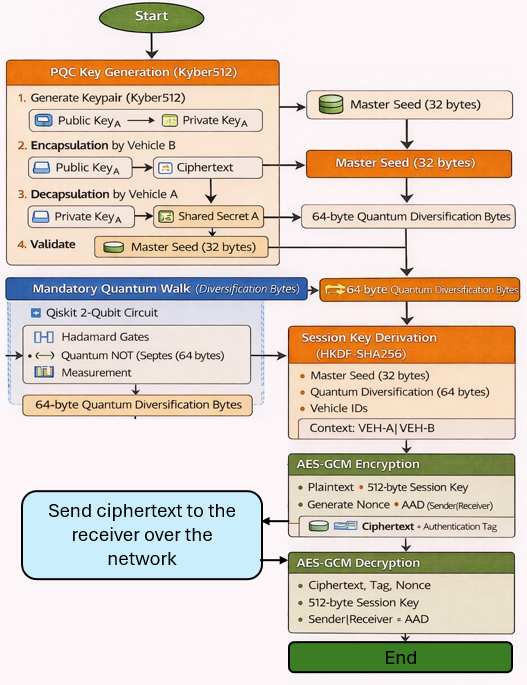
The hybrid quantum-classical cryptographic system of the proposed invention is a secure vehicular communications system based on post-quantum cryptography (PQC) and a key diversification mechanism with the use of quantum walk. The invention is aimed at securing both classical and quantum attacks on vehicle-to-vehicle (V2V) and vehicle-to-infrastructure (V2I) communications.
The main concept of the invention is to create a quantum-resistant shared secret with the help of lattice-based post-quantum key encapsulation mechanism (Kyber) and bind this shared secret with a quantum-generated randomness source provided by a controlled quantum walk. The resulting hybrid entropy is fed in with a standard cryptographic key derivation function (HKDF-SHA256) to derive high-entropy session keys. These session keys are then used to do authenticated encryption and decryption with AES-GCM, which takes care of confidentiality, integrity and authenticity of vehicular messages.
Practical implementations:
- Autonomous and semi-autonomous vehicles for secure V2V, V2I, and V2X communications
- Smart city and ITS infrastructure, including traffic signal coordination, toll systems, and congestion management
- Cooperative driving systems, such as vehicle platooning and collision avoidance.
Commercial Potential :
The commercial potential of the invention is significant due to:
- Growing regulatory mandates for vehicular cybersecurity (e.g., UN R155, ISO/SAE 21434)
- Increasing deployment of connected and autonomous vehicles worldwide
- The need for quantum-resilient security solutions with long operational lifetimes
Organisations most likely to be interested in this technology include:
- Automotive manufacturers (OEMs) are developing connected and autonomous vehicles
- Tier-1 automotive suppliers providing onboard communication and security systems
- Intelligent Transportation System providers and smart city solution vendors
- Automotive cybersecurity companies focusing on V2X and vehicular network security
- Government and transport authorities are responsible for traffic management and road safety systems
Future research plans :
Future research on this system could focus on several key areas: implementing real quantum hardware instead of software simulation to generate stronger randomness; optimising the system for low-power vehicle hardware to reduce computational overhead; testing and scaling the system in large, real-world vehicular networks with many simultaneous connections; adding post-quantum digital signatures for complete vehicle identity verification; obtaining formal security certifications aligned with automotive standards like ISO/SAE 21434; examining vulnerabilities to hardware-level attacks such as side-channel attacks; and integrating the system with existing V2X communication protocols like IEEE 802.11p to ensure smooth deployment in real-world connected vehicle infrastructure.