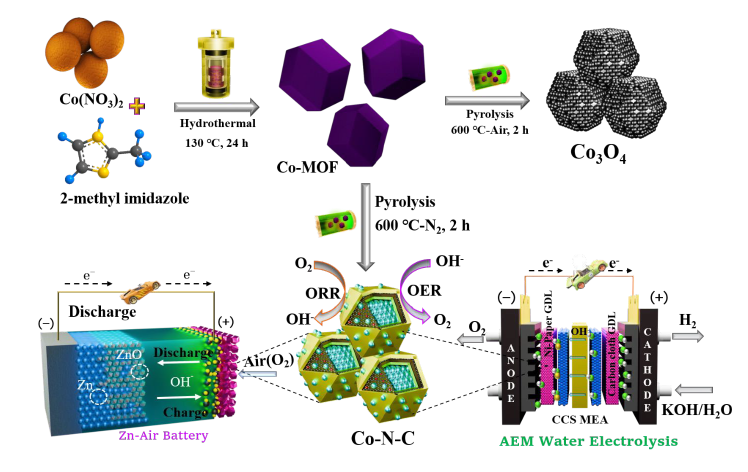

 In the global push to combat climate change, transitioning from heavily polluting fossil fuels to green technologies like rechargeable batteries and hydrogen production is essential, but are often hindered by a reliance on expensive precious metals like platinum. Addressing this cost barrier, Dr Narayanamoorthy Bhuvanendran, Assistant Professor in the Department of Environmental Science and Engineering at SRM University-AP, has published a breakthrough study titled “Synergistic metallic Co and Co-N₄ active sites in surface-enriched Co-N-C catalysts for alkaline zinc-air batteries and anion exchange membrane water electrolyzers.” Featured in the prestigious Journal of Materials Chemistry A, a Q1 journal with an impact factor of 9.2, the research details the development of a highly affordable new catalyst made from cobalt, nitrogen, and carbon for rechargeable zinc-air battery and water electrolyzers (water electrolyzers is a device that uses electricity to split water into two gases: hydrogen and oxygen).This cobalt catalyst becomes, a valuable and performs nearly as well as expensive precious metals alternative at a lower cost, because of its reactive sites, good conductivity and excellent stability. This novel material performs nearly as well as its expensive precious-metal counterparts due to its abundant reactive sites, strong electrical conductivity, and excellent stability. By effectively replacing cost-prohibitive materials in zinc-air batteries and water electrolyzers (devices that split water into hydrogen and oxygen), this work represents a vital step toward scaling up affordable energy storage systems and efficient green hydrogen production worldwide.
Abstract
Zinc–air batteries (ZABs) and anion exchange membrane water electrolyzers (AEMWEs) are promising technologies for grid-scale energy storage and sustainable hydrogen production, but their efficiency is limited by sluggish oxygen reduction (ORR) and oxygen evolution (OER) kinetics and catalyst instability. Here, we report a robust cobalt–nitrogen–carbon (Co–N–C) catalyst derived from a metal–organic framework, featuring metallic Co and Co-N₄ active sites in Co-N-C catalysts and structurally different Co₃O₄ nanostructures. Optimizing the local coordination environment promotes charge transfer at the Co centers and strengthens interactions with the N-doped carbon matrix, enabling superior bifunctional activity. The catalyst delivers a half-wave potential of 0.857 V for ORR and a low overpotential of 1.55 VRHE at 10 mA cm⁻² for OER, with remarkable stability of 10,000 cycles. Device-level evaluation demonstrates a peak power density of 257 mW cm⁻² in ZABs and a sustained current density of 465 mA cm⁻² at 1.8 V in AEMWEs, surpassing most reported Co–N–C catalysts. In situ Raman and X-ray absorption spectroscopy (metallic cobalt as the primary active site in Co-N-C), supported by density functional theory, identify Co–N₄ moieties as the secondary active sites as comperd to trans- CoCN2, and cis-CoCN2 in Co-N-C. This work establishes structure–activity insights for Co–N–C catalysts, advancing the design of next-generation bifunctional electrocatalysts for sustainable energy conversion.
The developed cobalt-nitrogen-carbon (Co-N-C) catalyst can be practically implemented in rechargeable batteries and water electrolyzers which are important green energy technologies. By substituting expensive platinum-based catalysts with an affordable and efficient alternative, this research can contribute to reducing the overall cost of renewable energy and make them available for large scale application. The use of this advance cobalt-based catalyst also contributes the advancement of next generation renewable energy alternatives technologies with enhanced performance and reliability.
From a societal perspective this new green energy alternative technology can be used in electric vehicles, backup power system, portable electronic devices and hydrogen production plants. The advancement of affordable green energy technologies can contribute to reducing greenhouse gas, decreasing the reliance on carbon fuels and encouraging the global transition toward eco-friendly and sustainable energy technologies. Overall, the development of efficient catalysts supports the broader goals of eco-friendly energy technologies that can enhance the quality of life while reducing pollution and protecting natural resources for upcoming generations.
Future research will focus on designing more advanced robust, cost-effective bifunctional electrocatalysts for future energy storage and hydrogen production technologies. Special emphasis will be placed on understanding the structure activity relationship through characterization techniques and theoretical studies and strategies of catalyst to create affordable sustainable energy technologies
Collaborations:
Dr Santhosh Kumar Ramasamy, Department of Energy Storage/Conversion Engineering of Graduate School, BK21 FOUR, Jeonbuk National University, Jeollabuk-do 54896, Republic of Korea
Dr Selva Kumar Ramasamy, Department of Chemistry, Maharishi Markandeshwar Engineering College, Maharishi Markandeshwar (Deemed to be University), Mullana, Ambala, Haryana, 133207, India
Read the full article here