


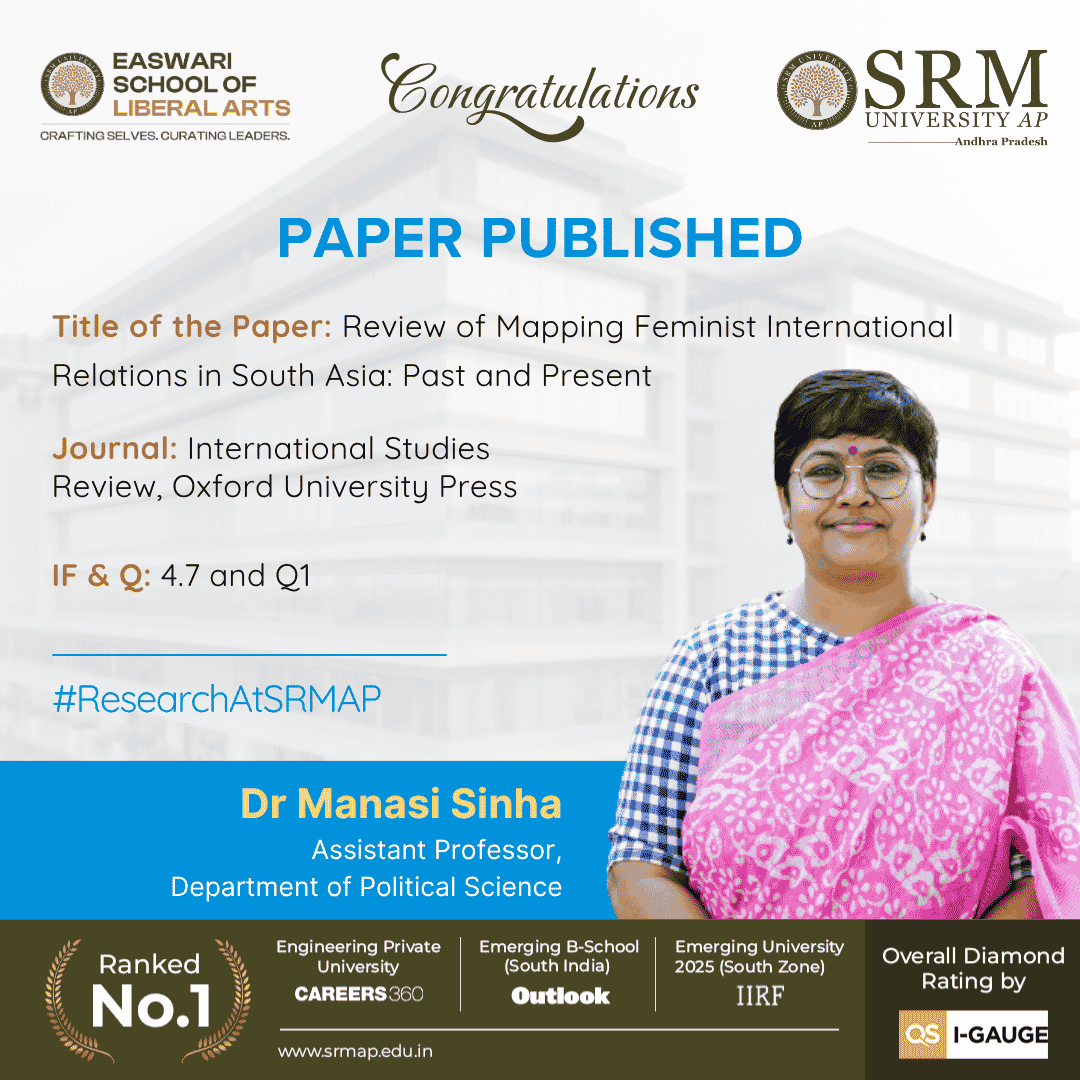
 International Relations has historically accorded disproportionate authority and visibility to Western theories, leaving scholars from the Global South to be viewed merely as local observers rather than foundational theoretical contributors. Even though researchers across South Asia have produced substantial feminist thinking on war, peace, nationalism, militarisation, identity, and political power, Euro-American frameworks continue to dominate global discourse. Addressing the central question of who gets to decide what counts as important knowledge about world politics, Dr Manasi Sinha from SRM University-AP demonstrates why South Asian feminist thinkers must be recognised not merely as scholars describing their region, but as vital theorists who help the global academic community understand international politics differently.
In a paper published in International Studies Review, a Q1 journal with an impact factor of 4.7 published by Oxford University Press, Dr Manasi Sinha, Assistant Professor in the Department of Political Science at SRM University-AP, in collaboration with Dr Pratyush Bibhakar from Bennett University, articulates this necessary paradigm shift. Their publication, titled “Review of Mapping Feminist International Relations in South Asia: Past and Present“, directly addresses these epistemic disparities and repositions regional scholarship within global academic frameworks.
The book review unsettles a persistent imbalance in Feminist International Relations (IR), where Euro-American thought often speaks as theory and the Global South appears merely as evidence. The review repositions South Asian feminist scholarship as a vital site of conceptual invention, historical memory, and intellectual authority capable of reshaping Feminist IR itself. Through the volume’s organising grammar of dialogue, difference, and dissidence, the review presents South Asia not as a distant landscape to be studied but as an intellectual vantage point from which global politics can be re-read. “Mapping” thus becomes an act of epistemic reclamation: it restores obscured voices, exposes unequal knowledge structures and redraws the boundaries of who can produce theory.
The review advances practical change in teaching, publishing, and research by urging broader IR curricula, reciprocal citation, and greater recognition of South Asian intellectual traditions. Its deeper contribution lies in epistemic justice: restoring marginalised feminist voices to theory-making. By centring dialogue, difference, and dissidence, it imagines a more plural International Relations shaped by diverse histories, struggles, and locations across borders. Looking ahead, future research emerging from this framework will explore storytelling in IR, critical ethnography in IR, and the intersection of feminist IR and emotive politics.
Read the full article here