
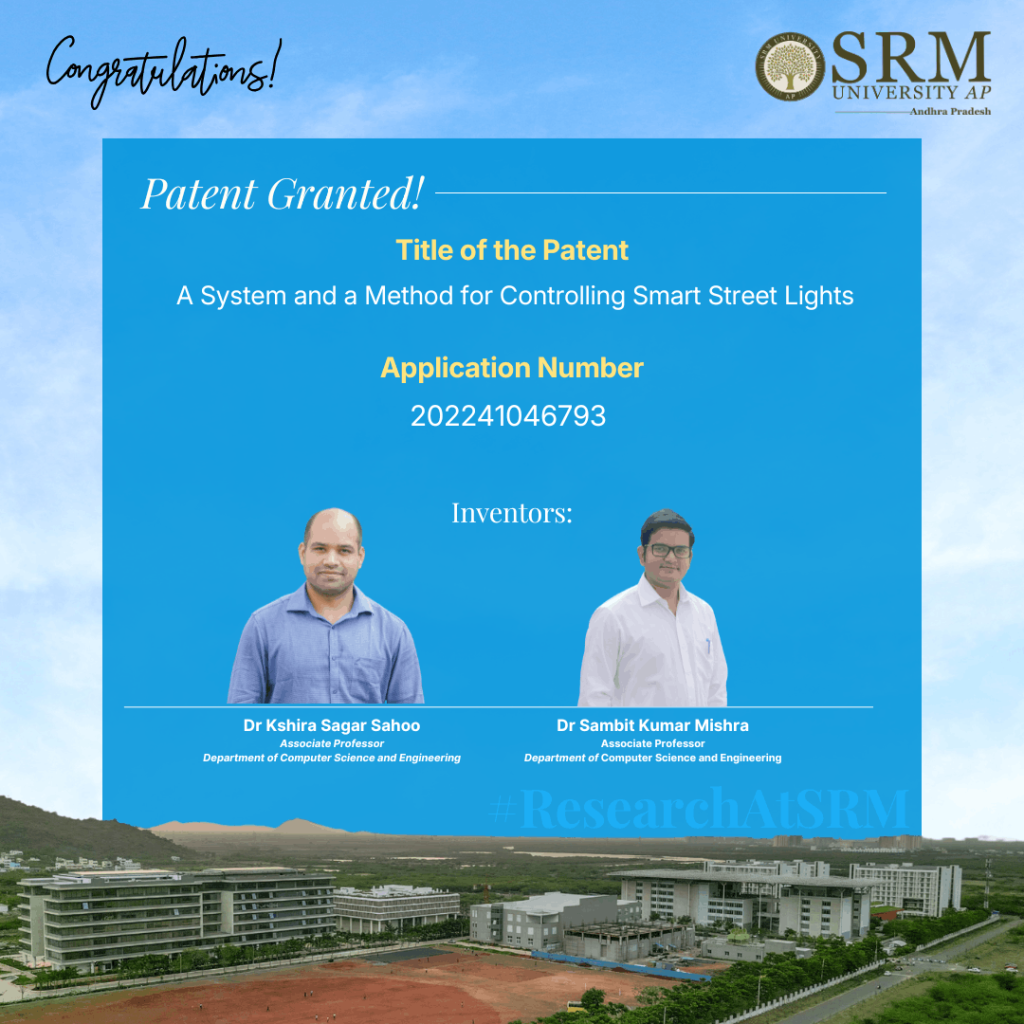
Dr Kshira Sagar Sahoo and Dr Sambit Kumar Mishra, Associate Professors from the Department of Computer Science and Engineering have developed a street lights system that uses smart sensor detection. Their patent titled “A System and a Method for Controlling Smart Street Lights” has been granted with the Application No – 202241046793 by the Indian Patent Office Journal.
Abstract
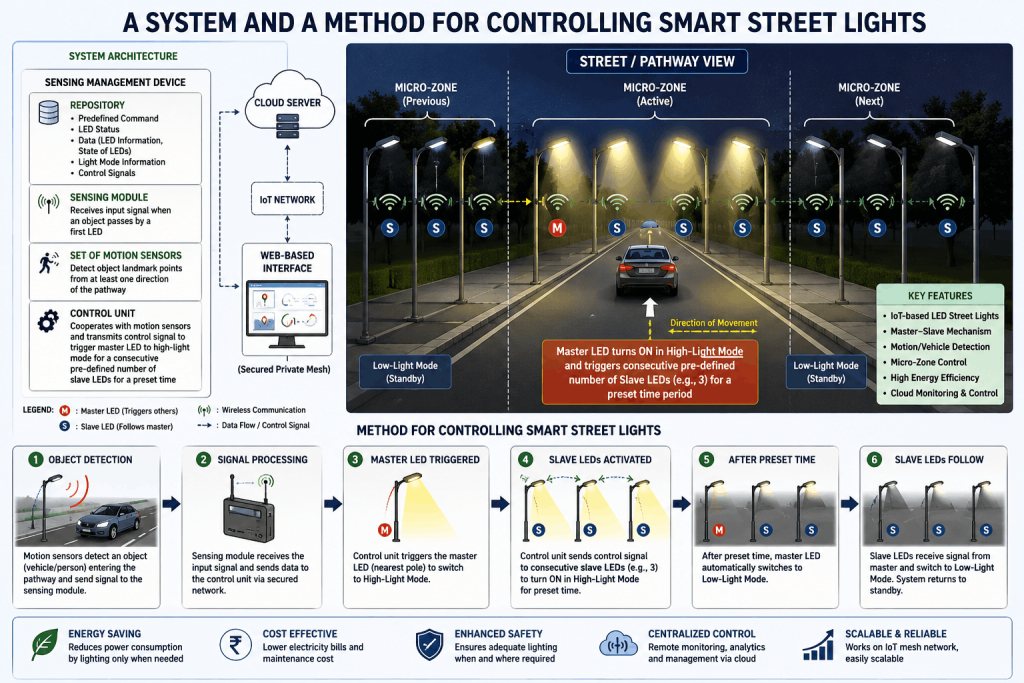
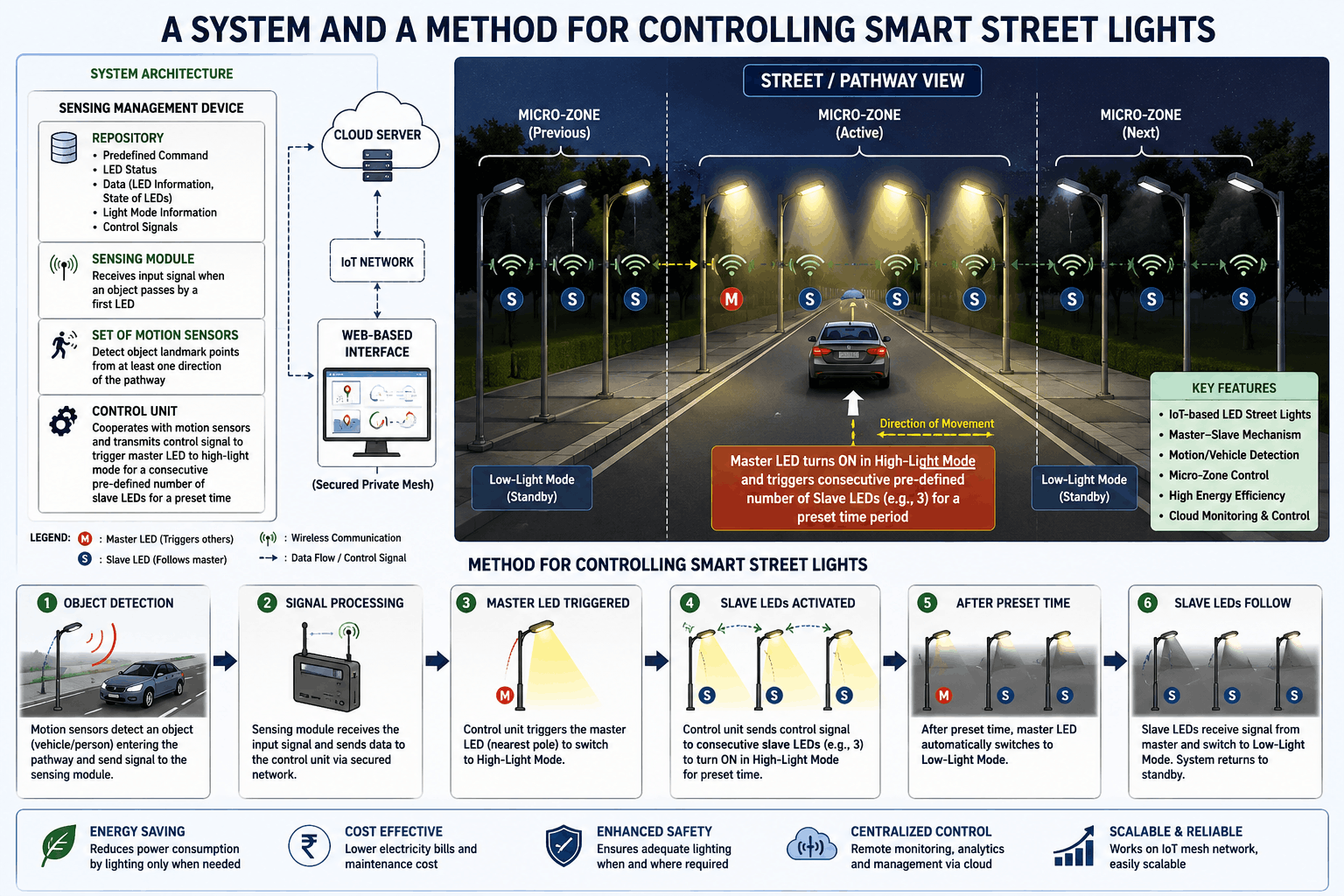
The patent titled “A System and a Method for Controlling Smart Street Lights” presents an IoT-based solution for efficient street lighting management. The system integrates motion sensors, a sensing management device, and cloud connectivity to dynamically control LED street lights. It employs a master–slave mechanism, where a primary light activates adjacent lights (micro-zone) in high-intensity mode when motion is detected, and reverts them to low-intensity mode after a predefined time. This approach significantly reduces energy consumption while maintaining effective illumination.
Explanation in Layperson’s Terms
Normally, street lights stay ON all night at full brightness, wasting electricity. In this system:
- Lights stay dim (low power) when no one is around.
- When a person or vehicle passes by, sensors detect movement.
- The nearest light becomes bright and also turns on a few nearby lights.
- Once the person moves away, the lights go back to dim mode.
So instead of lighting the entire road continuously, only the required area lights up—saving a lot of energy while still keeping roads safe.
Practical Implementation
- Can be deployed in basement parking in big malls where they don’t need full lighting all the time.
- Can be deployed on residential streets, campuses, and industrial areas
- Works with IoT networks and cloud-based monitoring systems
- Easily scalable using wireless sensor networks (lower installation cost)
Social & Environmental Impact
- Energy savings: Reduces unnecessary electricity usage significantly
- Cost reduction: Lower electricity bills and maintenance costs
- Sustainability: Supports green initiatives and carbon footprint reduction
- Safety: Ensures proper lighting only where needed, improving visibility
- Smart city development: Contributes to intelligent urban infrastructure
Future Research Plans
Future work can build on this system in several meaningful directions:
-
- Use machine learning to predict traffic patterns and adjust lighting proactively
- Combine with solar-powered units for complete energy independence
- Connect with CCTV, traffic signals, and emergency systems