 Modern aerospace, automotive, and nuclear engineering increasingly rely on functionally graded materials (FGMs), which blend metals and ceramics to create sandwich plates capable of withstanding extreme heat while remaining structurally strong. These plates are used in jet engines, spacecraft components, and other high-temperature environments where both strength and thermal resistance are critical.
During manufacture, however, such plates often develop tiny air pockets, known as porosity, particularly near their outer surfaces. Left unaccounted for, this porosity can alter how a component bends and distributes stress under combined heat and mechanical load, potentially compromising the safety and reliability of the structures it is used in.
The research published by Dr Supen Kumar Sah, Assistant Professor in the Department of Mechanical Engineering at SRM AP, in the Q2 journal of Journal of Reinforced Plastics and Composites, having an impact factor of 2.8, titled Thermo-mechanical bending analysis of porous FGM plates: Influence of temperature-dependent material properties and porosity distributions, provides a detailed analytical framework for predicting the thermo-mechanical bending behaviour of these plates, accounting for both porosity and temperature-dependent material properties.
This research studies how specialised sandwich-like plates, made from a mixture of metal and ceramic, bend and respond to heat when they contain tiny air pockets, known as porosity. By examining different patterns of these air pockets under varying temperature conditions, the study helps engineers design stronger, more reliable components for high-heat environments such as jet engines and spacecraft.
This research was carried out in collaboration with the Department of Aerospace Engineering, IIT Kharagpur.
Abstract
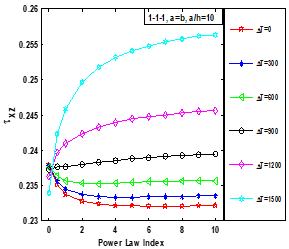
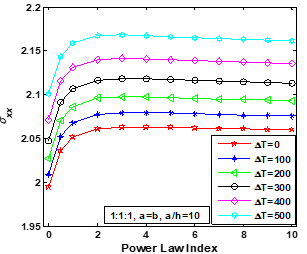
This study analytically investigates the thermo-mechanical bending of perfect and porous FGM sandwich plates with temperature-dependent properties, considering five porosity distribution models where porosity is confined to the outer faces and the ceramic core remains non-porous. A power law governs property gradation through the thickness, while a one-dimensional heat conduction equation supplies the temperature field. Using hyperbolic shear deformation theory (HYSDT) and Hamilton’s variational principle, governing equations are derived and solved via Navier’s technique. A detailed parametric study examines the influence of porosity distribution, coefficient, temperature dependency, power law index, and geometric ratios on deflection and stresses.
Practical Implementation and Social Implications
This research directly aids the aerospace, automotive, and nuclear industries in designing lighter, heat-resistant, and structurally safer components, reducing failure risks and improving fuel efficiency. Ultimately, it contributes to more sustainable and reliable technologies for high-temperature engineering applications, benefiting public safety and energy conservation.
Future work will extend the analysis to dynamic loading and transient thermal shocks, while incorporating nonlinear effects and damage evolution in porous FGM sandwiches. The team also aims to develop experimental validation and machine learning-based optimisation for real-world aerospace and energy applications.
Read the full article here.