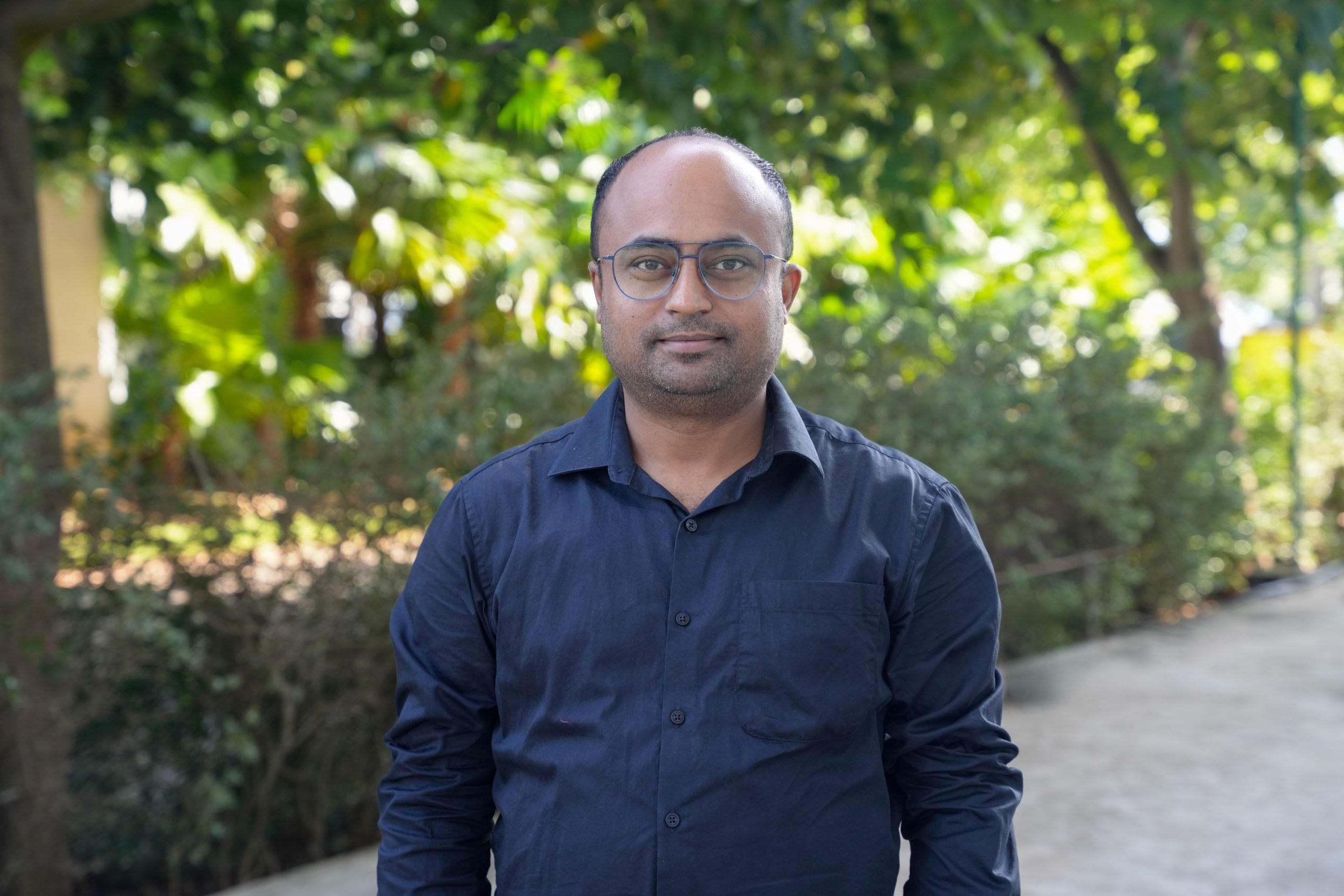

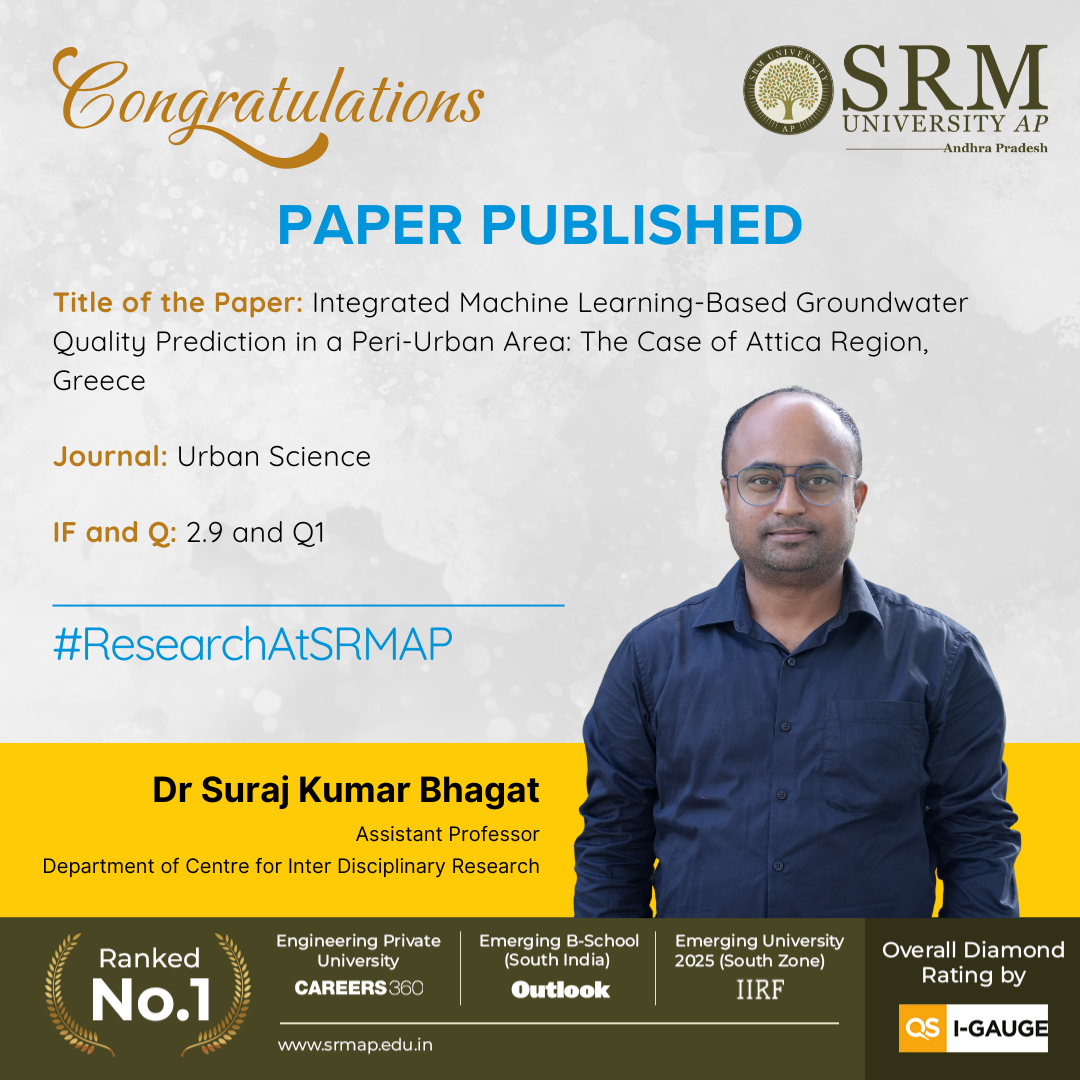
 In a significant step forward for environmental management, a newly developed artificial intelligence framework is helping city planners predict groundwater health even when critical data is messy or missing. This innovative research, led by Dr Suraj Kumar Bhagat, Assistant Professor in the Centre for Interdisciplinary Research, was recently published in Urban Science, a Q1 journal with an impact factor of 2.9, under the title “Integrated Machine Learning-Based Groundwater Quality Prediction in a Peri-Urban Area: The Case of Attica Region, Greece.” The study focused on Greece’s Attica region, analysing water samples from 80 monitoring stations across six key chemical markers. To overcome the challenge of incomplete datasets, advanced statistical techniques were utilized to accurately “fill in the blanks” before testing three different AI models. The research, which came as the product of a collaboration between researchers in India and Greece, revealed that an advanced deep-learning model called TabNet was the most accurate at predicting overall water quality, successfully identifying nitrates from agricultural fertilizers and sewage as the primary threat to the water supply. Ultimately, this framework equips city planners with a reliable, budget-friendly tool to safeguard vital water resources, even in the face of imperfect environmental data.
Abstract
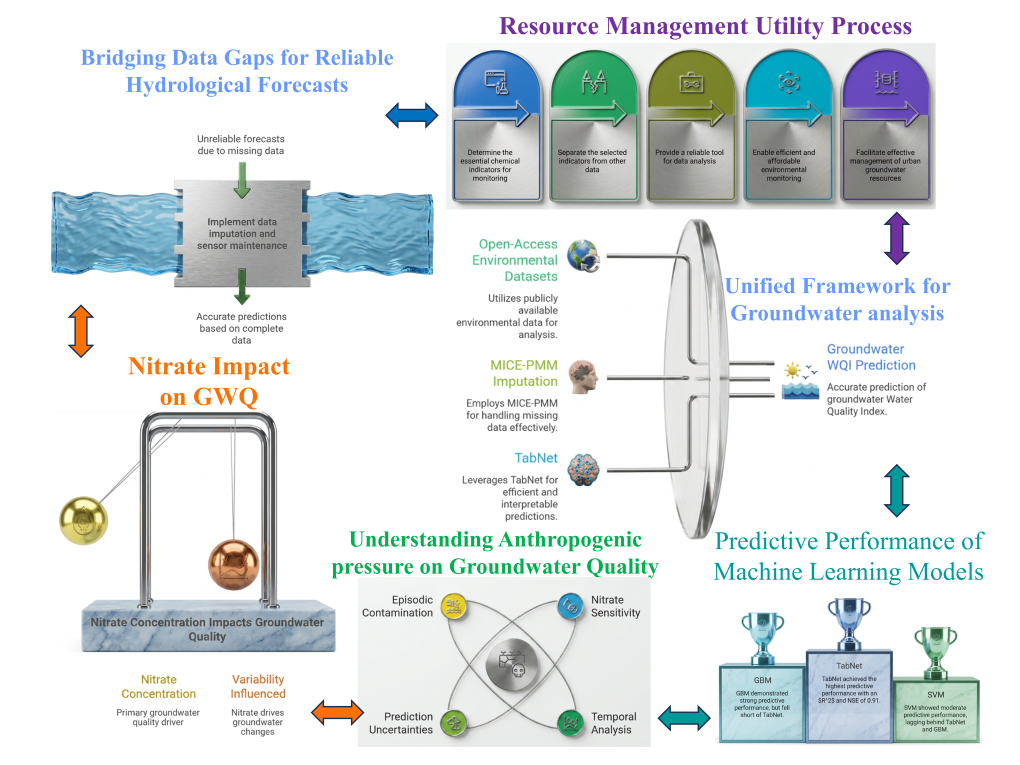
This study addresses the challenge of incomplete monitoring records in urban environments by predicting the Water Quality Index (WQI) in the Attica Basin, Greece. Utilizing a dataset of 958 observations from 80 stations, the research evaluates six physicochemical parameters using three machine learning approaches: TabNet, SVM, and Gradient Boosting Machines (GBM). To handle data scarcity, Multiple Imputation by Chained Equations with Predictive Mean Matching (MICE-PMM) was successfully implemented.
The integrated MICE-PMM and TabNet framework achieved the highest predictive performance (R2 = 0.91). Feature importance and sensitivity analyses identified nitrate and nitrogen-based compounds as the dominant drivers of WQI variability, reflecting significant anthropogenic pressures like agricultural runoff and wastewater discharge. Ultimately, this framework offers a highly transferable, data-driven tool for environmental monitoring and groundwater resource management in regions with fragmented environmental datasets.
Practical Implementation and social implications
Practically, cities can implement this framework to safeguard drinking water and optimize tight environmental budgets by targeting key pollutants like nitrates instead of funding exhaustive, expensive testing. Socially, this AI tool acts as an early warning system for peri-urban communities, protecting public health from contaminated agricultural runoff and wastewater seepage. By bridging gaps in broken or sparse data, it democratizes advanced environmental monitoring. This enables developing regions or underfunded municipalities to make data-driven decisions, hold polluters accountable, and secure equitable access to clean, safe groundwater for vulnerable populations..
Future Research Plans
Future research plans will focus on validating the MICE-PMM and TabNet framework across diverse global aquifers to confirm its geographical transferability. Researchers aim to integrate real-time sensor data and climate change projections into the model to predict how shifting weather patterns and prolonged droughts affect groundwater quality over time. Additionally, expanding the model to incorporate a broader range of contaminants, such as heavy metals and emerging microplastics, will enhance its predictive scope. Finally, upgrading the system into an automated, user-friendly digital dashboard will allow environmental managers to proactively simulate pollution scenarios and optimize water treatment strategies.
Read the full paper here