


 In India, environmental degradation and ecological crises do not affect all communities equally. Exposure to environmental risks, loss of livelihoods, and access to decision-making are profoundly shaped by caste, class, and socio-historical marginalisation. While western frameworks of Environmental Justice (EJ) historically linked race and class to environmental inequality, applying these models directly onto Indian society often produces a caste-blind vision that reduces ecological injustice merely to issues of economic development or class. Addressing these critical blind spots, research from SRM University-AP examines how caste historically and systematically dictates who bears the burden of hazardous work, polluted surroundings, and ecological displacement, demonstrating that environmental injustice in India cannot be understood without confronting caste directly.
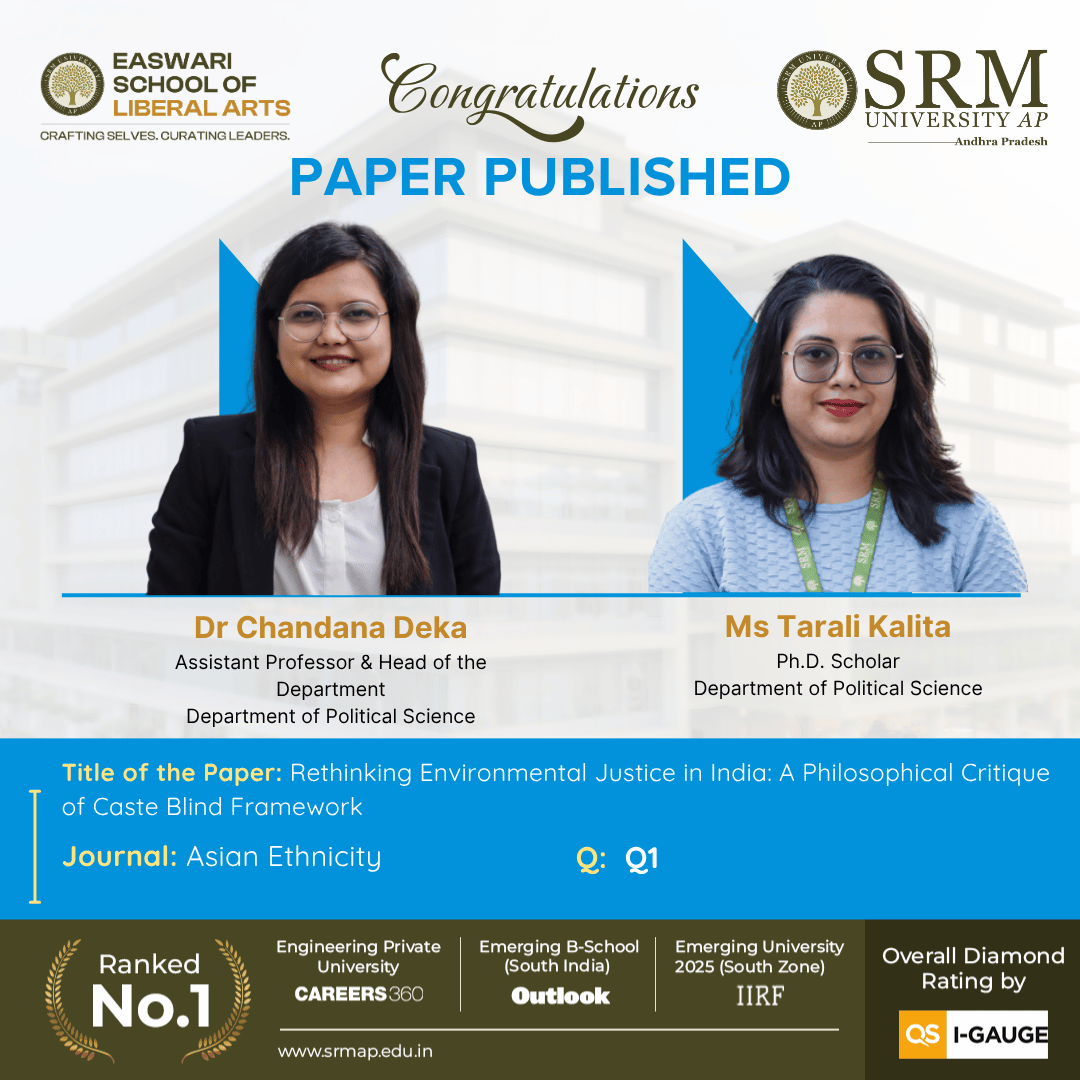
In a study published in Asian Ethnicity, a Q1 journal published by Routledge (Taylor & Francis), Ms Tarali Kalita, Research Scholar in the Department of Political Science, and Dr Chandana Deka, Assistant Professor of Philosophy and Head of the Department of Political Science at Easwari School of Liberal Arts, SRM University-AP, articulate this critical theoretical critique. Their research paper is titled “Rethinking Environmental Justice in India: A Philosophical Critique of Caste Blind Framework“.
In the West, Environmental Justice (EJ) emerged as an analytical and political discourse through movements that linked race, class, and environmental inequality. This article argues that the transposition of such frameworks onto Indian socio-historical and political realities often leads to a caste-blind vision which depoliticizes and reduces the problem of ecological inequality to one of either development or class. Through a philosophical engagement with various EJ framings, this article critiques the class- or caste-blind approaches to environmental injustice in India. It synthesises Ambedkarite and Marxist theories to trace that caste has historically shaped dangerous work, polluted environments, and differentiated exposures, even as capitalism increasingly comes to drive the exploitation of labour and nature. Dalit and Adivasi communities continue to bear the ecological price for ‘development’ today through displacement, hazardous labour, and environmental degradation. This systematic pattern demonstrates that environmental injustice in India has a caste-score to settle.
The findings provide important practical support for environmental policy, land acquisition, labour protection, development planning, and climate adaptation by helping identify who faces heightened environmental risks and why. By promoting the participation of marginalised communities, the recognition of local knowledge, and more inclusive environmental governance, the study supports policymakers in responding more equitably to social inequalities. Looking ahead, future research will examine caste, gender, and climate-related environmental vulnerabilities through field-based studies on displacement, occupational risks, and community participation. Further work will focus on developing caste-sensitive environmental impact assessment frameworks while deepening the relationship between Marxist–Ambedkarite thought, ecological justice, and democratic governance.
Read the full article here