


 Governance works best when the people it serves have a genuine say in the decisions that shape their daily lives. Traditionally, citizen participation has relied on mechanisms such as public consultations, feedback forms, and periodic elections, but these methods often struggle to capture the diverse voices within a community, leaving many citizens feeling unheard. As governments explore digital tools such as blockchain, digital governance platforms, and smart governance frameworks, a growing opportunity has emerged to make public administration more transparent, accountable, and responsive, particularly at the local level.
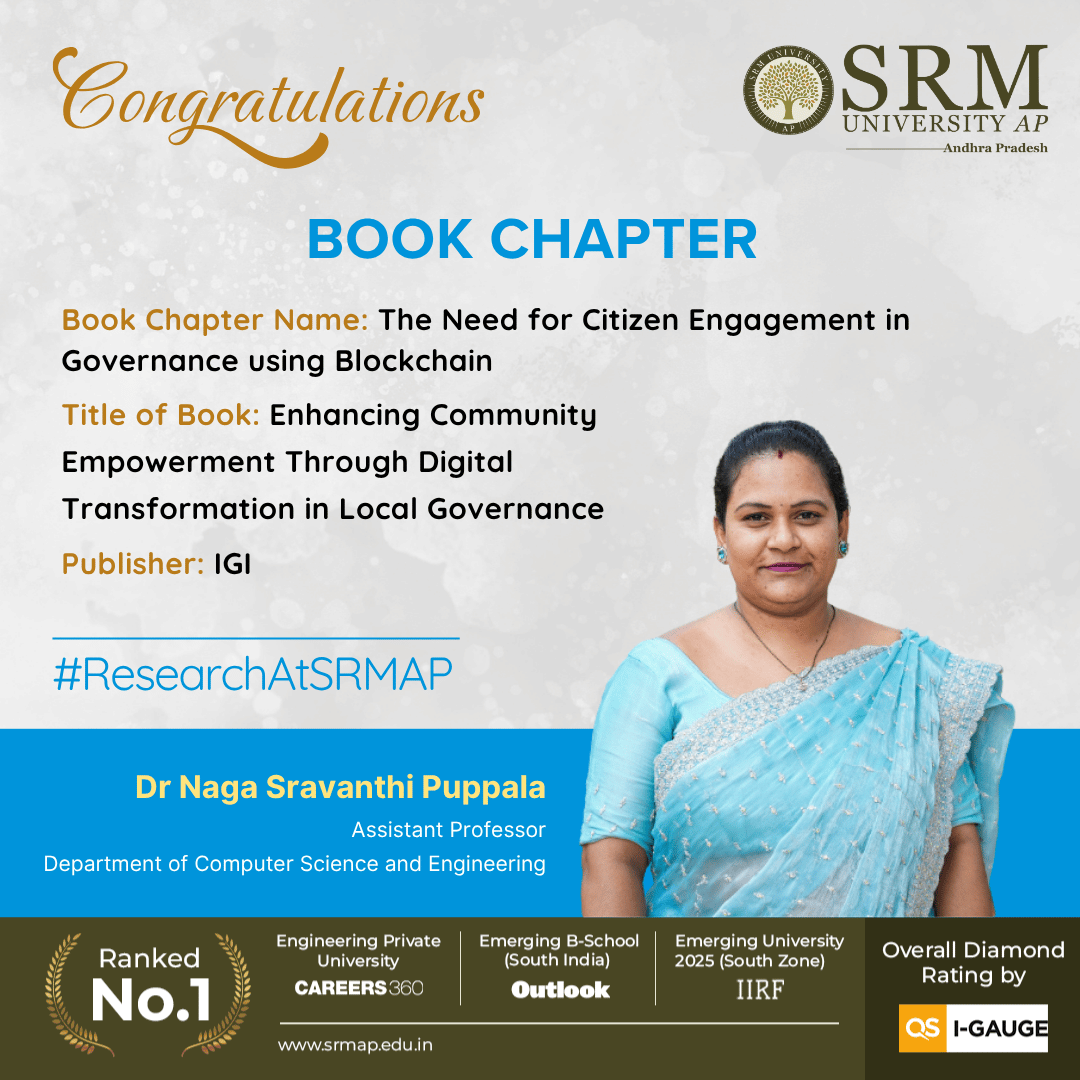
Dr Puppala Naga Sravanthi, Assistant Professor in the Department of Computer Science and Engineering at SRM University-AP, examines this shift in her book chapter titled The Need for Citizen Engagement in Governance, co-authored with Mrs Kodali Sagarika, a PhD Scholar. The chapter appears in Enhancing Community Empowerment Through Digital Transformation in Local Governance, published by IGI Global Scientific Publishing in 2026.
The chapter discusses how traditional mechanisms of public participation often fail to capture diverse voices, and proposes innovative digital approaches to strengthen citizen engagement at the local governance level. Special emphasis is placed on emerging technologies such as blockchain, digital governance, and smart governance frameworks to improve transparency, accountability, public trust, and citizen participation. It also reviews the historical evolution of citizen engagement, highlights global best practices, and examines how digital transformation can enable more responsive and participatory governance models, bridging democratic theory with practical technological solutions for modern public administration.
Why This Chapter Matters
This chapter is significant because it addresses one of today’s most critical governance challenges: building citizen trust through transparent, technology-enabled governance. It demonstrates how blockchain technology can strengthen accountability and transparency in public administration, connects democratic participation with digital innovation, and offers practical insights for implementing citizen-centric governance at the local level. It further highlights the role of emerging technologies in improving public service delivery and decision-making, and contributes to interdisciplinary research spanning computer science, e-governance, blockchain, and public administration.
For Dr Sravanthi, this publication reflects her ongoing research interests in blockchain applications, digital governance, cybersecurity, and trust management systems, extending these concepts beyond traditional blockchain applications into the domain of public governance.
The chapter will be valuable for researchers in digital governance and public administration, faculty members and academicians, and PhD and postgraduate students, as well as government policymakers, municipal administrators, and Panchayati Raj officials. It will also serve as a useful reference for smart city planners, e-governance professionals, blockchain researchers, digital transformation consultants, and technology policymakers interested in citizen-centric governance.
Publication Details
It is available under ISBN 979-8-3373-5751-5 (hardcover), ISBN 979-8-3373-5755-3 (softcover), and eISBN 979-8-3373-5752-2.
Read the chapter here.