


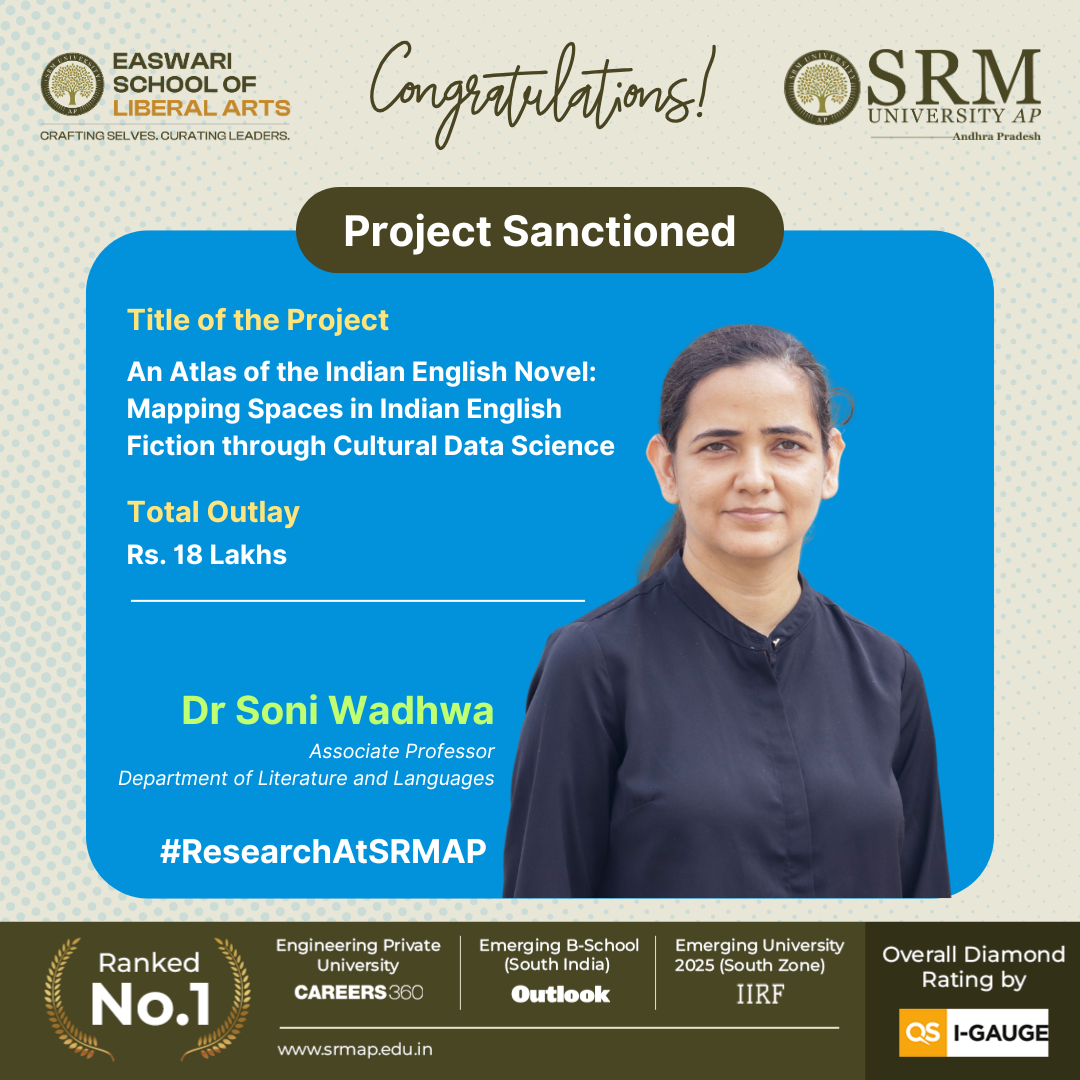
 Dr Soni Wadhwa, Assistant Professor in the Department of Literature and Languages, has been awarded a research grant under the “ANRF-ARG Matrices” scheme for her project titled “An Atlas of the Indian English Novel: Mapping Spaces in Indian English Fiction through Cultural Data Science.” Sanctioned with a total project cost of ₹18 lakhs for a period of three years, the project investigates the spatial dimensions of Indian English fiction through an interdisciplinary approach that combines literary studies with computational methods.
The research explores an important yet understudied question in Indian literary studies: where do Indian English novels locate their stories? Indian English fiction has emerged as one of the most influential literary traditions globally, reflecting the social, cultural, and political transformations of postcolonial India. From narratives rooted in regional landscapes to globally recognised literary works, Indian English novels have represented diverse experiences across the subcontinent. However, there has been limited systematic research examining the geographies these stories occupy.
This project seeks to address that gap by combining literary scholarship with computational analysis. Drawing inspiration from literary theorist Franco Moretti’s work on mapping the European novel, the study extends similar methods to Indian English fiction to understand the spatial patterns embedded within literary narratives.
Using digital humanities tools such as Named Entity Recognition (NER) and text mining, the project will analyse a large corpus of Indian English novels to identify and extract references to locations. These locations will then be categorised and mapped to study whether Indian English fiction predominantly centres metropolitan and cosmopolitan spaces or whether it reflects the broader geographic realities of India through villages, small towns, and regional contexts.
At its core, the research asks: Is Indian English fiction largely shaped around urban narratives and global literary visibility, or does it represent the wider social and cultural diversity of India?
Beyond literary analysis, the project contributes to the growing field of cultural analytics and demonstrates how computational methods can open new avenues for humanities research. By integrating data science with literary inquiry, the study aims to generate new insights into representation, publishing patterns, and the evolving cultural imagination of Indian English literature.
The findings are expected to contribute to broader discussions on literary representation, postcolonial studies, and digital humanities while offering new perspectives on how literature reflects and shapes understandings of place, identity, and cultural belonging in contemporary India.