


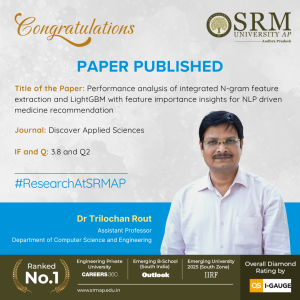
 Dr Trilochan Rout, Assistant Professor, Department of Computer Science and Engineering, SRM University–AP, has co-authored a research paper titled “Performance analysis of integrated N-gram feature extraction and LightGBM with feature importance insights for NLP driven medicine recommendation”, published in Discover Applied Sciences, a Q2 journal with an Impact Factor of 3.8.
The research explores the application of Natural Language Processing (NLP) and machine learning to develop an intelligent framework for medicine recommendation by analysing patient-generated drug reviews. With the growing availability of healthcare data and the increasing use of digital platforms for sharing patient experiences, textual drug reviews represent a valuable source of information. However, extracting meaningful insights from large volumes of unstructured text remains a significant challenge. The study addresses this challenge by integrating text-based feature extraction with machine-learning techniques to identify patterns that can support medicine recommendation and healthcare decision-making.
Analysing Patient Reviews Through NLP and Machine Learning
The proposed framework analyses patient drug reviews using N-gram feature extraction and LightGBM, enabling the researchers to examine textual and sentiment-related characteristics within the data. The study uses 215,063 patient reviews from the UCI ML Drug Review dataset, containing information such as drug names, medical conditions, patient ratings, and textual reviews.
N-gram feature extraction was used to capture meaningful combinations of words and phrases from patient reviews, while LightGBM was employed as a machine-learning approach to identify complex patterns and improve prediction performance. The researchers evaluated the two approaches to understand their effectiveness in sentiment classification and medicine recommendation.
The comparative analysis demonstrated a clear performance advantage for LightGBM. The model achieved an accuracy of 84.1% and a ROC-AUC score of 0.794, while the N-gram approach achieved 80.39% accuracy and a ROC-AUC of 0.723. These results indicate the potential of machine-learning-based approaches to improve the analysis of large-scale patient-generated healthcare data.
Understanding the Factors Behind Recommendations
Beyond predictive performance, the study also focuses on feature importance and interpretability. Understanding why a model produces a particular prediction is especially important in healthcare applications, where transparency and reliability are essential.
The feature-importance analysis identified sentiment and textual characteristics as important contributors to the model’s predictions. Such insights can help researchers and healthcare professionals better understand the factors influencing the recommendation process rather than relying solely on the output of a machine-learning model.
The findings demonstrate how combining NLP with explainable machine learning can contribute towards the development of healthcare decision-support systems that are not only data-driven but also more interpretable.
Potential Healthcare Applications
The proposed framework has potential applications in intelligent healthcare systems that can analyse large volumes of patient feedback and identify useful patterns related to medicines and patient experiences. By processing textual reviews at scale, an NLP-based system could assist in identifying sentiment trends and extracting relevant information that may otherwise be difficult to analyse manually.
The explainable feature-importance component can further support healthcare professionals and researchers in understanding the characteristics influencing model predictions. This could contribute to the development of more personalised and data-driven healthcare services.
However, such systems are intended to function as decision-support tools rather than replacements for clinical expertise. Further clinical validation and evaluation using diverse and real-world healthcare datasets would be necessary before such approaches could be considered for clinical deployment.
Collaborative Research
The research was carried out through a collaboration between researchers from SOA Deemed to be University and SRM University–AP. The collaboration brought together expertise in Natural Language Processing, machine learning, healthcare data analysis, and computational research.
Dr. Trilochan Rout’s contribution primarily involved designing the research workflow in collaboration with the research team and analysing and interpreting the experimental results. The collaborative approach enabled the researchers to integrate computational techniques with healthcare-focused data analysis to investigate practical applications of NLP and machine learning.
Looking Ahead
Building on the findings of the current study, future research will focus on strengthening NLP-based medicine recommendation through advanced Transformer and deep-learning architectures. The research will explore contextual language models capable of capturing deeper semantic relationships within patient-generated text.
Future work will also investigate explainable AI, multimodal healthcare data, and more robust clinical validation. Integrating multiple forms of healthcare information could provide a more comprehensive understanding of patient needs, while explainable AI approaches could further improve transparency and trust in automated recommendations.
The long-term objective is to develop healthcare recommendation systems that are more accurate, interpretable, personalised, and clinically applicable. Such research can contribute to the broader advancement of AI-enabled healthcare by demonstrating how large-scale patient-generated data can be transformed into meaningful insights for decision support.
Dr Trilochan Rout’s research contributes to the growing body of work at the intersection of AI, NLP, machine learning, and healthcare, highlighting the potential of computational methods to address emerging challenges in data-driven medicine and intelligent healthcare systems.