 Antimicrobial resistance is among the most pressing public health threats worldwide, and few organisms illustrate it better than Acinetobacter baumannii, a multidrug-resistant bacterium that moves between hospitals, water systems and animal populations. Knowing quickly which strains carry greater risk is central to surveillance, yet conventional characterisation remains slow and resource-intensive. In research published in the Journal of Hazardous Materials, a Q1 journal with an impact factor of 10.6, under the paper titled “Rapid SERS-Machine Learning–Enabled Virulence Profiling of Acinetobacter baumannii for Environmental Surveillance”, a team from SRM University-AP has demonstrated a faster route. Dr Rajapandiyan Panneerselvam, Associate Professor, Department of Chemistry, and Prof. Jayaseelan Murugaiyan, Professor, Department of Biological Sciences, led the work with Ms Phularida Amulraj, Ms Karpagavalli Palpandi and Ms Jayasree Kumar, PhD Scholars.
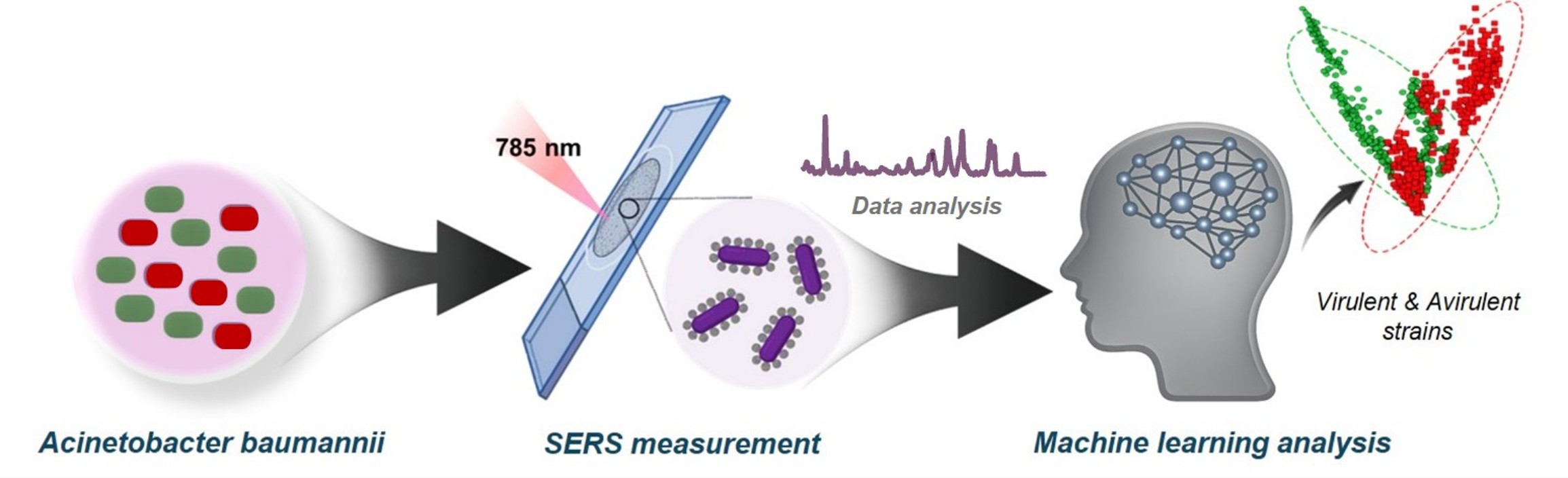
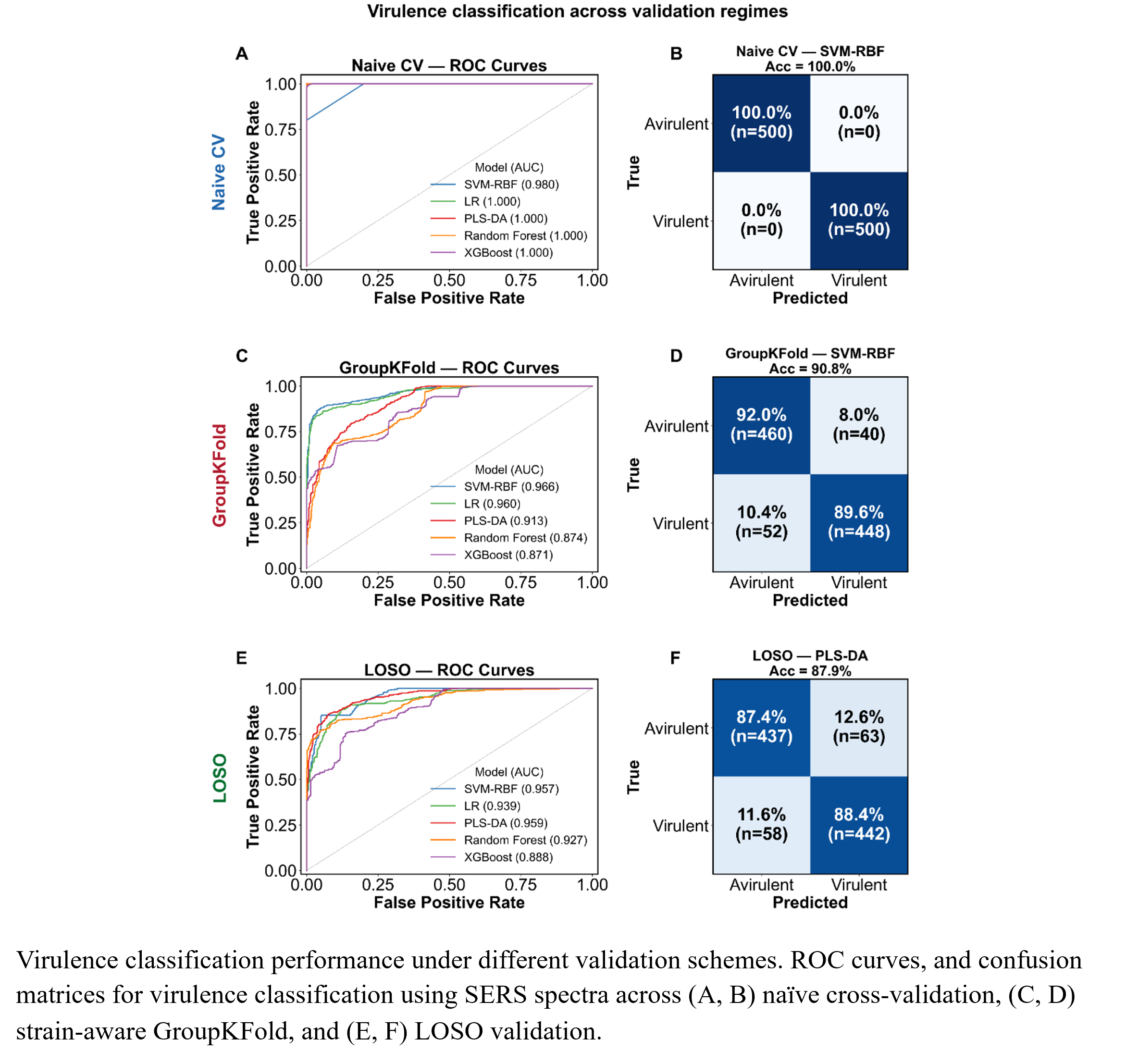
The study pairs surface-enhanced Raman spectroscopy (SERS), which gives each bacterial cell a molecular fingerprint, with machine learning that reads patterns in those fingerprints. Applied to 20 environmental and veterinary isolates, the approach distinguished virulence-associated groups in the laboratory without the need for labels or lengthy preparation. The team also took care over how the results were tested. Because models can flatter themselves when they are trained and tested on the same strains, the researchers validated their approach on strains the model had never seen, giving a more honest measure of how it would perform in practice.
The work brought together expertise in analytical chemistry, spectroscopy, machine learning, microbiology, bacterial virulence and genomics. Alongside colleagues from the RARE Lab, the Department of Chemistry, the Centre for Interdisciplinary Research and the Department of Biological Sciences at SRM University-AP, it drew on researchers from Tottori University and Shimane University in Japan, the Indian Institute of Technology Hyderabad and the Chennai Institute of Technology. Such global collaboration reflects the university’s aim of tackling problems that cross disciplines and borders.
Abstract
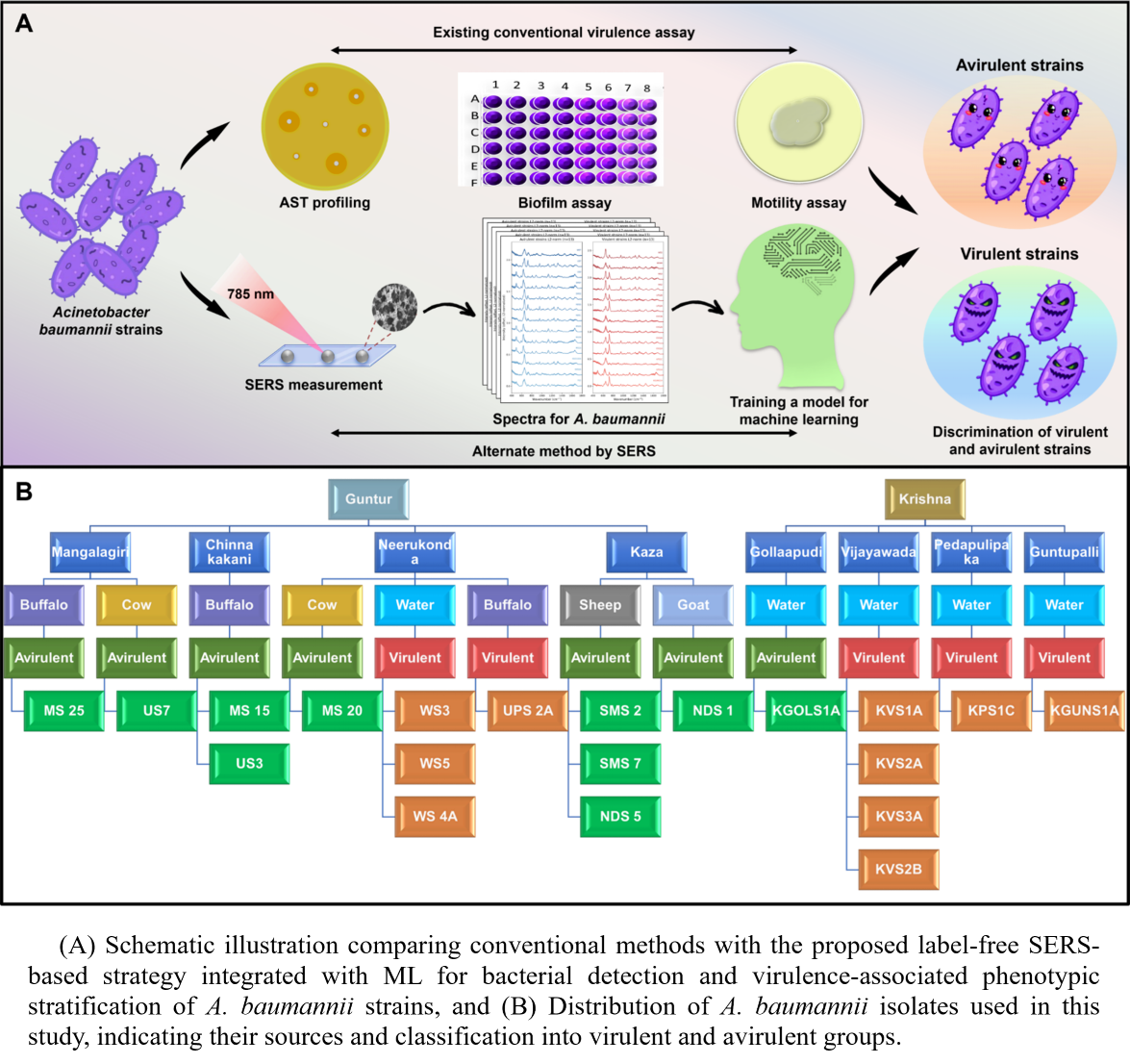
Acinetobacter baumannii is a critical multidrug-resistant pathogen that can spread through environmental and veterinary sources, which makes its surveillance important from a One Health perspective. This study developed a proof-of-concept SERS and machine learning approach for rapid, label-free profiling of virulence-associated characteristics. Whole-cell SERS spectra from 20 environmental and veterinary isolates, 10 virulent and 10 avirulent, produced reproducible biochemical fingerprints in the 400 to 1800 cm-1 region. Strain-aware validation gave more realistic performance estimates, with PLS-DA achieving 87.9% accuracy and a ROC-AUC of 0.959 under leave-one-strain-out validation. The study demonstrates the potential of SERS with machine learning for rapid bacterial risk profiling, while underlining the importance of rigorous, strain-aware validation.
Practical Implementation/Social Implications of the Research
The long-term goal is to contribute to rapid analytical approaches for environmental and One Health surveillance of antimicrobial-resistant bacteria. A platform of this kind could assist in screening and characterising isolates from environmental water, veterinary sources and other surveillance settings. It may eventually complement conventional microbiological and molecular techniques by offering rapid biochemical fingerprinting from relatively small samples.
The researchers are candid that the present work is a laboratory proof-of-concept and not yet a field-ready surveillance platform. Larger and genetically diverse isolate collections, complex environmental samples, mixed microbial communities and independent external datasets will all be needed before practical use. The wider significance lies in strengthening the ability to understand and monitor resistant bacterial populations where the environments of animals and people meet, in keeping with the principles of One Health.
Future Plans
The team will expand the framework to larger and more genetically diverse collections of A. baumannii isolates, to test whether the patterns observed hold beyond the present cohort. They also plan to evaluate the method on independent external datasets and in more complex environmental settings, including mixed microbial communities. Another priority is the experimental validation of what the Raman signatures reveal biochemically, using controlled bacterial systems such as isogenic mutant strains linked to specific virulence factors. The eventual aim is a more robust, reproducible and interpretable SERS-based platform for rapid bacterial characterisation and One Health surveillance.
Read the full article here