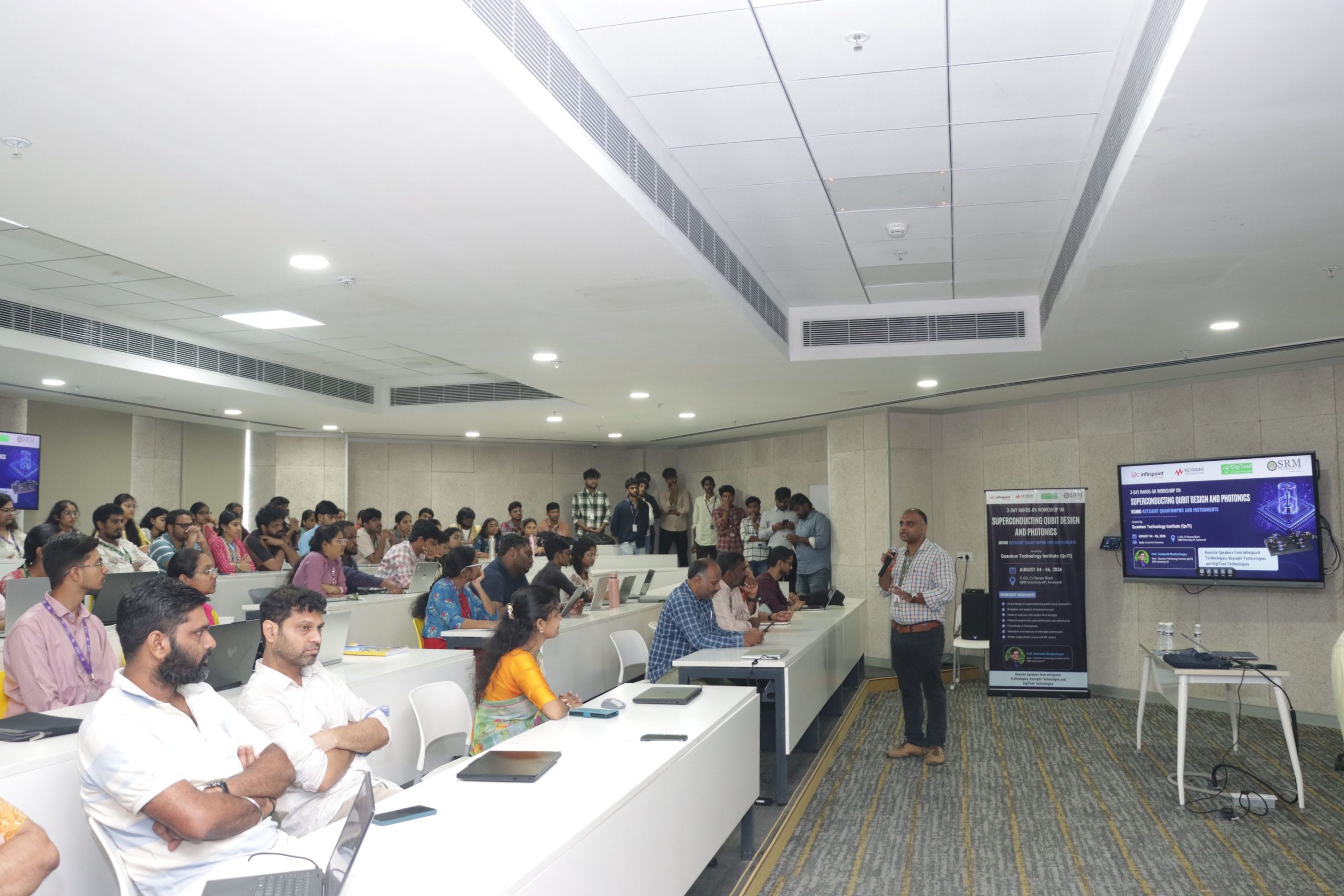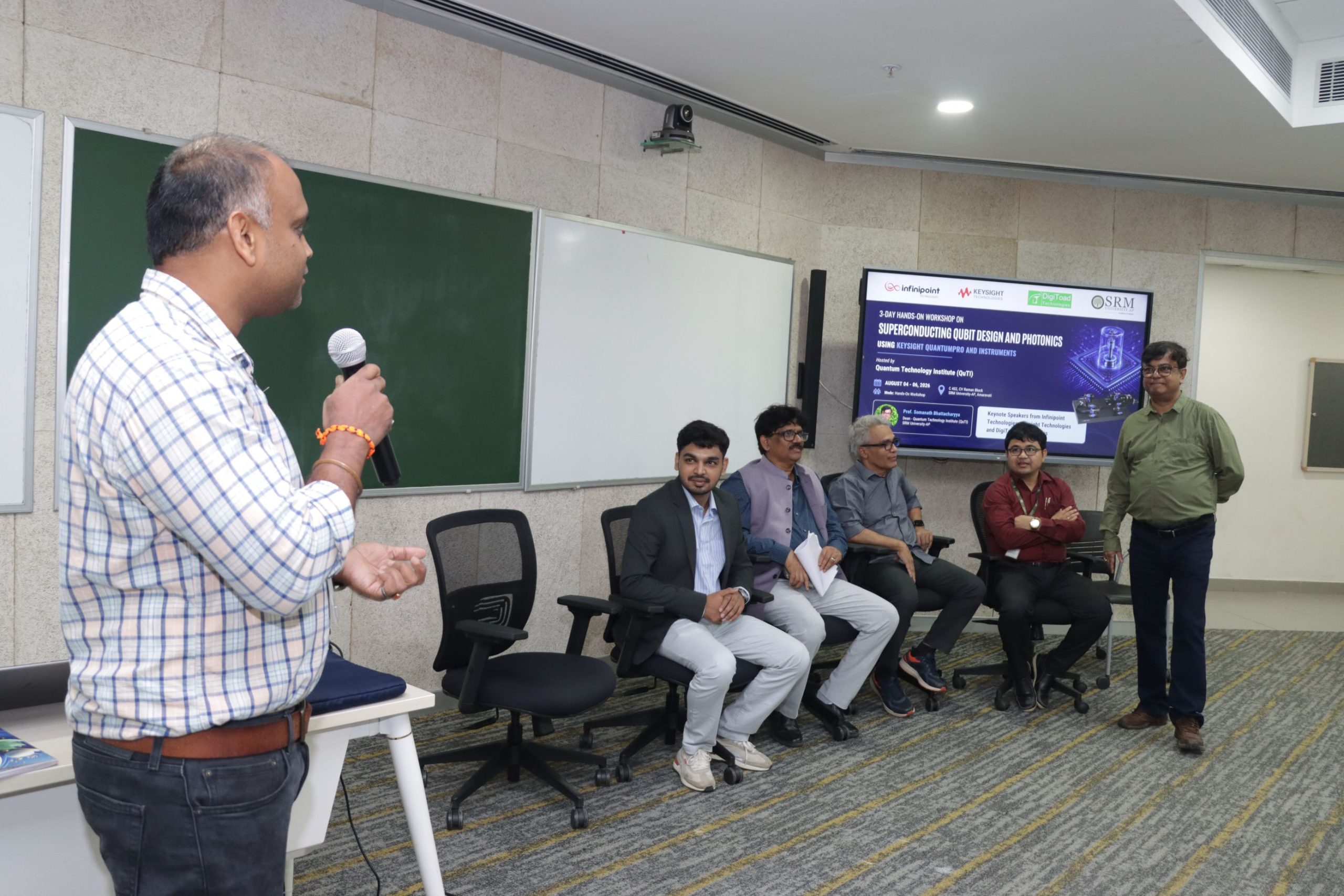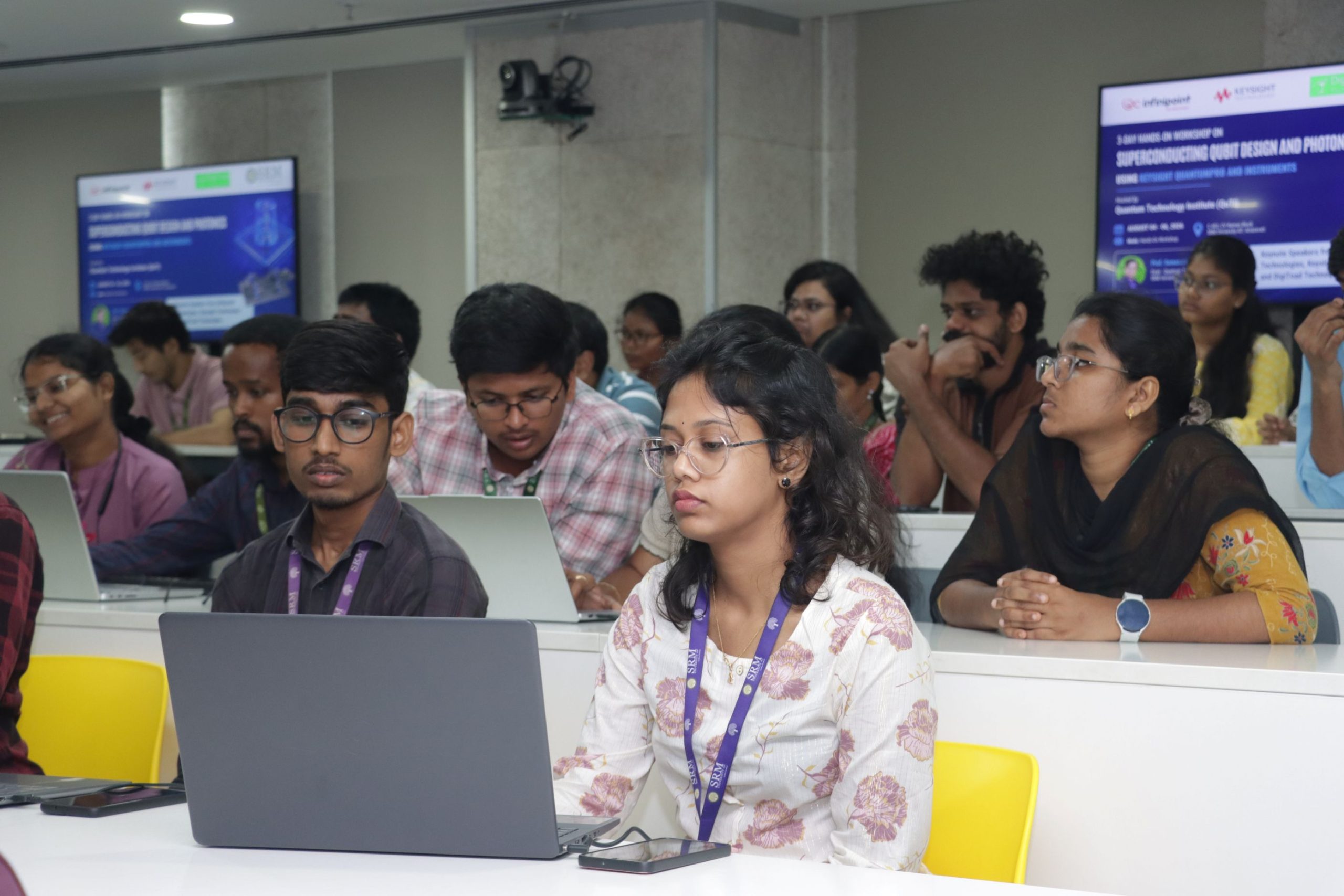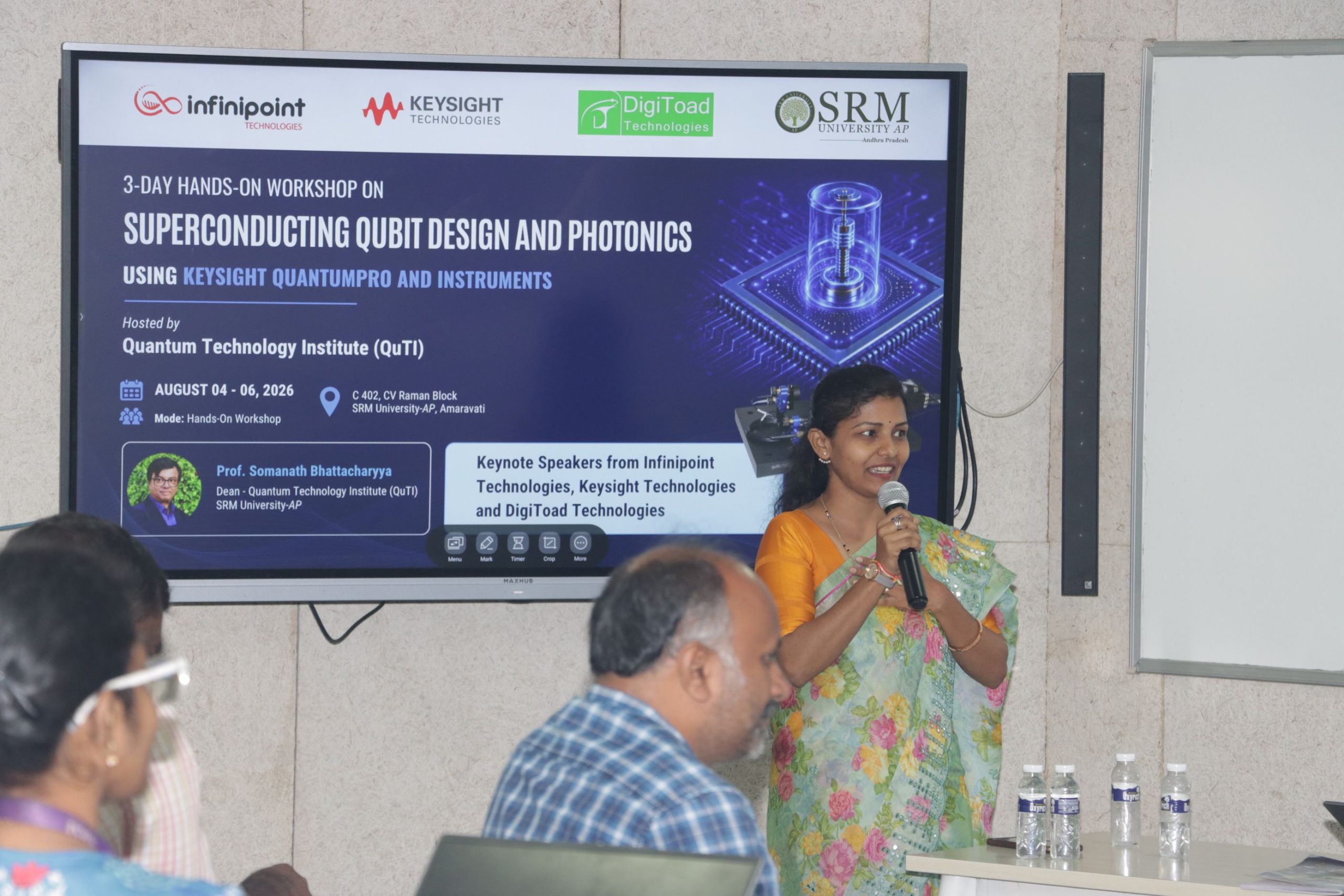

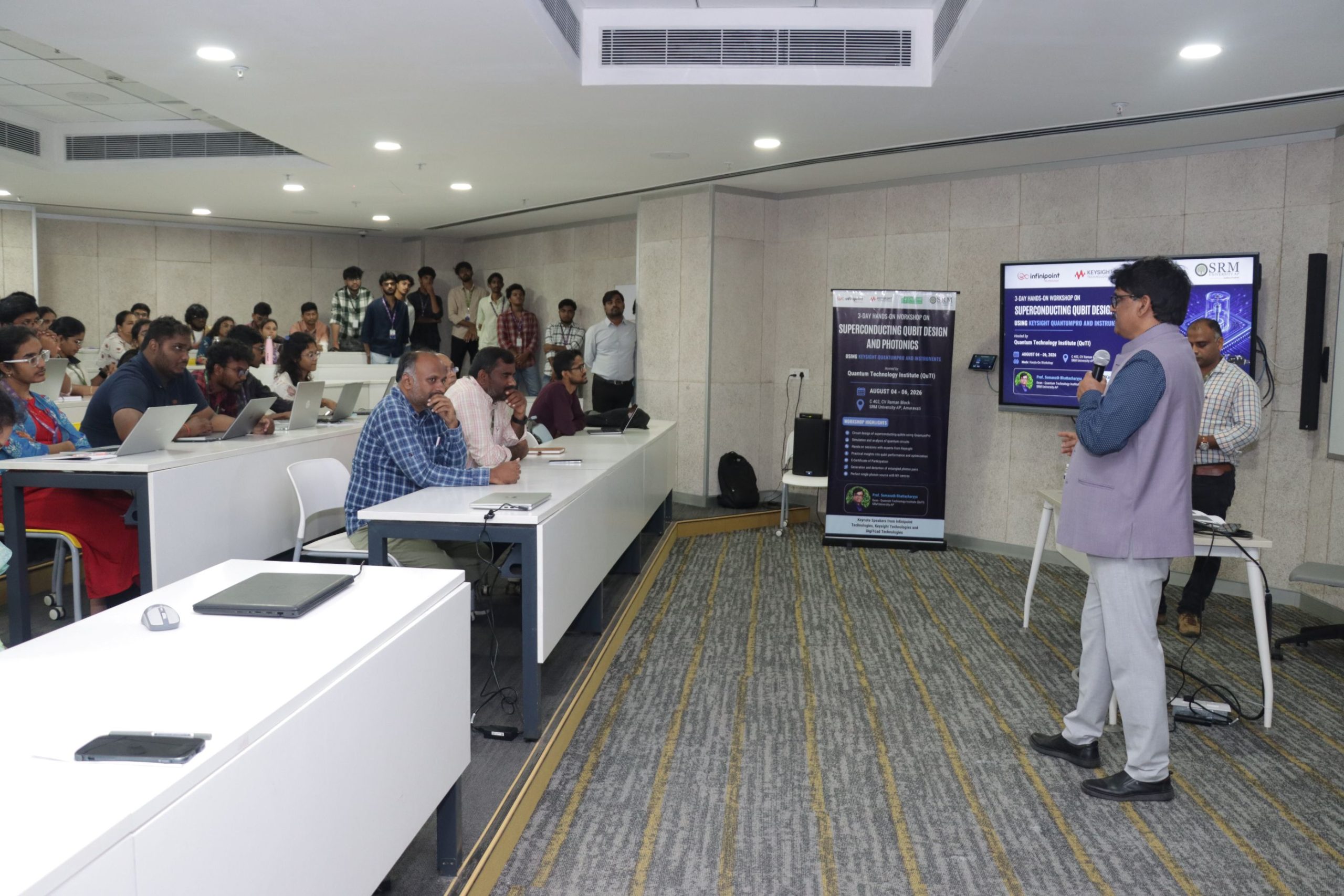
 The Quantum Technology Institute (QuTI) at SRM University-AP, Amaravati, successfully organised a Three-Day Hands-on Workshop on Superconducting Qubit Design and Photonics using Keysight QuantumPro and Instruments from 4 to 6 August 2026 at C 402, CV Raman Block, SRM University-AP. The workshop was co-organised in association with the Andhra Pradesh State Council of Higher Education and brought together students, researchers, and faculty for an intensive, practice-oriented engagement with one of the most consequential frontiers in modern computing and communication technology.
The programme was designed to bridge the gap between theoretical knowledge of quantum mechanics and the practical reality of working with quantum computing hardware. Participants were given the opportunity to design and build superconducting qubits from the ground up, beginning with single-qubit systems and advancing progressively to more complex multi-qubit architectures, giving them a firsthand understanding of how quantum computers are constructed and operated.
Inaugural Session
The workshop commenced with a formal inaugural session that set an aspirational and academically rigorous tone for the three days ahead. The conveners of the workshop, Prof. Rupesh Kumar and Dr. Varsha Sambangi of the Quantum Technology Institute, welcomed the participants and introduced the objectives and structure of the programme.
Prof. Somnath Bhattacharya delivered the opening address, articulating the vision behind the workshop with clarity and purpose. He noted that while SRM University-AP’s Quantum Research Centre is fully operational and among the most advanced on any Indian university campus, many students had not yet had the opportunity to develop a working, hands-on understanding of how a quantum computer functions from within. This workshop, he explained, was conceived precisely to address that gap. He also shared a significant milestone achieved by the university’s quantum research team: the laboratory has recently reached a temperature of 4 Kelvin, a critical threshold in superconducting quantum research, and the team is now preparing to test resonators for the first time. This development marks a major step forward for a facility that is 85 percent indigenously built.
Prof. CV Tomy, Dean of the School of Engineering and Sciences, addressed the participants on the broader academic significance of the programme. He emphasised that a strong foundational understanding of quantum mechanics and quantum physics is no longer a specialised requirement confined to physics departments. It is becoming an essential literacy for engineers across disciplines, and workshops of this nature play a defining role in preparing the next generation of technologists for a field that is reshaping industries and scientific paradigms worldwide.
The Vice Chancellor, Prof. Ch. Satish Kumar, delivered a substantive and engaging address covering the foundational principles of quantum computing. He spoke in depth about superposition, coherence, entanglement, and the broader quantum framework, offering participants a panoramic understanding of the scientific landscape they were about to work within. His address reflected both the university’s deep institutional investment in quantum science and his own considerable personal engagement with the subject.
Prof. Ranjit Thapa was also present at the inaugural session, lending the programme further academic distinction.
Technical Sessions and Hands-on Training
The academic content of the workshop was structured across three focused days, each building on the foundations established in the previous one. Participants were introduced to superconducting qubit architectures and the physical principles governing their behaviour, before moving into the design and simulation of single and multi-qubit systems using the Keysight QuantumPro platform.
Subsequent sessions covered amplifier design for quantum readout chains, a technically demanding area that addresses one of the central engineering challenges in quantum computing: accurately reading the quantum state of a qubit without disturbing it. Participants also engaged with parameter extraction and optimisation techniques, learning to draw meaningful data from quantum systems and refine performance parameters for greater reliability and accuracy.
The final technical sessions walked participants through the complete end-to-end workflow using Keysight QuantumPro, providing them with a coherent and practical picture of how each individual component they had studied connects within a functioning quantum computing pipeline.
Practical Demonstration at the Quantum Research Centre
The concluding day of the workshop featured a live practical demonstration at SRM University-AP’s Quantum Research Centre, widely regarded as the crown jewel of the university’s research infrastructure and one of the most advanced quantum computing facilities on any Indian university campus.
The Vice Chancellor, Prof. Ch. Satish Kumar, was personally present for the demonstration, engaging directly with the experiments and posing technical questions that were addressed by Prof. Somnath Bhattacharya and the faculty team in real time. The demonstration featured equipment and solutions from DigiFood Technologies Pvt. Ltd., using their quADD platform. Participants witnessed live demonstrations covering quantum physics education setups, time tagging solutions for quantum research and industry applications, sub-nanometer displacement measurement using interferometric replacement wavemeters, and entanglement demonstration using the quADD Entanglement Demonstrator boards.
For a significant number of participants, this was the first occasion on which quantum computing moved from a concept encountered in textbooks and lectures to something they had physically interacted with, calibrated, and observed in operation. The demonstration drew considerable enthusiasm and generated substantive technical discussion among participants, faculty, and the industry experts present.
Outcomes and Way Forward
The outcomes of the workshop were widely regarded as exceptional. Participants left with a clearer, more grounded understanding of superconducting qubit design, the instrumentation required for quantum research, and the real-world challenges and opportunities that define this field. The hands-on format ensured that learning was not confined to passive instruction but was instead embedded in direct experience with state-of-the-art quantum hardware and software.
The workshop reinforced SRM University-AP’s position as a nationally significant institution in the domain of quantum science and technology, and underscored the Quantum Technology Institute’s commitment to making advanced quantum education accessible to the next generation of Indian researchers and engineers. It also strengthened the university’s ties with the broader quantum research and industry ecosystem, with participants from multiple institutions expressing interest in future collaborative engagements with QuTI.
SRM University-AP remains committed to organising programmes of this nature as part of its broader mission to build a vibrant, research-driven academic community at the frontier of emerging science and technology.