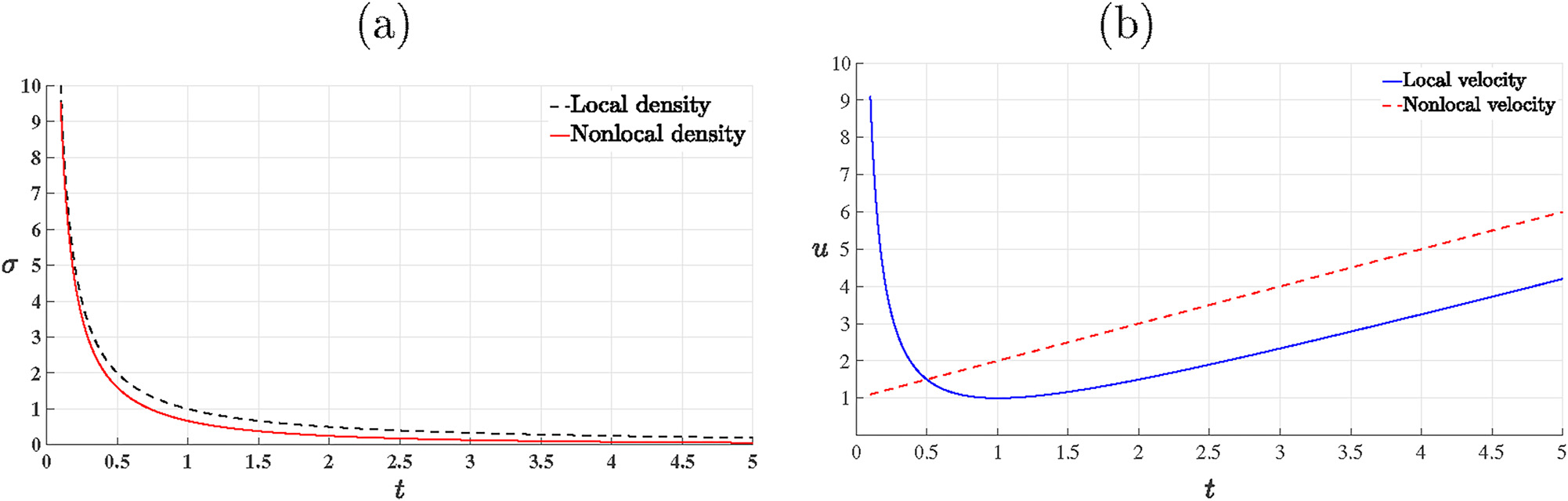
 Traffic can be represented mathematically as a continuous stream described by two main quantities: the number of vehicles on a section of road and their average velocity. The model also accounts for resistance associated with braking or road conditions, and for nonlinear changes in vehicle behaviour as traffic becomes congested. Mathematical symmetries are used to identify special traffic patterns that can be expressed by exact formulas, including decreasing traffic density, acceleration and deceleration, localised congestion, and fronts that travel without changing shape. Such solutions are valuable test cases, as a computer program designed to solve the same traffic equations should be able to reproduce them accurately. In this context, “nonlocal symmetry” refers to a mathematical construction involving auxiliary cumulative variables, and does not mean that drivers physically interact over unlimited distances.
The research published by Dr Tapan Kumar Hota, Assistant Professor in the Department of Mathematics at SRM AP, in the Q3 journal of Zeitschrift für Naturforschung A, having an impact factor of 1.7, titled Local and Nonlocal Symmetry Analysis of a Frictional Aw–Rascle–Zhang Model with Chaplygin Gas Dynamics, presents a symmetry-based analytical study of a frictional Aw-Rascle-Zhang traffic-flow model incorporating Classical, Generalized, and Modified Chaplygin pressure laws, deriving exact vehicle-density and velocity profiles through invariant reductions.
This research was carried out in collaboration with Dr Sandhya Maurya, a former Post-Doctoral Researcher.
Abstract
This research presents a symmetry-based analytical study of a frictional Aw-Rascle-Zhang traffic-flow model with Classical, Generalized, and Modified Chaplygin pressure laws. We classify local Lie point symmetries and derive invariant reductions that produce exact vehicle-density and velocity profiles. For the Classical Chaplygin case, conservation-law potentials reveal additional nonlocal symmetry structures and spatially dependent solution branches. In the frictionless limit, travelling-wave reductions yield bounded fronts and localised pulses. The physical admissibility of these solutions is examined through density positivity, finite velocity, and explicitly defined regularity domains. These exact solutions provide analytical benchmarks for checking symbolic calculations and numerical traffic-flow solvers. The study is restricted to smooth invariant branches and does not yet establish stability, entropy admissibility, shock formation, or evolution from general initial data.
Practical Implementation and Social Implications
The most immediate application is the verification of mathematical and computational traffic-flow models. The exact density and velocity profiles derived in this research can serve as reference solutions for numerical algorithms, and comparing a computed solution against these exact profiles can reveal discretisation errors, loss of density positivity, incorrect treatment of friction, or improper handling of singular boundaries.
After further development involving stability analysis, entropy-admissible weak solutions, and calibration with real traffic data, rigorously verified models of this type may contribute to traffic forecasting, congestion management, road planning, and the analysis of stop-and-go waves. These social benefits are prospective, and the present paper does not claim field deployment or measured reductions in congestion, accidents, fuel consumption, or emissions.
Future work will focus on developing weak-solution formulations, entropy conditions, characteristic analyses, and Riemann solvers for shocks, contact discontinuities, and delta shocks, alongside investigating linear and nonlinear stability, shock formation, and evolution from general initial data. The team also plans to construct potential systems and nonlocal symmetry reductions for the Generalized and Modified Chaplygin pressure laws, using the exact solutions obtained as benchmarks for systematically verified numerical schemes, before comparing and calibrating the model against real traffic data to draw operational conclusions.
Read the full article here.