

Dr Vigneswaran VS, Assistant Professor, Department of Environmental Science and Engineering, has published a paper titled “Toward Net-Zero Technologies: Biowaste-derived Materials for Green Hydrogen, High-performance Anodes, and Photothermal Energy Conversion” in the Q1 journal International Journal of Hydrogen Energy with an impact factor of 8.6.
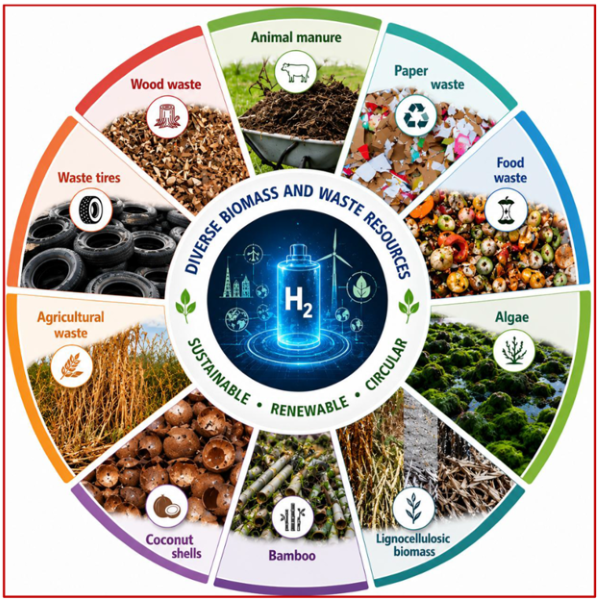
This research explores an innovative way to transform common organic waste such as agricultural residues, wood chips, and food scraps into high-performance “green” materials through a specialised heating process that creates a porous, charcoal-like substance known as biochar. This versatile material offers a sustainable solution to three major environmental challenges: it catalyses zero-emission hydrogen production, serves as a low-cost, efficient component for advanced battery storage, and acts as a solar-powered “sponge” that turns undrinkable water into clean freshwater through evaporation. By “upcycling” massive amounts of waste that would otherwise be burned or discarded, this technology promotes a circular economy that significantly reduces the carbon footprint and production costs of renewable energy systems, providing a practical roadmap toward a net-zero future.
Abstract
The global transition toward sustainable energy systems has intensified the search for eco-friendly and cost-effective methods of hydrogen production. This review explores an integrated approach utilizing naturally available biowaste as multifunctional materials for (i) green hydrogen generation, (ii) high-performance anode development, and (iii) efficient photothermal absorption. Biowaste-derived carbonaceous materials were synthesized via pyrolysis and surface activation, yielding porous structures with high surface area, excellent electrical conductivity, and abundant functional groups. Biowaste-based biochar has emerged as a pioneering material for green hydrogen production and as a high-performance anode material for energy storage. However, challenges such as optimizing production under production constraints and scaling up need to be addressed to make biowaste-based biochar a viable and sustainable option. This review explores the effects of biowaste type and operating conditions on biochar properties and outlines future research directions to enhance its practical application in hydrogen production and anode material synthesis.
Practical Implementation/ Social Implications of the Research
The practical implementation of this research lies in converting agricultural and biological waste into value-added biochar materials for clean energy applications, including hydrogen production and sustainable battery technologies. This approach promotes waste valorization, reduces dependence on fossil-based and mined materials, and supports the transition toward a circular and low-carbon economy. From a societal perspective, the research contributes to sustainable waste management, greenhouse gas mitigation, renewable energy development, and resource conservation. Furthermore, it creates opportunities for rural economies by utilizing locally available biomass residues and advancing environmentally friendly energy storage technologies.
Collaborations
Dr Poongavanam Ganeshkumar – Department of Chemical Engineering, School of Bio and Chemical Engineering, SRM IST, Tamil Nadu, India.
Dr Vinothkumar Sivalingam – National Demonstration Center for Experimental Mechanical Engineering Education, School of Mechanical Engineering, Shandong University, Ji’nan, Shandong, China
Dr S Divya – School of Chemical Engineering, Yeungnam University, Gyeongsan, South Korea
Prof. Tae Hwan Oh – School of Chemical Engineering, Yeungnam University, Gyeongsan, South Korea
Prof. Sang Joon Lee – Department of Mechanical Engineering, Pohang University of Science and Technology, Gyeongbuk, Republic of Korea
Dr J Bharani Chandar – Department of Mechanical Engineering, Vel Tech Rangarajan Dr Sagunthala R&D Institute of Science and Technology, Tamil Nadu, India.
Future Research Plans
Future research will focus on optimizing biomass-derived biochar properties and developing advanced modification strategies to enhance its performance in hydrogen production and energy storage applications. Further studies are required to improve the electrochemical efficiency, scalability, and cost-effectiveness of biochar-based materials for commercial implementation. In addition, the integration of waste-derived feedstocks with circular economy approaches and the exploration of novel catalysts and electrode materials are expected to expand the role of biochar in sustainable energy systems.