


Imagine if a teacher could understand how every student learns, or a manager could understand what motivates every employee, simply through a scientifically designed assessment.
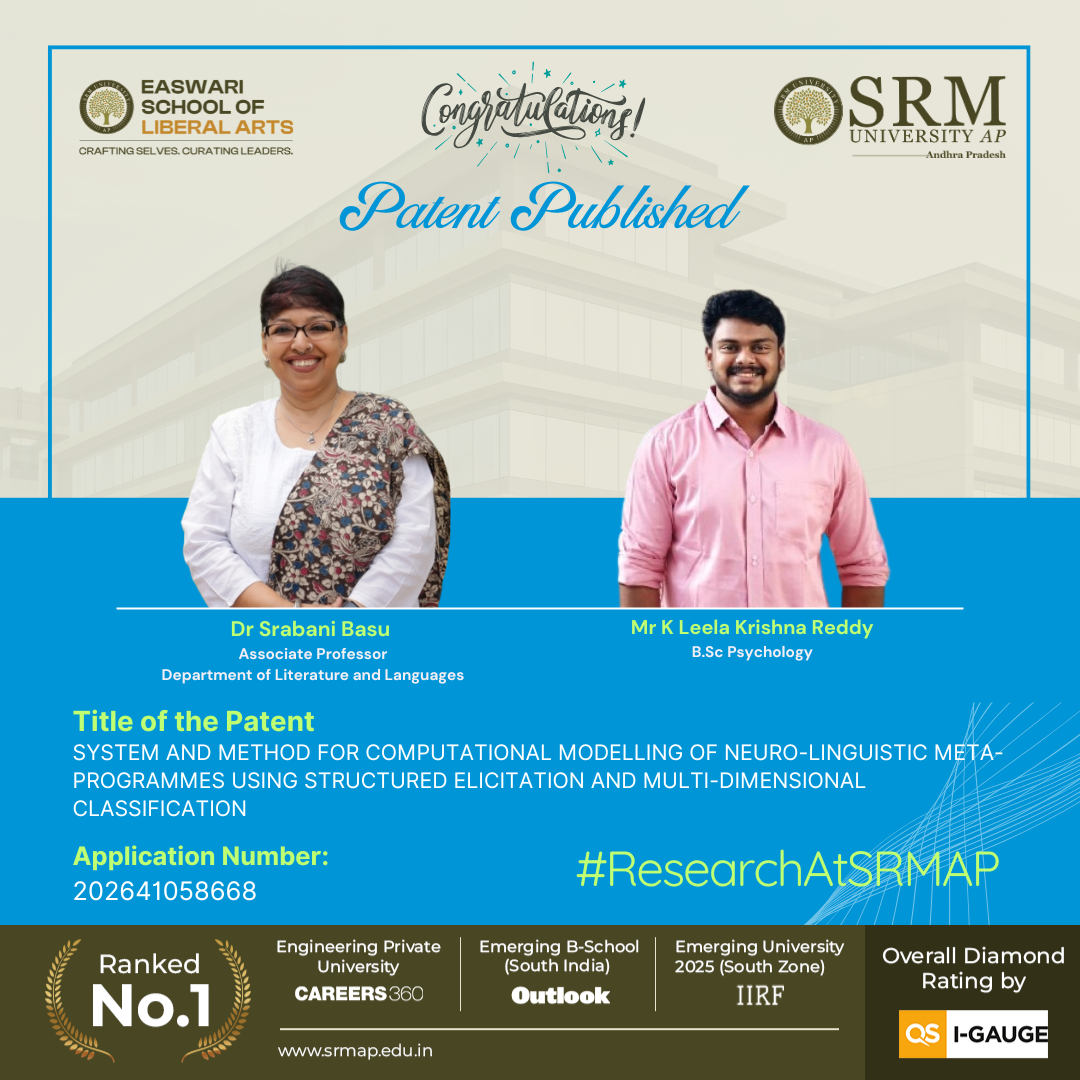
Dr Srabani Basu, Associate Professor, Department of Literature and Languages and Mr K Leela Krishna Reddy, B.Sc. Psychology student, have created a software that asks users a carefully designed set of questions and identifies their natural thinking patterns, communication preferences, decision-making styles, emotional tendencies and motivational drivers. Instead of requiring experts to manually analyse responses, the system automatically generates an easy-to-understand behavioural profile and visual reports.
Their patent titled “System and Method for Computational Modelling of Neuro-Linguistic Meta-Programmes using Structured Elicitation and Multi-Dimensional Classification” with Application Number: 202641058668, has been published by the Indian Patent Office.
This software allows teachers, counsellors, coaches and organisations to understand people more accurately, personalise learning and development, improve communication, and make better human-centred decisions.
Abstract
This patent presents a novel computational framework for modelling Neuro-Linguistic Programming (NLP) meta-programmes through structured elicitation and multi-dimensional classification. The invention integrates behavioural science with computational intelligence to digitally identify how individuals perceive information, make decisions, communicate, learn, and respond emotionally. By automating psychological profiling through an interactive assessment platform, the system generates comprehensive behavioural profiles for individuals and groups. The innovation has significant applications in education, coaching, counselling, leadership development, human resource management, and behavioural research, making psychological assessment more scalable, consistent, and data-driven.
Practical Implementation/ Social Implications of the Research
The invention has the potential to transform the way individuals are understood across educational, organisational and developmental contexts.
Possible applications include:
- Personalised learning pathways for students based on their cognitive preferences.
- Early identification of learners requiring additional academic or emotional support.
- Leadership profiling and talent development within organisations.
- Improved recruitment, team building and succession planning.
- Coaching and counselling through evidence-based behavioural insights.
- Behavioural analytics for organisational decision-making.
Beyond institutional applications, the invention promotes greater self-awareness, more empathetic communication, and personalised human development. By making behavioural profiling faster, more scalable and accessible, it contributes towards creating more inclusive educational and workplace environments.
Future research will focus on enhancing the computational intelligence of the platform through larger datasets, improved behavioural modelling, and advanced predictive analytics. We also plan to integrate adaptive assessments, longitudinal behavioural tracking, and AI-assisted recommendations for education, leadership development, coaching and organisational effectiveness.
The long-term vision is to build a comprehensive behavioural intelligence ecosystem that enables personalised learning, improved human development and data-driven decision-making while maintaining ethical standards and user privacy.