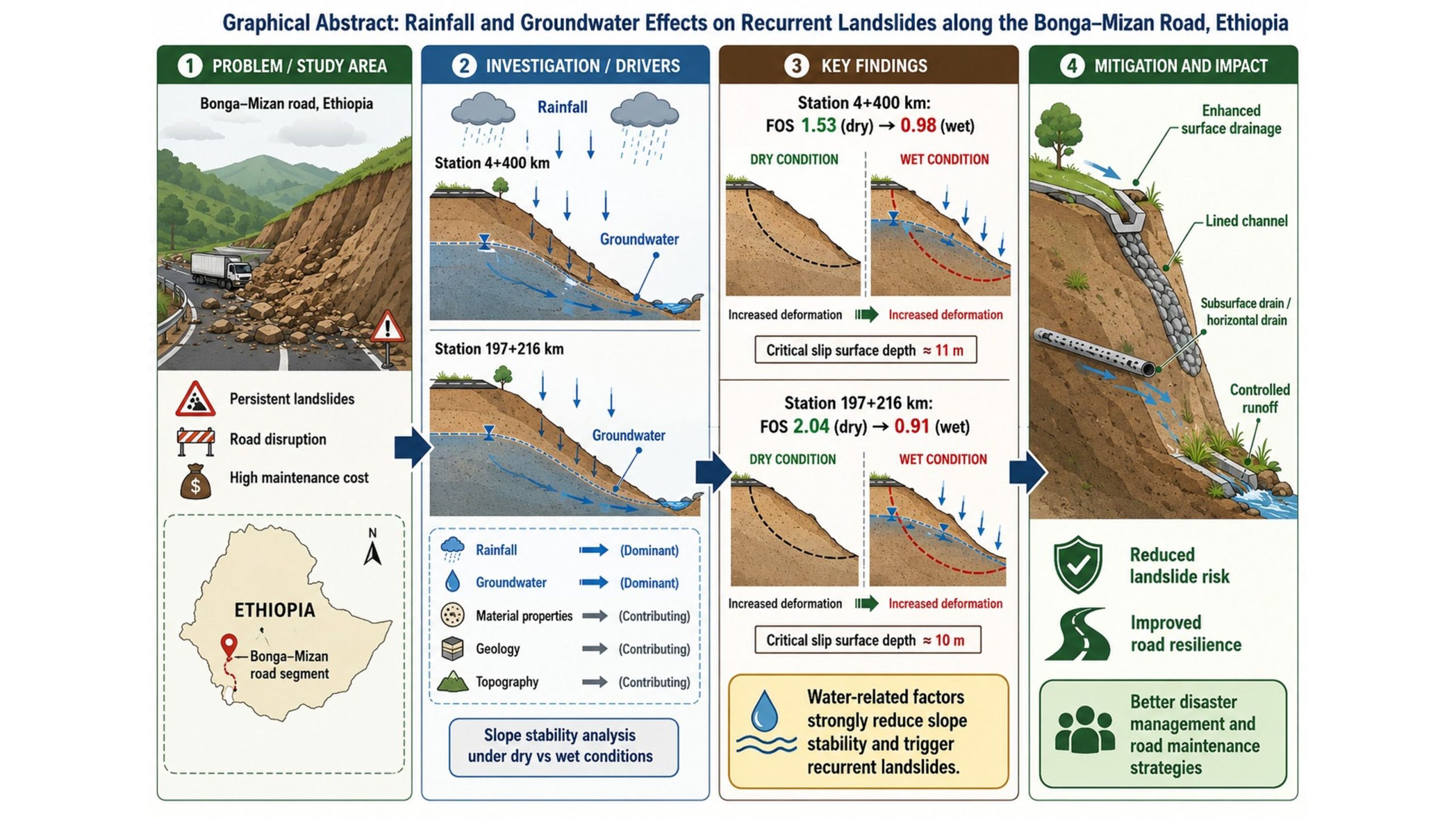

 The Bonga-Mizan highway in Ethiopia keeps getting damaged by landslides, and scientists wanted to find out exactly why. By analysing soil samples and using computer simulations, they discovered that the main villain is heavy rain. When it rains for a long time, the water soaks deep into the ground, acting like a wedge. It fills the spaces between soil particles, builds up pressure, and destroys the soil’s “grip.” Eventually, the top 30 feet of weak, muddy soil completely loses its strength and slides right off the solid bedrock beneath it. Dr Suraj Kumar Bhagat, Assistant Professor, Centre for Interdisciplinary Research, SRM AP proves in his research paper titled “Numerical analysis of rainfall-induced landslides and stability assessment along the Bonga-Mizan road section, Ethiopia” that while the slopes are perfectly safe when dry, they become dangerously unstable during rainy periods. This paper was published on the Q2 journal of Advances in Civil Engineering, Wiley having an impact factor of 1.6. To fix this and save the road, the study concludes that the area needs heavy-duty drainage systems to safely channel water away before it can soak into the hill.
Abstract
This study investigates recurrent, rainfall-induced landslides along the Bonga-Mizan road in Ethiopia using field investigations, laboratory testing, and FLAC2D and Slope/W numerical modelling. Analyses at two critical stations reveal that prolonged rainfall infiltration elevates pore-water pressure and reduces effective stress in weak colluvial and weathered volcanic materials. This hydrological pressure triggers deep-seated rotational landslides at depths of 10–11 meters, dropping factors of safety from stable dry conditions to unstable wet states (FOS < 1.0). To enhance road infrastructure resilience, mitigation must prioritize integrated surface and groundwater drainage control combined with slope-geometry optimization
Practical implementation and social implications
The most immediate social implication of this research is the protection of lives and livelihoods. In rural Ethiopia, roads like the Bonga-Mizan highway are economic lifelines; when a landslide cuts them off, isolated communities lose access to emergency medical care, schools, and markets for their agricultural goods. Practically, engineers can implement these findings by building targeted, deep-subsurface drainage systems. By installing perforated pipes and horizontal drains 35 feet deep into the hillsides, they can intercept groundwater right at the critical 10-to-11-meter failure zone identified in the study. Safely channelling this water away prevents the deadly buildup of underground pressure, effectively keeping the soil dry and stable. Moving from reactive “cleanup” to this kind of proactive, data-driven engineering prevents infrastructure damage, saves taxpayer money on constant road repairs, and ensures uninterrupted regional trade and travel.
Collaborations
Ethiopia; India
Future Research Plans
Future research will focus on developing real-time landslide early warning systems along the Bonga-Mizan corridor by integrating satellite-based rainfall data with automated, in-situ piezometers that monitor underground water pressure. Additionally, large-scale climate change projection modelling will be used to simulate how increasingly intense, unpredictable weather patterns might affect slope stability over the next five years. Finally, future studies will investigate the long-term effectiveness and cost-benefits of bio-engineering solutions – such as planting specific deep-rooted native vegetation – combined with traditional structural drainage to create more sustainable, eco-friendly infrastructure resilience.
The link to the article
https://onlinelibrary.wiley.com/doi/10.1155/adce/8007761